
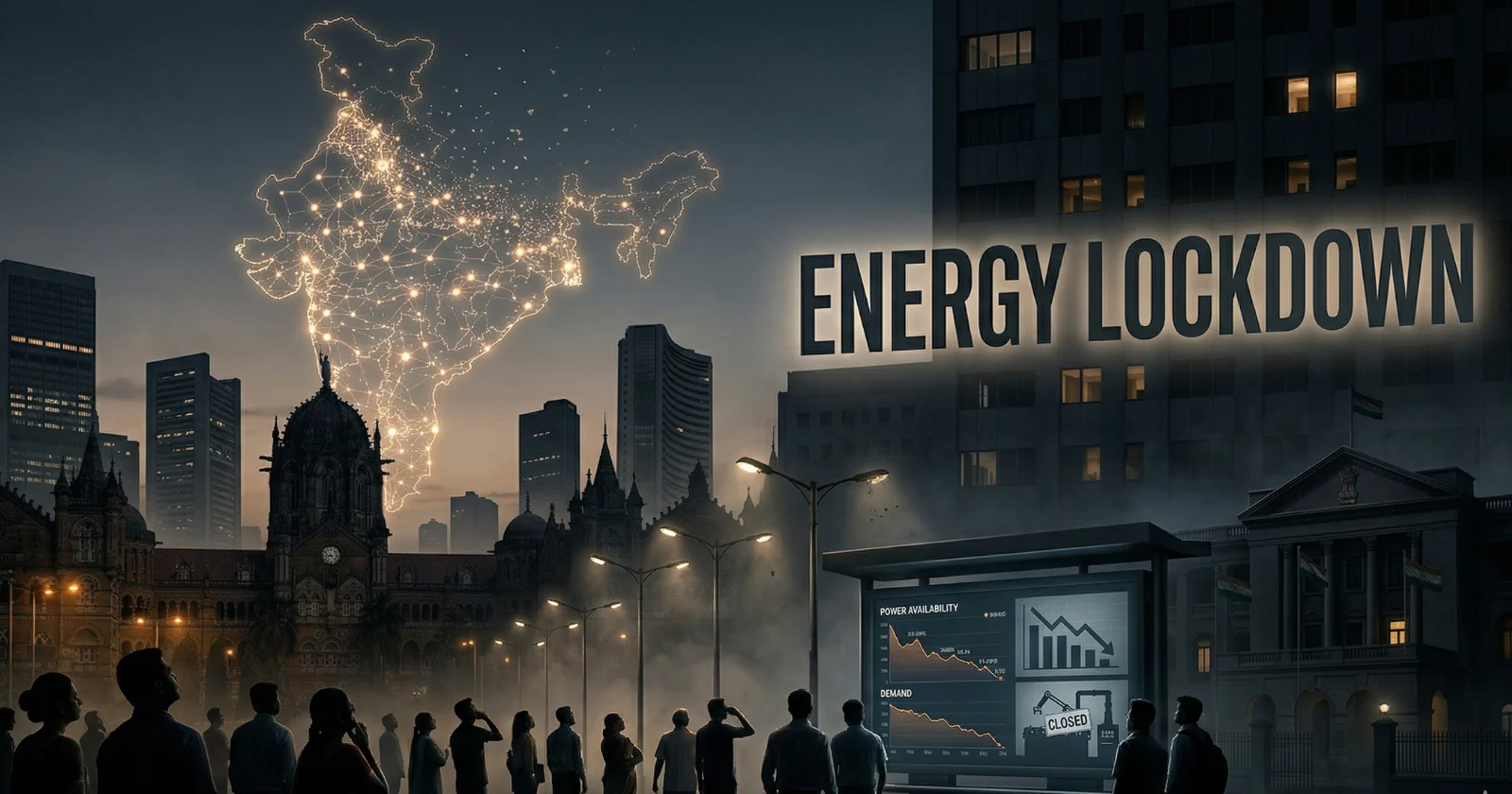
Latest News Update on Energy Lockdown In India 2026 (28 March 2026) – Recent official clarification from the government has dismissed all rumours regarding any “energy lockdown” or nationwide restrictions in India. Union Minister for Petroleum and Natural Gas Hardeep Singh Puri stated that there is no proposal under consideration for any lockdown, and such claims are completely false. He further emphasized that the government is actively monitoring global energy developments and supply chains in real time, while ensuring uninterrupted availability of fuel and essential commodities across the country. The minister also reassured citizens that India remains prepared to handle emerging challenges and urged people to remain calm and avoid misinformation. (News Source –Aakashvani)
Latest Update (March 26–27, 2026): Clarification Amid Rising Panic
Recent official statements and multiple fact-check reports confirm that no “energy lockdown” has been announced in India. The confusion largely began after the Prime Minister’s speech in Parliament, where he urged citizens to remain “prepared and united” similar to the COVID-19 period. This statement was widely misinterpreted on social media, leading to panic searches and misinformation. Government sources have clearly stated that fuel supply chains remain functional, and there is no restriction on public movement, fuel purchase, or economic activity.
⚠️ Ground Reality: Crisis Is Real, Lockdown Is Not
While the term “energy lockdown” is misleading, the underlying energy stress is genuine and policy-relevant. Disruptions in the Strait of Hormuz due to the ongoing West Asia conflict have tightened LPG and crude supply across Asia, causing price volatility and localized shortages. Some Asian countries are already considering energy-saving measures like reduced fuel usage and limited industrial activity, but India has so far focused on supply management, diplomatic coordination, and reserve utilisation instead of restrictions. This distinction is critical for UPSC preparation — separating geopolitical energy crisis (real) from lockdown narrative (false).
Updated: March 25, 2026, 11 PM (IST) | GS Paper II | GS Paper III | Energy Security | Governance | India–West Asia
⚠️ Fact-Check First
The term “Energy Lockdown In India 2026” is a social media trend, not an official government declaration. No energy lockdown has been announced or planned. This article separates fact from viral panic and provides a complete analysis for UPSC aspirants.
What Is the “Energy Lockdown In India 2026”?
On March 24, 2026 — exactly six years after India’s first COVID-19 lockdown — the phrase Energy Lockdown In India 2026 began trending across social media platforms. Within hours it became one of the most-searched terms in the country, fuelled by fear, misinformation, and genuine anxiety about rising fuel prices.
The reality is more nuanced. India is navigating one of its most serious energy disruptions in decades, rooted in a geopolitical conflict that has choked a critical global oil chokepoint. But the government has confirmed: no lockdown is planned, no fuel emergency has been declared, and supply chains — while strained — remain functional.
For UPSC aspirants, this topic is a goldmine. It intersects energy security, governance, India–West Asia diplomacy, inflation, and crisis management — all squarely within GS Paper II and GS Paper III.
Key Numbers at a Glance
| Indicator | Figure |
|---|---|
| Crude oil sourced from West Asia | 80–90% |
| Oil price spike (March 2026) | +35% ($66 → $82–106/barrel) |
| India’s crude oil strategic reserve | ~60 days |
| India’s LPG strategic reserve | ~5 days only |
| LPG stranded in Persian Gulf | 3,20,000 tonnes on 22 ships |
| Estimated GDP growth impact | −25 basis points |
| Domestic LPG connections (IOCL+BPCL+HPCL) | 32.94 crore |
| Domestic production meeting LPG demand | Only 41% |
The Root Cause: West Asia Conflict and the Strait of Hormuz
The energy crisis did not emerge in isolation. A sequence of rapid geopolitical events between late February and mid-March 2026 set off a chain reaction that reached Indian kitchen cylinders within days.
28 February 2026 The United States and Israel declared Operation Epic Fury, launching coordinated strikes on Iranian nuclear and military installations.
Early March 2026 Iran retaliated with missile strikes on US bases and Israeli towns, then took the extraordinary step of blocking the Strait of Hormuz — the world’s most critical energy chokepoint, through which roughly 20% of all globally traded petroleum passes. The strait is only 33 km wide at its narrowest point. Countries such as Saudi Arabia, UAE, Iraq, Qatar, and Kuwait — all major exporters — depend on this route. The blockade caused oil prices to spike 35%, from around $66 per barrel to between $82 and $106.
9 March 2026 India invoked the Essential Commodities Act, issuing a Natural Gas Control Order to prioritise domestic household supply over industrial consumers.
11 March 2026 The government confirmed sufficient short-term stocks of petrol, diesel, and aviation turbine fuel. A 24×7 national petroleum monitoring control room was activated. The Indian Navy reported 28 Indian-flagged vessels and 778 Indian seafarers operating in the Gulf region.
18 March 2026 Tanker Jag Ladki delivered 80,886 metric tonnes of crude oil at Mundra Port, demonstrating continued — if strained — supply via alternative routes.
20 March 2026 The International Energy Agency (IEA) released its 10-Point Emergency Demand Reduction Plan. This was widely and incorrectly misrepresented on Indian social media as a mandatory global lockdown.
24 March 2026 The phrase “Energy Lockdown In India 2026” began trending nationally. The sixth anniversary of India’s 2020 COVID lockdown, combined with a misreading of PM Modi’s parliamentary address, triggered mass social media panic.
Why India Is Heavily Exposed
India’s vulnerability to a Strait of Hormuz disruption is structural, not incidental. Decades of energy policy have created deep dependencies that cannot be unwound overnight.
Crude Oil Dependence India is the world’s third-largest crude oil importer. West Asia supplies 80–90% of its crude requirements, with more than 50% of that transiting the Strait of Hormuz.
LPG Supply Chain Fragility India is the world’s second-largest LPG importer. Annual domestic consumption stands at approximately 31.3 million metric tonnes. Domestic production meets only 41% of demand. Qatar and Saudi Arabia supply the bulk of imports. The Strait of Hormuz closure disrupted the LPG supply chain within days — stranding 3,20,000 tonnes on 22 ships in the Persian Gulf. Weekly LPG inflows declined by nearly one-third.
Single Chokepoint Risk The Strait of Hormuz — 33 km at its narrowest — is the single transit point for the majority of India’s energy imports. There is no readily available alternative that matches its cost and transit time.
Macroeconomic Exposure Every $10 rise in crude oil prices widens India’s current account deficit by approximately 0.4–0.5% of GDP. The 35% price spike directly threatens inflation control, fiscal consolidation, and economic growth projections.
What Citizens Are Actually Experiencing
While no official energy lockdown exists, the disruption is very real for households and businesses. Rural and low-income households face the sharpest impact.
LPG Shortages and Rising Costs
- LPG cylinder deliveries delayed by several days across multiple cities
- Black market cylinder prices have soared in many regions
- New LPG connections placed on hold in certain states
- Indian Oil, Bharat Petroleum, and Hindustan Petroleum are absorbing higher import costs to maintain current retail prices — but this is unsustainable over the long term
- Rising fertiliser costs (gas-dependent production) are beginning to feed into food prices
Industrial and Economic Impact
- Industrial gas supply curtailed — fertilisers, refineries, and petrochemicals placed under controlled allocation
- Aviation fuel costs rising, airlines flagging surcharges
- Rising transport costs feeding through the entire supply chain
- Energy price uncertainty creating equity market volatility
- India’s GDP growth projected to decline by approximately 25 basis points if the crisis persists
India’s Crisis Management: Government Response
India’s response to the 2026 energy disruption has been multi-pronged — diplomatic, logistical, legislative, and communicative. It represents a notably more mature posture than the country’s experience during the 2020 COVID pandemic.
1. Diplomatic Breakthrough External Affairs Minister S. Jaishankar held direct negotiations with Iranian officials at the peak of the crisis. Iran agreed to allow Indian LPG tankers to transit the Strait of Hormuz on a case-by-case basis, calling India a “friend” with shared strategic interests. Indian tankers Shivalik and Nanda Devi transited safely under naval surveillance. This was a significant diplomatic achievement given that Iran and the US–Israel axis were in active conflict.
2. Strategic Petroleum Reserves India has built approximately 60 days of crude oil reserves over the past decade, stored at Visakhapatnam, Mangaluru, and Padur. Petroleum Minister Hardeep Singh Puri confirmed that around 70% of crude sourcing is no longer Hormuz-dependent, reflecting years of import diversification. The critical vulnerability, however, remains on the LPG side — where strategic reserves cover only approximately 5 days of domestic demand.
3. Alternative Supply Routes and Diversification
- Shipments rerouted via the Cape of Good Hope to bypass the Strait of Hormuz — longer but viable
- Increased imports from the USA, Russia, and non-Gulf producers
- Domestic LPG production scaled up as a short-term measure
- Government directives issued against hoarding and panic buying
4. Naval Deployment The Indian Navy deployed warship escorts for merchant vessels in high-risk Gulf zones — modelled on Operation Sankalp (originally conducted during the 2019 Gulf tensions). By March 11, 2026: 28 Indian-flagged vessels were operating in the Gulf region, 778 Indian seafarers were under naval protection, a 24×7 vessel monitoring system was implemented, and 23 warships were deployed in the Gulf of Oman and Persian Gulf.
5. Legislative Action A Natural Gas Control Order was issued on March 9, 2026 under the Essential Commodities Act, prioritising household supply over industrial consumers and placing energy exports below domestic demand in the allocation order.
6. PM Modi’s Parliamentary Address PM Modi addressed both Houses of Parliament, acknowledged the gravity of the situation, urged calm and preparedness (drawing a parallel to COVID-era discipline), and confirmed that petrol, diesel, and LPG stocks are maintained on reserve. No lockdown was announced or implied.
India’s Preparedness: 2026 vs 2020
| Parameter | 2020 (COVID Crisis) | 2026 (Energy Crisis) |
|---|---|---|
| Strategic petroleum reserves | Limited | ~60 days crude |
| LPG reserves | Minimal | ~5 days (critical gap) |
| Import source diversification | Heavily Hormuz-dependent | ~70% non-Hormuz crude |
| Naval readiness in Gulf | Moderate | Full escort deployed |
| Diplomatic channel with Iran | Inactive | Direct bilateral arrangement secured |
| 24×7 fuel monitoring | Not in place | Active national control room |
| PM–Parliament communication | TV address | Both Houses addressed |
| Ujjwala Yojana coverage | Partial rollout | 10+ crore households covered |
The IEA 10-Point Emergency Demand Reduction Plan — Explained
One of the primary drivers of the “energy lockdown” panic was the misrepresentation of the International Energy Agency’s 10-Point Emergency Demand Reduction Plan on Indian social media.
What it actually is: The plan was originally developed by the IEA in 2022 in response to the Russia–Ukraine war, with the objective of cutting global oil demand by approximately 2.7 million barrels per day. It was re-issued as advisory guidance in March 2026.
What it is not: It is entirely voluntary. It has not been adopted as official policy by any Indian authority. It contains no provisions for any kind of lockdown.
The 10 Points:
- Lower speed limits on highways
- Promote remote working (work from home)
- Car-free Sundays in cities
- Encourage carpooling and public transport use
- Reduce non-essential business air travel
- Increase use of high-speed and overnight rail
- Avoid private car use in city centres
- Promote efficient and eco-driving practices
- Accelerate adoption of electric vehicles
- Encourage alternative fuels and broader energy efficiency
These are advisory conservation suggestions — not mandatory lockdown measures. None have been implemented as binding policy by the Indian government.
Why the Lockdown Panic Spread: An Analysis
The viral panic is itself a case study in information disorder — relevant for UPSC Ethics and Governance sections.
- Anniversary effect: March 24 was the sixth anniversary of India’s COVID-19 lockdown. The psychological association between “energy shortage” and “lockdown” was immediate for millions.
- PM Modi’s language misread: His parliamentary address compared energy preparedness to COVID-era preparedness — intended as reassurance, widely misread as a lockdown warning.
- IEA plan misrepresented: Voluntary global conservation guidelines were actively circulated on WhatsApp and social media as “India’s mandatory lockdown plan.”
- Real disruptions amplifying fear: Actual LPG delivery delays and rising prices gave the misinformation a credible factual anchor.
- Social media dynamics: Sensational content travels faster than factual corrections — a well-documented feature of information disorder that has direct implications for governance.
Energy Lockdown In India 2026: Fact vs Fiction
What Is True
- A genuine global energy crisis is ongoing
- The Strait of Hormuz closure is real and has disrupted supply
- India’s LPG supply chain has been materially disrupted
- Fuel and commodity prices have risen significantly
- LPG delivery delays are being experienced in several cities
- India’s GDP growth outlook has worsened by approximately 25 basis points
- The West Asia conflict’s economic consequences could be prolonged
What Is Not True
- No energy lockdown has been declared or planned in India
- The national fuel supply chain has not collapsed
- The IEA plan is not a mandatory global lockdown
- PM Modi’s address to Parliament was not a lockdown announcement
- India is not running out of petroleum in the near term
- No formal power blackouts have been announced by any authority
- There is no restriction on purchasing fuel
Key Terms for UPSC Revision
Strait of Hormuz A narrow waterway (33 km at its narrowest) between Iran and Oman through which approximately 20% of all globally traded petroleum passes. Its closure creates immediate global oil supply disruption and is one of the world’s most significant energy chokepoints.
Strategic Petroleum Reserve (SPR) Government-maintained emergency crude oil stockpiles stored in underground caverns at Visakhapatnam, Mangaluru, and Padur. India’s current SPR covers approximately 60 days of crude consumption.
Essential Commodities Act A central legislation that empowers the government to regulate the supply, distribution, and pricing of essential goods. Used in March 2026 to issue the Natural Gas Control Order, prioritising household gas supply over industrial use.
Operation Sankalp The Indian Navy’s 2019 mission to escort Indian commercial shipping through Gulf waters during heightened Iran–US tensions. Revived as the operational template for the 2026 crisis response.
IEA 10-Point Emergency Demand Reduction Plan A voluntary framework by the International Energy Agency proposing demand-side measures to reduce global oil consumption by 2.7 million barrels per day. Originally issued in 2022 during the Russia–Ukraine energy crisis. Not legally binding on any nation.
Pradhan Mantri Ujjwala Yojana A government scheme providing subsidised LPG connections to over 10 crore BPL households. Ensures that economically vulnerable families are prioritised during supply disruptions.
Frequently Asked Questions
Is there an actual energy lockdown in India right now?
No. The Indian government has clearly stated that no energy lockdown has been planned or announced. The term is a social media trend, not an official policy measure.
What caused the energy crisis in India in 2026?
The proximate cause is the closure of the Strait of Hormuz by Iran following the US–Israel Operation Epic Fury strikes on Iranian targets on February 28, 2026. This disrupted global oil and LPG supply at a scale that directly impacted India given its heavy import dependence.
Is LPG available in India during this crisis?
Yes, supply continues — but with delays and shortages in many areas. India’s LPG strategic reserve covers only approximately 5 days of domestic demand, making this the most critical vulnerability in the current situation.
What is the government doing?
The government has activated 24×7 petroleum monitoring, invoked the Essential Commodities Act, secured a diplomatic arrangement with Iran for case-by-case LPG tanker transit, deployed naval escorts in the Gulf, and begun rerouting imports through the Cape of Good Hope and non-Gulf suppliers.
Will petrol and diesel prices rise sharply?
Not immediately. Oil marketing companies are absorbing increased import costs to hold retail prices stable in the short term. However, a retail price revision becomes increasingly likely if the crisis extends for several more weeks.
How much oil reserve does India have?
Approximately 60 days of crude oil in strategic reserves, plus commercial stock with refineries and marketers. The critical gap is on the LPG side, where strategic reserves cover only approximately 5 days.
What is the IEA’s 10-point emergency plan and does it apply to India?
The IEA plan is a set of voluntary advisory measures. It has not been adopted as official policy by any Indian authority and contains no provisions for a lockdown of any kind.
Final Thought: Building Energy Resilience
The Energy Lockdown In India 2026 episode — a crisis that was simultaneously real and overstated — offers important lessons. India’s dependence on a single sea lane for the bulk of its cooking gas supply is an acknowledged structural weakness. Yet the crisis has also demonstrated India’s growing strengths: a proactive diplomatic establishment that secured arrangements with a hostile Iran, a navy capable of protecting commercial shipping in contested waters, and a decade of reserve-building that provides genuine short-term resilience on the crude oil side.
The long-term lesson is clear. India must accelerate renewable energy adoption, deepen LPG strategic reserves, further diversify import geography, and reduce overall petrochemical dependence to move from reactive crisis management to genuine energy sovereignty.
Responsible citizenship also demands accuracy. In an era of high-velocity misinformation, verifying information before sharing it is not just a personal choice — it is a civic duty.
Get fastest alerts on Results, Admit Cards & Govt Jobs directly on your phone.