During my second attempt, I was drowning in Modern History dates. Revolt of 1857, formation of Congress, Swadeshi Movement, Round Table Conferences — everything blurred together. Then I sat down one Sunday afternoon and forced myself to fit the entire Modern History syllabus onto a single A3 sheet. That one page changed how I revised, and I genuinely believe it added at least 8-10 marks to my Prelims score.
Let me walk you through exactly how I built that timeline, what I included, what I left out, and how you can create your own version today.
Where This Topic Sits in the UPSC Syllabus
Modern Indian History is one of the most heavily tested areas in UPSC Prelims. Every year, you can expect 4 to 8 questions directly or indirectly from this section. In Mains, it forms a significant chunk of GS Paper I.
| Exam Stage | Paper | Syllabus Section |
|---|---|---|
| Prelims | General Studies | History of India and Indian National Movement |
| Mains | GS-I | Modern Indian History from the mid-18th century — significant events, personalities, issues |
The syllabus specifically mentions “significant events, personalities, issues” — and a timeline is the single best tool to connect all three. Related topics include the Freedom Struggle, Post-Independence Consolidation, and History of the World (which also benefits from chronological clarity).
Why a Single Page Works Better Than 400-Page Books
I had read Spectrum’s Modern India cover to cover — twice. But when I sat for mock tests, I kept confusing the sequence of events. Was the Lucknow Pact before or after Champaran Satyagraha? Did the Simon Commission come before or after the Nehru Report? These are exactly the kind of traps UPSC sets in Prelims.
The problem was not knowledge. The problem was structure. My brain had absorbed facts in chapters, not in chronological order. A book organises information by theme — Governor Generals in one chapter, Gandhi’s movements in another, Revolutionary activities in a third. But UPSC questions test you across themes, within the same time period.
A single-page timeline forces you to see everything that happened in, say, 1919 — Rowlatt Act, Jallianwala Bagh, Khilafat issue, Montagu-Chelmsford Reforms — all at one glance. This is how the examiner thinks, so this is how you should revise.
The Exact Method I Used to Build My Timeline
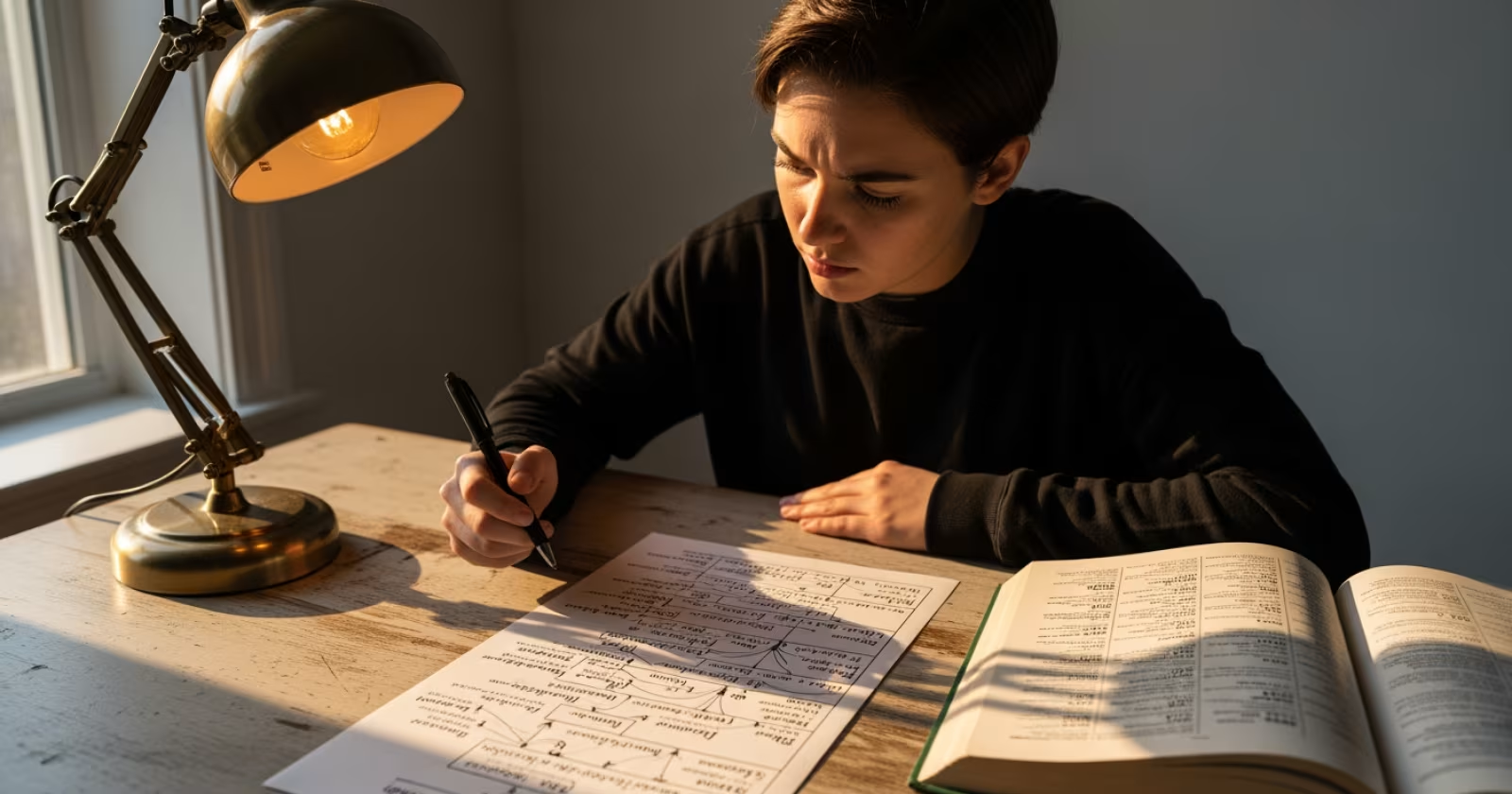
I used one A3-size sheet (you can also tape two A4 sheets together). I drew a vertical line down the centre. On the left side, I wrote years. On the right side, I wrote events, acts, and key personalities. Here is the step-by-step process.
Step 1 — Fix your time boundaries. I started from 1757 (Battle of Plassey) and ended at 1950 (Constitution comes into effect). Everything outside this range, I handled in separate Ancient/Medieval and Post-Independence notes.
Step 2 — Mark anchor years first. Before filling in details, I marked the big anchor years that everyone knows: 1857, 1885, 1905, 1919, 1920, 1927, 1930, 1935, 1942, 1947. These act as mental pillars. Once you memorise these ten dates cold, everything else fits around them.
Step 3 — Fill in events using colour codes. I used four colours. Blue for British policies and Acts. Red for Indian resistance and movements. Green for organisational developments (Congress sessions, Muslim League, etc.). Black for socio-religious reform movements. This colour system was a game-changer during revision because my eyes could instantly scan for patterns.
Step 4 — Add only exam-relevant details. This is where discipline matters. I did not write paragraphs. Each entry was 5 to 10 words maximum. For example, next to 1905 I wrote: “Partition of Bengal — Swadeshi & Boycott — Curzon.” That is it. The timeline is a trigger, not a textbook. When I glanced at those words, my brain recalled the full chapter.
Step 5 — Add a thin row for Viceroys and Governor-Generals. Along the bottom edge, I drew a narrow strip showing which Viceroy served during which period. This is one of the most asked areas in Prelims, and seeing the Viceroy alongside the events they oversaw made retention effortless.
What I Deliberately Left Out
A one-page timeline cannot hold everything. I made hard choices. I left out detailed descriptions of reform movements before 1857 — those I handled in a separate sheet. I also excluded most world events, keeping only those directly linked to India (like World War I, World War II, and the Russian Revolution’s influence on Indian revolutionaries).
I skipped sub-events within movements. For instance, under the Non-Cooperation Movement, I did not list every individual incident. I only noted the start year, the key trigger (Khilafat + Jallianwala Bagh), and the end event (Chauri Chaura, 1922). The goal was bird’s-eye view, not microscopic detail.
How I Used the Timeline for Daily Revision
Every morning during my last two months of Prelims preparation, I spent exactly seven minutes with this sheet. I would cover the right side (events) with a blank paper and try to recall what happened in each year. Then I would cover the left side (years) and try to recall the date for each event. This two-way recall is far more powerful than just reading notes passively.
Before every mock test, I would photograph the timeline in my mind. During the actual exam, when I encountered a question about the chronological order of events, I could mentally “see” the sheet and trace the sequence. At least three questions in my Prelims paper were directly answered this way.
Common Mistakes to Avoid When Making Your Timeline
Do not try to make it pretty. I have seen aspirants spend hours decorating timelines with highlighters and stickers. That time is better spent on revision. Function over form — always.
Do not copy someone else’s timeline. The act of building it yourself is half the learning. When you decide what to include and what to exclude, you are already processing the information at a deep level. A borrowed timeline gives you none of that benefit.
Do not make it longer than one page. The moment you spill onto a second page, you lose the single-glance advantage. Be ruthless with what you cut. If a fact has never appeared in any previous year question and is not part of the core narrative, drop it.
Key Points to Remember for UPSC
- Chronological confusion is one of the biggest reasons aspirants lose marks in Modern History — a timeline directly solves this.
- UPSC Prelims typically asks 4 to 8 questions from Modern Indian History every year, and at least 1-2 involve sequencing or matching events to dates.
- Anchor years (1857, 1885, 1905, 1919, 1920, 1930, 1935, 1942, 1947) are the skeleton — everything else hangs on them.
- Colour-coding by category (British Acts, Indian movements, organisations, social reform) improves visual recall significantly.
- The Viceroy-event mapping is among the most frequently tested patterns — always include it on your timeline.
- Two-way recall practice (covering dates, then covering events) builds active memory, not passive recognition.
- Building the timeline yourself is more valuable than the finished product — the process is the learning.
A single-page timeline will not replace your textbook, but it will transform how you retain and retrieve what you have already studied. If you have finished even one reading of Spectrum or any standard Modern History text, sit down this weekend and build your own version. Keep it on your desk, revise it daily, and watch how those confusing dates start falling into place naturally. The effort of one focused afternoon can pay off across multiple papers and multiple attempts.