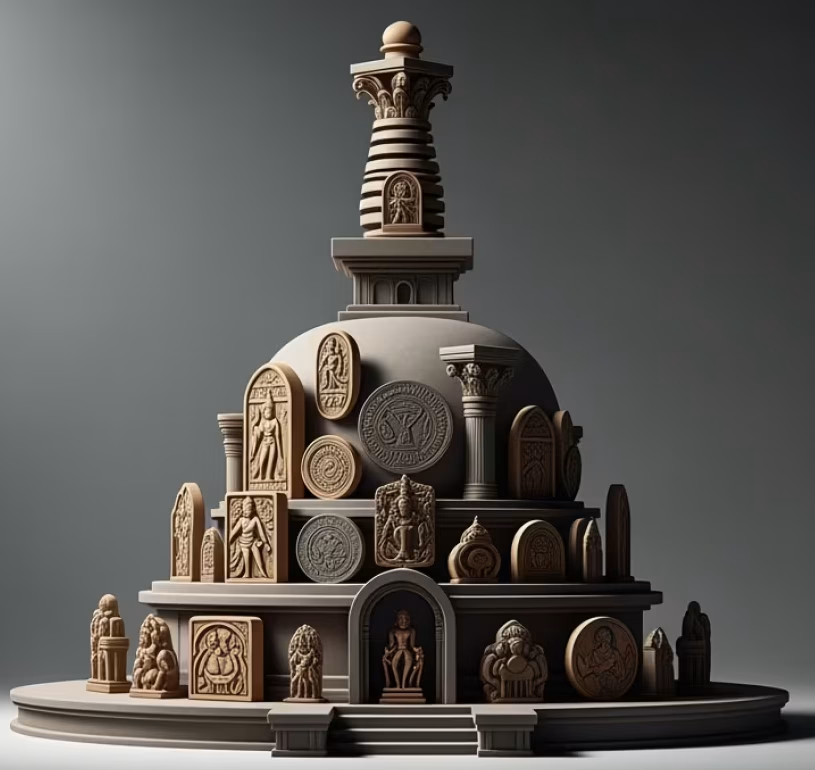

Most aspirants prepare history by memorizing timelines — Mauryas, then Guptas, then Sultanate, then Mughals, and so on. But what if I told you that one of the smartest approaches I have seen a topper use threw that entire sequence out the window and replaced it with something far more powerful?
That approach was theme-wise note making. And after spending years teaching history to UPSC aspirants, I can confirm it works better than chronological preparation for most students. Let me walk you through exactly how it works and how you can build your own version.
Where This Topic Sits in the UPSC Syllabus
History is one of the heaviest subjects in the UPSC syllabus. It appears in both Prelims and Mains. The way you organize your notes directly affects how well you recall facts and build arguments in the exam hall.
| Exam Stage | Paper | Syllabus Section |
|---|---|---|
| Prelims | General Studies | Indian History — Ancient, Medieval, Modern |
| Mains | GS Paper I | Indian Heritage and Culture, History and Geography of the World and Society |
| Mains | Essay Paper | Historical themes frequently form essay topics |
UPSC has consistently asked questions that cut across time periods. A question on land revenue systems, for instance, may require you to compare Mauryan, Mughal, and British methods in a single answer. Year-wise notes make this very hard. Theme-wise notes make it natural.
Why Year-Wise Preparation Falls Short
Let me be honest — there is nothing wrong with learning history chronologically at first. You need a timeline in your head. The problem starts when your notes are also organized purely by time period.
Here is what happens. You study the economic system under the Mughals in Chapter 7 of one book. Then you study the economic system under the British in Chapter 15 of another book. By the time you reach the British chapter, you have half-forgotten the Mughal details. When a Mains question asks you to “trace the evolution of land revenue systems in India,” you are left flipping through mental pages scattered across months of preparation.
Year-wise notes create silos. Each dynasty or period sits in its own box. But UPSC does not ask questions in boxes. It asks questions that demand connections across centuries.
The Theme-Wise Method — How the Topper Did It
The approach I saw work brilliantly involved a simple but disciplined process. After completing a first reading of the entire history syllabus chronologically — using standard sources like Tamil Nadu textbooks, Spectrum for Modern History, and a good Ancient and Medieval India reference — this aspirant created a second layer of notes organized entirely by themes.
The themes were not random. They were drawn directly from the pattern of UPSC questions over the past 15 years. Here are some of the themes that formed separate note sections:
- Land Revenue and Agrarian Systems — from Mauryan kara to British Permanent Settlement
- Trade and Commerce — internal and external trade across all periods
- Religious and Social Reform Movements — Bhakti, Sufi, 19th-century reformers
- Art and Architecture — Mauryan pillars to Indo-Islamic to colonial architecture
- Administrative Evolution — Ashoka’s dhamma to Mughal mansabdari to British bureaucracy
- Women and Society — status across ancient, medieval, and modern periods
- Tribal and Peasant Movements — Santhal, Munda, Deccan Riots, Tebhaga
- Constitutional Development — Regulating Act 1773 to Indian Independence Act 1947
Each theme became a self-contained document. Under “Land Revenue Systems,” for example, the notes began with the Arthashastra’s description of taxation, moved through Alauddin Khalji’s market reforms, then Akbar’s Zabti and Dahsala systems, then the British experiments — Permanent Settlement, Ryotwari, Mahalwari — all on the same pages.
How to Build Your Own Theme-Wise Notes
You do not need to be a topper to do this. You need patience and a clear process. Here is the method I recommend to my students.
Step 1 — Complete one full chronological reading first. Do not skip this. You need the timeline as a foundation. Use your standard NCERT and reference books. Take basic notes during this phase — just enough to capture key facts.
Step 2 — Identify 12 to 15 themes from past UPSC questions. Go through the last 10 to 15 years of Prelims and Mains questions on history. You will see the same themes appearing again and again. List them out. The ones I mentioned above are a strong starting point.
Step 3 — Create one document or notebook section per theme. Now go back through your chronological notes and reorganize the relevant facts under each theme. This is the hard work. It may take two to three weeks. But it is the most productive revision you will ever do, because you are actively processing and reorganizing information — not passively re-reading.
Step 4 — Add comparative elements. Within each theme, create small comparison points. For example, under “Administration,” note how Ashoka’s provincial system differed from Akbar’s Subah system and from British Presidency governance. These comparisons become ready-made Mains content.
Step 5 — Update with current affairs links. If a new archaeological discovery in 2026 relates to Harappan trade, add it under your “Trade and Commerce” theme. This keeps your notes alive and exam-ready.
How This Helps in the Actual Exam
In Prelims, UPSC often tests fine factual distinctions. Theme-wise notes help because all related facts sit together. When you revise “Art and Architecture” as one block, you are far less likely to confuse a Chola bronze with a Pala sculpture.
In Mains, the advantage is even bigger. GS Paper I regularly asks questions that span multiple centuries. A 2019 question asked aspirants to discuss the evolution of temple architecture. A 2022 question asked about the nature of peasant movements. These questions demand thematic thinking. If your notes are already organized this way, your answer practically writes itself.
For the Essay paper, historical themes provide powerful illustrative material. An essay on social justice benefits enormously from a well-organized “Social Reform Movements” theme note that covers Jyotiba Phule, Pandita Ramabai, Periyar, and Ambedkar in one place.
Common Mistakes to Avoid
Some students try to do theme-wise notes without first reading chronologically. This leads to confusion because you lack the timeline scaffolding. Always do chronological reading first.
Another mistake is making the themes too broad. “Culture” as a single theme is too wide. Break it into “Art and Architecture,” “Literature and Language,” and “Religion and Philosophy.” Keep each theme focused enough to be useful during quick revision.
Do not make your notes too long. The purpose is consolidation, not duplication. Each theme should ideally be 8 to 12 handwritten pages or 4 to 6 typed pages. If it is longer, you have included too much detail that belongs in textbooks, not in revision notes.
Key Points to Remember for UPSC
- Chronological reading builds the foundation — theme-wise notes build the exam weapon. Do both in sequence.
- UPSC Mains questions on history are overwhelmingly thematic, not period-specific. Your notes should match the question pattern.
- 12 to 15 well-chosen themes can cover nearly the entire history syllabus for both Prelims and Mains.
- Comparative points within each theme give you instant Mains answer content and analytical depth.
- Theme-wise notes are living documents — keep adding current affairs and new PYQ insights as you progress.
- The process of reorganizing notes is itself deep revision — it forces active recall and connection-building.
- Keep each theme concise — aim for consolidated revision sheets, not second textbooks.
This method demands a few extra weeks of effort during your preparation, but the return during revision season and in the exam hall is enormous. Start by picking just three themes this week — Land Revenue, Social Reforms, and Art and Architecture — and build your first set. Once you see how naturally your answers improve, you will not go back to scattered, period-wise notes. Steady, structured effort always adds up.