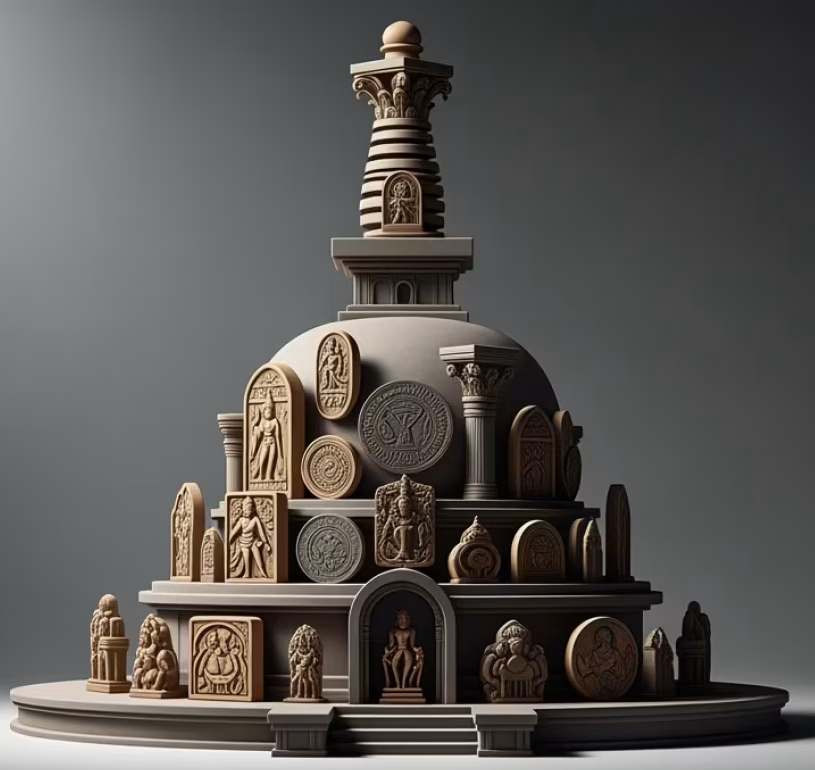

Every year, thousands of aspirants walk into the Prelims hall and lose 8 to 12 marks on questions they never prepared for — questions on Indian paintings, temple architecture, classical dances, and UNESCO heritage sites. The pattern is almost always the same: Art and Culture gets pushed to the last month, crammed from random PDFs, and then forgotten under exam pressure.
I have watched this cycle repeat for over fifteen years of teaching UPSC aspirants. And I can tell you with confidence — the problem is not that Art and Culture is difficult. The problem is that most students start it far too late, treat it as a minor topic, and never build the visual and conceptual memory this subject demands. Let me walk you through exactly when and how to approach this subject so it becomes a scoring strength, not a last-minute weakness.
Where This Topic Sits in the UPSC Syllabus
Art and Culture is not a standalone paper, but it spreads across both Prelims and Mains. In Prelims, it appears under “Indian Heritage and Culture” within the General Studies paper. In Mains, it falls under GS Paper I, specifically under the line: “Indian culture will cover the salient aspects of Art Forms, Literature and Architecture from ancient to modern times.”
| Exam Stage | Paper | Syllabus Section |
|---|---|---|
| Prelims | General Studies | Indian Heritage and Culture, History and Geography of the World and Society |
| Mains | GS-I | Indian Culture — Art Forms, Literature, Architecture (Ancient to Modern) |
On average, 8 to 15 questions in Prelims every year are directly or indirectly linked to Art and Culture. In Mains, at least one full question of 10 or 15 marks appears from this area. UPSC has also been increasing the difficulty level — moving from direct factual recall to application-based and comparative questions. This makes early and deep preparation essential.
Why Students Delay Art and Culture — And Why That Hurts
There are three common reasons aspirants push this subject to the end. First, it feels “soft” compared to Polity, Economy, or Geography. Students assume they can read it in a week. Second, there is no single authoritative textbook like Laxmikanth for Polity, so students feel lost about sources. Third, the subject requires visual memory — remembering the difference between Nagara and Dravidian temple styles, for example — which cannot be built overnight.
The result is predictable. When aspirants cram Art and Culture in the final two weeks before Prelims, they mix up Warli and Madhubani paintings, confuse Kathak with Kathakali, and cannot recall whether Ajanta caves are Buddhist or Hindu. These are not trick questions. They are basic conceptual questions that reward students who started early and revised multiple times.
The Right Time to Start — A Practical Timeline
Based on what works for aspirants who clear the exam, here is my recommendation. If you are starting UPSC preparation fresh, begin Art and Culture within your first three months — right alongside Ancient and Medieval Indian History. These subjects overlap heavily. When you study the Mauryan period, study Mauryan art. When you study the Chola dynasty, study Chola bronze sculptures and temple architecture. This integrated approach saves time and builds deeper understanding.
If you are already six months into your preparation and have not touched Art and Culture, start it immediately. Do not wait for your “revision phase.” Allocate 45 minutes daily for four weeks. That is enough to cover the core syllabus once. Then revise it once every month through short notes.
If Prelims is less than three months away and you have zero preparation in this area, treat it as an emergency. Focus only on the highest-yield areas: Indian architecture (temples, stupas, caves), classical and folk dances, Indian paintings, UNESCO World Heritage Sites in India, and GI-tagged cultural items. These five areas cover roughly 70 percent of questions asked.
What to Study — A Source-Wise Breakdown
Start with the NCERT Class 11 Fine Arts textbook — “An Introduction to Indian Art.” This small book covers ancient to modern Indian art in simple language with images. Most aspirants do not even know this book exists. Read it twice. Then move to Nitin Singhania’s “Indian Art and Culture” book, which is written specifically for UPSC and organises topics in exam-friendly format.
For visual learning, use the CCRT (Centre for Cultural Resources and Training) website. It has images, descriptions, and videos on Indian art forms. Since Art and Culture is a visual subject, you must see the art — not just read about it. Look at actual images of Chola bronzes, Gandhara sculptures, Mughal miniature paintings, and Pattachitra scrolls. This visual familiarity is what separates students who score from those who guess.
Supplement your static preparation with current affairs. Every year, UPSC picks Art and Culture questions linked to recent events — a new UNESCO inscription, a GI tag controversy, a cultural festival in the news. Read the culture section of your monthly current affairs magazine carefully.
How UPSC Asks Art and Culture Questions — The Pattern
UPSC does not simply ask “Name the dance form of Kerala.” The questions have evolved. In recent years, the exam has asked matching-type questions — match the folk dance with the state. It has asked about the philosophical or religious context behind art forms. It has asked about lesser-known tribal art traditions. And it has increasingly asked about intangible cultural heritage.
This means rote memorisation alone will not work. You need to understand why a particular art form developed, what community practises it, what materials are used, and how it connects to the broader cultural history of the region. This depth of understanding only comes when you start early and revise regularly.
A Common Mistake — Treating Art and Culture as Separate from History
One of the biggest errors I see is aspirants studying Art and Culture in complete isolation from History. These two subjects are deeply connected. The Bhakti movement gave rise to specific music and literary traditions. Mughal patronage shaped miniature painting schools. British colonial policies affected Indian handicrafts and textile traditions. When you study them together, you remember more and understand the “why” behind each art form — which is exactly what UPSC tests.
Build a timeline in your notes. Place art developments alongside political events. When you see that the Pala dynasty patronised Buddhist art while ruling Bengal, or that the Vijayanagara Empire promoted Carnatic music, the connections become natural and memorable.
Key Points to Remember for UPSC
- Art and Culture carries 8 to 15 questions in Prelims and at least one dedicated question in GS-I Mains — it is not optional.
- Start Art and Culture within the first three months of preparation, integrated with Ancient and Medieval History for better retention.
- The NCERT Class 11 Fine Arts textbook is an underused goldmine — read it before any reference book.
- Visual memory is essential. Study actual images of sculptures, paintings, and architectural styles from CCRT or reliable online sources.
- UPSC now asks application-based and context-based questions, not just direct factual recall — surface-level cramming will not help.
- Track cultural current affairs monthly: new UNESCO tags, GI tags, national cultural awards, and government cultural schemes.
- Never study Art and Culture in isolation — always connect art developments to the dynasty, movement, or era that produced them.
Art and Culture is one of those subjects where starting early gives you a disproportionate advantage because most of your competition will start late. Build your notes now, revise with images, and integrate it with your history preparation. If you give this subject just 30 to 45 minutes a day over the next four weeks, you will be ahead of 80 percent of aspirants sitting in the same exam hall. That is not a guess — that is a pattern I have seen year after year.