
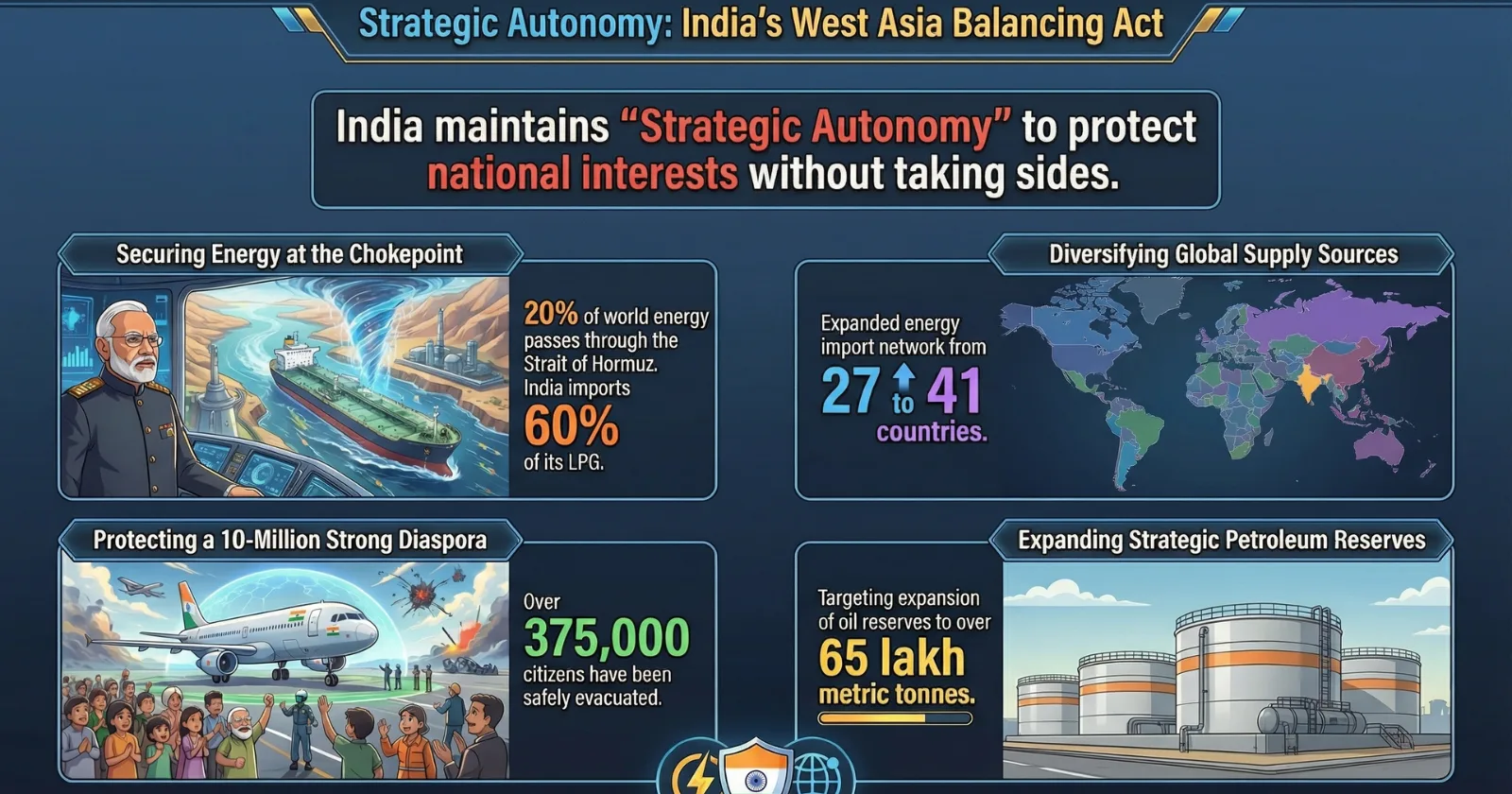
Prime Minister Narendra Modi addressed both Houses of Parliament during the Budget Session, presenting India’s official stance on the escalating West Asia conflict, which had entered its fourth week. His address covered five major diplomatic messages and discussed India’s energy security vulnerabilities, the safety of the Indian diaspora in Gulf countries, and the country’s broader foreign policy strategy built around Strategic Autonomy.
This article presents 10 UPSC GK questions with answers drawn directly from PM Modi’s parliamentary address and the surrounding developments. These questions are highly relevant for UPSC Prelims 2026, State PSC exams, and SSC GK sections.
Before attempting the questions, aspirants should read our detailed analysis: Energy Lockdown In India 2026 — Complete UPSC Notes on Crisis, Governance and Economic Impact
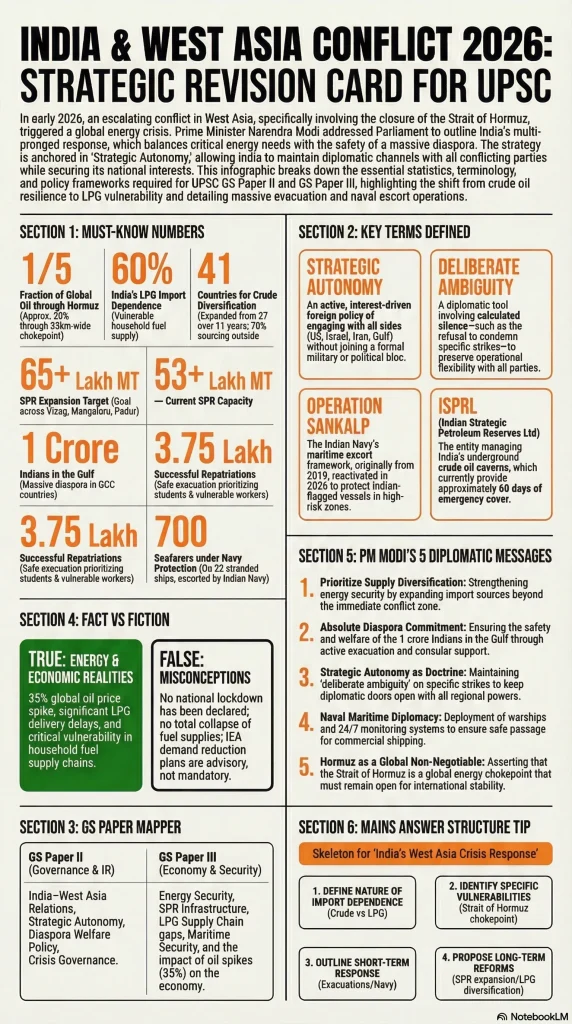
India’s West Asia Strategy at a Glance
PM Modi’s Lok Sabha address highlighted India’s multi-pronged response to the crisis — balancing energy security, humanitarian obligations toward the Indian diaspora, and diplomatic relationships with all parties to the conflict. Key pillars of India’s approach include:
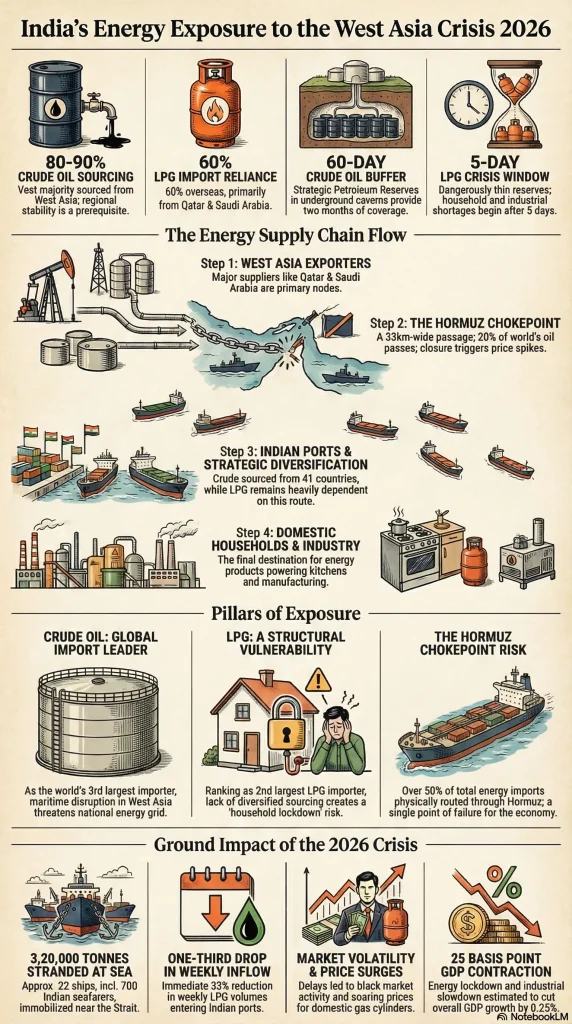
- Protecting 1 crore Indians living and working in Gulf countries
- Securing energy supply through import diversification across 41 countries
- Expanding Strategic Petroleum Reserves from 53+ lakh MT toward 65+ lakh MT
- Maintaining Strategic Autonomy — engaging all sides without taking a formal position
- Facilitating the safe return of 3.75 lakh+ Indian citizens from the conflict zone
For background on the Strait of Hormuz crisis, you can read the IEA’s official advisory on emergency oil demand reduction and the Ministry of External Affairs statements on West Asia.
10 UPSC GK Questions with Answers
Question 1. According to PM Modi’s statement, what fraction of the world’s energy supply passes through the Strait of Hormuz?
- A. 1/5
- B. 1/4
- C. 1/10
- D. 1/3
Hint: Consider the fraction that represents twenty per cent of the total.
Answer: A — 1/5
Explanation: PM Modi described the Strait of Hormuz as a non-negotiable global energy chokepoint, through which approximately one-fifth (20%) of all globally traded petroleum passes. Its closure by Iran following Operation Epic Fury triggered an immediate global oil price spike of 35%. The strait is only 33 km wide at its narrowest point, making physical blockade a credible threat.
UPSC relevance: GS Paper II (India–West Asia Relations), GS Paper III (Energy Security, Petroleum Sector)
Question 2. What is the current percentage of India’s LPG requirements that are met through imports?
- A. 40%
- B. 75%
- C. 50%
- D. 60%
Hint: The percentage is more than half but less than three-quarters of the total requirement.
Answer: D — 60%
Explanation: India’s domestic LPG production meets only 40% of total demand. The remaining 60% is imported, primarily from Qatar and Saudi Arabia — both of which depend on the Strait of Hormuz for export. This structural dependency is why the strait’s closure had an immediate, direct impact on Indian households within days. India is the world’s second-largest LPG importer. For more context, see the Petroleum Planning and Analysis Cell (outbound link).
UPSC relevance: GS Paper III (Energy Security, LPG Supply Chain, Import Dependence)
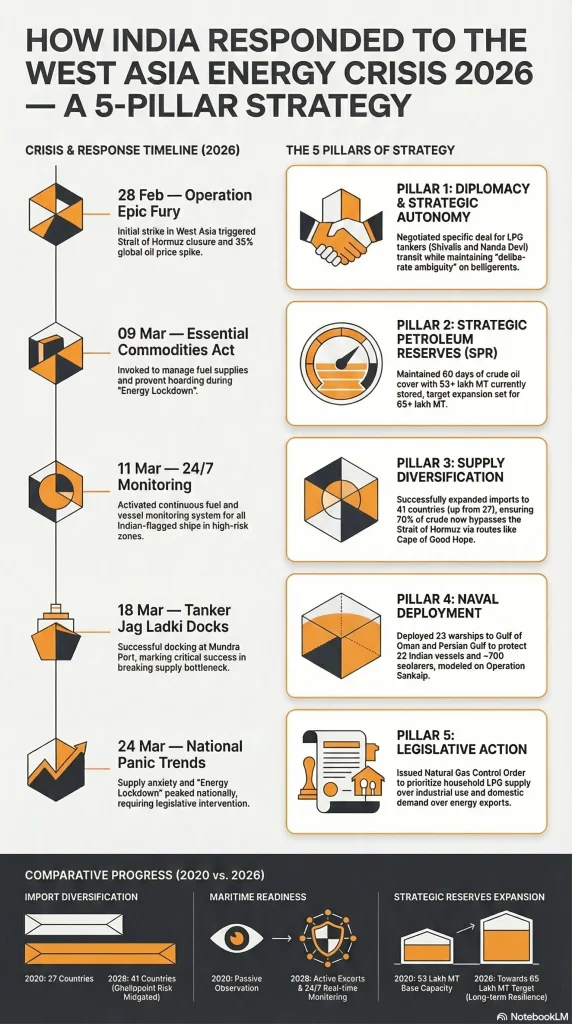
Question 3. India’s strategy to reduce energy dependence involved expanding its import sources from 27 countries to how many over the last 11 years?
- A. 48
- B. 35
- C. 52
- D. 41
Hint: The total number of countries is in the low forties.
Answer: D — 41
Explanation: Over 11 years of deliberate import diversification policy, India expanded its crude oil import sources from 27 countries to 41 countries. This diversification means that approximately 70% of India’s crude sourcing is now routed outside the Strait of Hormuz, compared to near-total dependence in the early 2010s. However, LPG diversification has lagged significantly behind crude oil, leaving household energy as the most exposed segment.
UPSC relevance: GS Paper III (Energy Policy, Import Diversification), GS Paper II (Governance, Policy Implementation)
Question 4. India currently holds a Strategic Petroleum Reserve of 53+ lakh metric tonnes. What is the government’s target for expansion?
- A. 75+ lakh metric tonnes
- B. 65+ lakh metric tonnes
- C. 80+ lakh metric tonnes
- D. 60+ lakh metric tonnes
Hint: The expansion target is exactly twelve lakh metric tonnes higher than the current base capacity.
Answer: B — 65+ lakh metric tonnes
Explanation: India currently maintains Strategic Petroleum Reserves of 53+ lakh metric tonnes stored in underground caverns at Visakhapatnam (Andhra Pradesh), Mangaluru (Karnataka), and Padur (Karnataka). The government has set an expansion target of 65+ lakh metric tonnes — an increase of approximately 12 lakh metric tonnes. At current consumption levels, the existing reserve provides approximately 60 days of crude oil cover. You can read more about India’s SPR programme at the Indian Strategic Petroleum Reserves Limited (ISPRL).
UPSC relevance: GS Paper III (Energy Security, Strategic Reserves, Infrastructure)
Question 5. Which term is used to describe India’s pragmatic foreign policy approach of balancing interests without taking sides in the conflict?
- A. Diplomatic Isolationism
- B. Non-Alignment 2.0
- C. Strategic Autonomy
- D. Strategic Neutrality
Hint: This concept emphasises a nation’s ability to act on its own interests independently of external powers.
Answer: C — Strategic Autonomy
Explanation: Strategic Autonomy is the defining principle of India’s contemporary foreign policy. Unlike Cold War-era Non-Alignment (which was passive), Strategic Autonomy is an active, interest-driven posture — India engages with all major powers (USA, Russia, Iran, Israel, Gulf states) simultaneously, pursuing its national interest without being formally aligned with any bloc. In PM Modi’s Lok Sabha address, this manifested as the deliberate absence of condemnation of either US–Israeli or Iranian actions — described by analysts as “deliberate ambiguity.” This approach preserves India’s diplomatic channels with all parties while protecting its energy and diaspora interests.
UPSC relevance: GS Paper II (India’s Foreign Policy, IR Theory), Essay Paper
Question 6. Approximately how many Indians live and work in the Gulf countries, representing a significant stake in the region’s stability?
- A. 10 million
- B. 1 million
- C. 20 million
- D. 5 million
Hint: The number is equivalent to one crore people.
Answer: A — 10 million (1 crore)
Explanation: Approximately 1 crore (10 million) Indians live and work across Gulf Cooperation Council (GCC) countries — including UAE, Saudi Arabia, Kuwait, Qatar, Bahrain, and Oman. This is one of the world’s largest diaspora concentrations in a single region. Their collective remittances contribute significantly to India’s foreign exchange earnings and to the economies of remittance-dependent states like Kerala, Telangana, and Tamil Nadu. The West Asia conflict directly threatens their livelihoods, safety, and remittance flows. You can explore diaspora data at the Ministry of External Affairs — Indian Diaspora portal.
UPSC relevance: GS Paper II (Indian Diaspora, India–Gulf Relations), GS Paper III (Remittances, External Sector)
Question 7. What specific education-related measure was taken for the Indian community in the Gulf following the escalation of the conflict?
- A. Postponing the start of the academic year by six months
- B. Providing mandatory evacuation for all school-aged children
- C. Moving all examinations to an online-only format
- D. Cancelling Class 10 and 12 board exams
Hint: The measure involved the Central Board of Secondary Education and impacted senior secondary students.
Answer: D — Cancelling Class 10 and 12 board exams
Explanation: As the conflict escalated and security conditions in Gulf cities deteriorated, the Central Board of Secondary Education (CBSE) cancelled Class 10 and Class 12 board examinations for students enrolled in CBSE-affiliated schools across Gulf countries. This was a welfare measure prioritising student safety over academic timelines, and it had significant implications for university admissions and career planning for thousands of Indian students studying abroad.
UPSC relevance: GS Paper II (Governance, Education Policy, Diaspora Welfare)
Question 8. Which of the following was identified as a “deliberate ambiguity” in PM Modi’s Lok Sabha address?
- A. The failure to mention the impact on Indian seafarers
- B. The refusal to name the Strait of Hormuz
- C. The absence of any plan for energy source diversification
- D. The lack of condemnation regarding US or Israeli actions
Hint: Think about what was intentionally left unsaid to avoid alienating major global powers.
Answer: D — The lack of condemnation regarding US or Israeli actions
Explanation: PM Modi’s address deliberately avoided condemning either the US–Israeli Operation Epic Fury strikes on Iran, or Iran’s retaliatory missile attacks. This “deliberate ambiguity” is a calculated diplomatic tool — by refraining from taking a public position, India preserves its working relationships with Washington, Tel Aviv, and Tehran simultaneously. India imports defence equipment and technology from Israel, has deep energy ties with Gulf states that align with the US, and has historical diplomatic and energy ties with Iran. Alienating any one of them would impose significant strategic costs.
UPSC relevance: GS Paper II (India’s Foreign Policy, Strategic Autonomy, International Relations)
Question 9. Approximately how many Indian seafarers are currently stuck on ships in the Strait of Hormuz?
- A. 450
- B. 700
- C. 200
- D. 1,200
Hint: The number is exactly seven hundred.
Answer: B — 700
Explanation: As of mid-March 2026, approximately 700 Indian seafarers were aboard 22 ships stranded in or near the Strait of Hormuz following Iran’s blockade. This figure was cited in PM Modi’s parliamentary address as he announced the deployment of Indian Navy warships to escort commercial vessels in high-risk Gulf zones — modelled on Operation Sankalp (India’s 2019 Gulf escort mission). The Indian Navy simultaneously activated a 24×7 vessel monitoring system covering all Indian-flagged ships in the region.
UPSC relevance: GS Paper III (Maritime Security, Naval Diplomacy), GS Paper II (Diaspora Protection, Crisis Governance)
Question 10. Since the beginning of the conflict, more than how many Indians have safely returned to India?
- A. 1,00,000
- B. 5,00,000
- C. 3,75,000
- D. 2,50,000
Hint: The number of returnees is three lakh and seventy-five thousand.
Answer: C — 3,75,000
Explanation: Over 3.75 lakh (375,000) Indian citizens were safely evacuated and repatriated from Gulf countries in the weeks following the conflict’s escalation. The operation prioritised students, unskilled workers, and other vulnerable groups. The scale of this evacuation reflects both the size of India’s Gulf diaspora and the operational capacity of the Ministry of External Affairs and Air India in executing large-scale evacuation missions. This is comparable in scale to Operation Kaveri (Sudan, 2023) and Operation Ganga (Ukraine, 2022), establishing India’s growing competence in citizen evacuation operations.
UPSC relevance: GS Paper II (Diaspora Protection, Indian Foreign Policy, Consular Services, Crisis Governance)
Complete Answer Key
| Question | Answer | Key Concept |
|---|---|---|
| Q1 | A — 1/5 (20%) | Strait of Hormuz global significance |
| Q2 | D — 60% | India’s LPG import dependence |
| Q3 | D — 41 countries | Energy import diversification |
| Q4 | B — 65+ lakh MT | Strategic Petroleum Reserve target |
| Q5 | C — Strategic Autonomy | India’s foreign policy doctrine |
| Q6 | A — 10 million (1 crore) | Indian diaspora in Gulf |
| Q7 | D — CBSE board exam cancellation | Diaspora welfare, education |
| Q8 | D — No condemnation of US/Israel | Deliberate ambiguity in diplomacy |
| Q9 | B — 700 seafarers | Maritime security, Indian Navy |
| Q10 | C — 3,75,000 | Evacuation operations |
UPSC Mains Angle: India’s West Asia Policy — Key Themes
These 10 questions are a gateway to much larger Mains themes. Here are the angles worth preparing:
For GS Paper II (International Relations & Governance)
India’s West Asia policy sits at the intersection of energy security, diaspora protection, and strategic autonomy. The ability to negotiate LPG tanker transit with Iran while maintaining defence ties with Israel — without formally condemning either side — is a textbook case of interest-based foreign policy. UPSC Mains often asks candidates to evaluate the strengths and limits of India’s non-condemnation approach in regional conflicts.
For GS Paper III (Economy & Security)
The Strait of Hormuz crisis exposes a structural flaw in India’s energy security architecture: strong crude oil reserves but dangerously thin LPG reserves (approximately 5 days only). The contrast between India’s crude diversification success (27 to 41 supplier countries) and its LPG vulnerability is a ready-made answer structure for questions on India’s energy security gaps.
Key Terms to Remember
- Strategic Autonomy — India’s doctrine of independent, interest-driven foreign policy engagement
- Deliberate Ambiguity — Calculated silence on specific allegations to preserve diplomatic options
- Operation Sankalp — Indian Navy’s 2019 Gulf escort mission; template for 2026 response
- ISPRL — Indian Strategic Petroleum Reserves Limited; manages SPR facilities
- Strategic Petroleum Reserve (SPR) — Emergency crude oil stockpile; current 53+ lakh MT, target 65+ lakh MT
- GCC — Gulf Cooperation Council; home to 1 crore Indian workers
Practice These Related Questions
For a comprehensive understanding of this topic, also practise questions on:
- India’s position on the Russia–Ukraine conflict and its energy implications
- India’s voting pattern at the UN Security Council on West Asia resolutions
- The role of remittances in India’s balance of payments
- India’s LPG subsidy architecture and the PM Ujjwala Yojana
- Maritime security doctrine and India’s role in the Indian Ocean Region
Frequently Asked Questions
Are these questions based on actual UPSC papers?
These questions are based on PM Modi’s Lok Sabha address during the Budget Session 2026 and current affairs from March 2026. They are framed in the UPSC Prelims style and are highly likely to appear in upcoming Prelims, State PSC, and SSC exams given the topic’s currency and relevance.
Which UPSC papers do these questions relate to?
Primarily GS Paper II (Governance, International Relations, Indian Foreign Policy, Diaspora) and GS Paper III (Energy Security, Economy, Maritime Security). The Strategic Autonomy question also carries Essay Paper relevance.
Is India’s West Asia policy relevant for UPSC Mains 2026?
Very much so. The combination of energy security, diaspora protection, naval diplomacy, and strategic autonomy makes this one of the highest-probability Mains topics for 2026. Prepare both factual recall (Prelims) and analytical answers (Mains).
What was PM Modi’s five-point diplomatic message in Parliament?
PM Modi’s address covered:
(1) energy security and supply diversification;
(2) protection of the Indian diaspora in Gulf countries;
(3) India’s Strategic Autonomy and deliberate ambiguity on condemnation;
(4) naval deployment for maritime security; and
(5) the non-negotiable nature of the Strait of Hormuz as a global energy chokepoint.
Get fastest alerts on Results, Admit Cards & Govt Jobs directly on your phone.