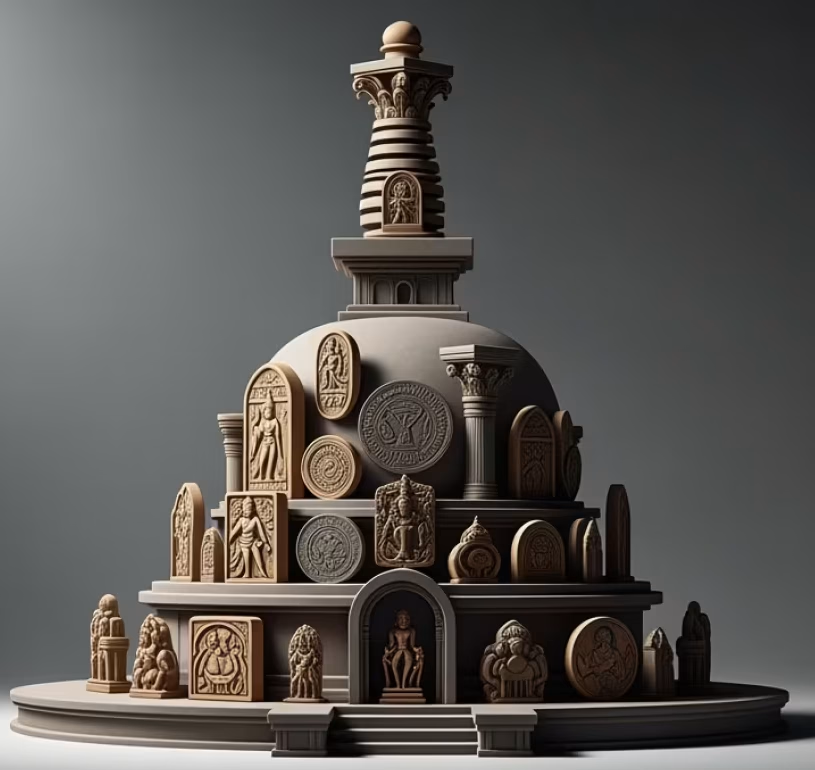

Most aspirants study the Mauryan Empire only for GS-I Ancient History and forget about it when they open their GS-II notes. That is a costly mistake. The administrative genius of Chandragupta, Kautilya, and Ashoka laid down principles that still echo in how modern India governs itself — from centralised bureaucracy to the welfare state idea embedded in our Constitution.
I have spent over fifteen years teaching UPSC aspirants, and one pattern I notice repeatedly is that toppers connect dots across papers. They do not treat history and governance as separate silos. In this piece, I will walk you through exactly how the Mauryan chapter serves double duty — helping you score in both Ancient History and Governance questions.
Where This Topic Sits in the UPSC Syllabus
The Mauryan Empire is explicitly mentioned in the Prelims syllabus under “Indian Heritage and Culture, History.” For Mains, it falls under GS-I (Indian Culture — Ancient History) and, more subtly, under GS-II (Governance, Constitution, Polity). Kautilya’s Arthashastra has been referenced in questions testing knowledge of ancient administrative systems and their modern relevance.
| Exam Stage | Paper | Syllabus Connection |
|---|---|---|
| Prelims | General Studies | Indian Heritage and Culture — Ancient History |
| Mains | GS-I | Indian Culture — Salient aspects of Art, Literature, Architecture from ancient times |
| Mains | GS-II | Governance, transparency, accountability — historical roots of Indian administration |
| Mains | GS-IV (Ethics) | Contributions of moral thinkers from India — Ashoka’s Dhamma |
Questions on Mauryan administration have appeared at least 8-10 times across Prelims and Mains in the last two decades. The 2026 trend in UPSC is asking aspirants to link historical institutions with modern governance challenges. This makes the Mauryan chapter even more relevant now.
The Mauryan Administrative Machine — A Prototype for Modern Governance
When Chandragupta Maurya unified most of the Indian subcontinent around 321 BCE, he did not just build an empire. He built one of the world’s first systematic bureaucracies. The credit for designing this system goes largely to his mentor Kautilya, whose treatise Arthashastra is essentially an ancient manual on statecraft.
The Mauryan state was divided into provinces, districts, and villages — a hierarchy strikingly similar to India’s present division into States, Districts, and Gram Panchayats. The emperor sat at the top. Provincial governors called Kumaras or Aryaputras administered large regions. Below them were district officers and village headmen.
This three-tier structure is almost a mirror image of India’s current administrative framework. When you study GS-II topics like district administration or the role of the Collector, remember that the seed of this idea was planted over 2,300 years ago in Pataliputra.
Kautilya’s Arthashastra and the Modern Welfare State
Many aspirants think the welfare state is a Western concept imported through our Constitution. That is only partly true. Kautilya’s Arthashastra clearly states that the happiness of the subjects is the happiness of the king. The text prescribes that the state must regulate markets, prevent hoarding, provide famine relief, and maintain public infrastructure like roads and irrigation.
Compare this with Article 38 of our Constitution, which directs the State to secure a social order for the promotion of welfare of the people. The Directive Principles of State Policy in Part IV carry a philosophical lineage that includes Kautilya’s vision alongside Fabian socialism and Gandhian thought.
In a Mains answer on the welfare state or on governance philosophy, referencing Kautilya gives your essay historical depth. It shows the examiner that you understand India’s governance tradition is not borrowed — it has indigenous roots.
Ashoka’s Dhamma — Ethics in Administration
Ashoka’s Dhamma was not a religion. It was a code of ethical conduct for both rulers and citizens. His Rock Edicts speak of tolerance, non-violence, respect for elders, and compassion towards animals and servants. He appointed Dhamma Mahamattas — special officers to spread ethical practices across the empire.
This connects directly to the GS-IV Ethics paper. When UPSC asks about the role of ethics in public administration, Ashoka is a powerful Indian example. His idea that the state has a moral responsibility — not just a functional one — resonates with modern concepts like good governance, accountability, and transparency.
Ashoka also practiced what we today call decentralisation of moral authority. He did not impose Dhamma through force. He used persuasion, public inscriptions, and officers embedded in communities. This is strikingly similar to modern India’s approach through awareness campaigns and local self-governance.
Espionage, Intelligence, and Internal Security
The Arthashastra devotes entire chapters to espionage. Kautilya describes a network of spies — Gudhapurushas — who monitored officials, merchants, and even common citizens. The purpose was to prevent corruption, rebellion, and external threats.
For GS-III (Internal Security) and GS-II (Role of civil services, transparency), this is a rich reference point. Modern India’s intelligence framework — RAW, IB, and state intelligence units — performs functions that Kautilya conceptualised centuries ago. Of course, the ethical boundaries have evolved, but the structural logic remains similar.
Revenue, Taxation, and Economic Governance
The Mauryan state collected land revenue, trade taxes, and various cesses. The Sannidhata was the chief treasury officer. The Samaharta was the chief revenue collector. Tax rates were clearly defined — typically one-sixth of agricultural produce.
This system is the ancestor of India’s modern revenue administration. When you study topics like GST, land revenue systems, or fiscal federalism for GS-III, knowing the Mauryan tax structure helps you write historically informed answers. UPSC values aspirants who can show continuity in Indian institutional history.
Key Points to Remember for UPSC
- Arthashastra is not just a history text — it covers governance, economics, law, and ethics, making it relevant across GS-I, II, III, and IV.
- The Mauryan three-tier provincial system (province-district-village) is a precursor to India’s current administrative structure.
- Ashoka’s Dhamma Mahamattas represent one of the earliest examples of state-appointed ethical oversight officers.
- Kautilya’s welfare principles predate Western welfare state theory by nearly two millennia — use this in Mains essays.
- The Mauryan espionage system connects to GS-III Internal Security topics and GS-II accountability debates.
- Mauryan taxation concepts (Samaharta, Sannidhata) help contextualise modern fiscal administration questions.
- Ashoka’s governance philosophy is directly usable in GS-IV answers on ethics in public life and contributions of Indian moral thinkers.
Understanding the Mauryan Empire as a governance case study — not just a history chapter — gives you a genuine edge in the UPSC examination. I suggest you make a one-page comparison chart mapping Mauryan institutions to their modern Indian equivalents and keep it in your revision folder. That single sheet can add depth to answers across at least three GS papers, and depth is what separates average answers from top-scoring ones.
Get fastest alerts on Results, Admit Cards & Govt Jobs directly on your phone.