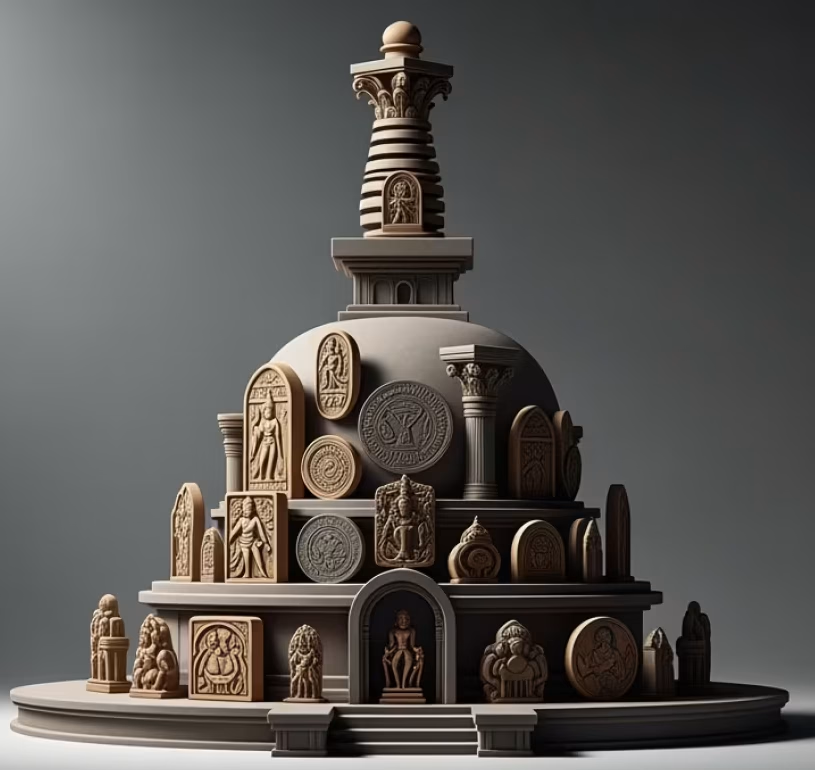
Every year, at least 3 to 5 questions in UPSC Prelims come from Art and Culture — and every year, thousands of aspirants lose marks not because they did not study, but because certain terms simply confused them. I have spent over fifteen years watching students mix up Mandapa with Mantapa, confuse Gandhara with Mathura, and blank out when they see words like “Chiaroscuro” or “Pietra Dura” in an option list. Today, I am going to break down ten of the most commonly confusing art and culture terms so they never trip you up again.
Where This Topic Sits in the UPSC Syllabus
Art and Culture is a dedicated segment of the UPSC Prelims General Studies paper. In the Mains examination, it falls under GS Paper I. The syllabus specifically mentions “Indian culture will cover the salient aspects of Art Forms, Literature and Architecture from ancient to modern times.” Questions from this area have appeared consistently — roughly 4 to 8 questions every year in Prelims since 2011.
| Exam Stage | Paper | Syllabus Section |
|---|---|---|
| Prelims | General Studies | Indian Heritage and Culture, History and Geography of the World and Society |
| Mains | GS-I | Indian Culture — Art Forms, Literature, Architecture from Ancient to Modern Times |
Related topics that frequently overlap include Indian architecture styles, classical dance forms, UNESCO heritage sites, and ancient Indian literature.
Term 1 — Mandapa vs. Shikhara vs. Garbhagriha
These three terms describe parts of a Hindu temple, and students constantly mix them up. The Garbhagriha is the innermost sanctum — the small, dark room where the main deity is placed. Think of it as the “heart” of the temple. The Mandapa is the pillared hall in front of the Garbhagriha where devotees gather. The Shikhara is the towering structure that rises above the Garbhagriha — it is the temple’s spire or tower. In Dravidian architecture, this tower is called a Vimana, not Shikhara. That distinction alone has been tested in Prelims.
Term 2 — Gandhara Art vs. Mathura Art
Gandhara Art flourished in present-day Afghanistan and northwest Pakistan. It was heavily influenced by Greek and Roman styles — Buddha statues here have wavy hair, draped robes, and realistic facial features. Mathura Art was indigenous to India, centred around present-day Uttar Pradesh. Buddha in Mathura art has a shaved head, a thin muslin robe, and a halo around the head. The simplest trick: Gandhara looks Greek, Mathura looks Indian.
Term 3 — Mudras in Buddhist and Hindu Art
A Mudra is a symbolic hand gesture found in sculptures and paintings. The ones UPSC loves to test are: Abhaya Mudra (right hand raised, palm facing outward — symbolises fearlessness), Bhumisparsha Mudra (right hand touching the earth — Buddha calling the earth as witness), Dhyana Mudra (both hands resting on the lap — meditation), and Varada Mudra (right hand extended downward — granting boons). When you see a Prelims question showing an image or describing a posture, they are testing whether you can match the gesture to its name and meaning.
Term 4 — Pietra Dura
This Italian term means “hard stone.” It refers to the inlay technique where semi-precious stones like lapis lazuli, jasper, and cornelian are cut and fitted into marble to create intricate patterns. You see this on the Taj Mahal’s walls. Students often confuse it with fresco painting, which involves painting on wet plaster. Pietra Dura is stone inlay work; fresco is wall painting. Two completely different things.
Term 5 — Chiaroscuro
This word sounds intimidating, but the concept is simple. Chiaroscuro is the use of strong contrasts between light and dark in painting to create depth and drama. It originated in European Renaissance art but appeared in some Mughal miniature paintings. UPSC has used this term in option lists to test whether you know basic art vocabulary beyond Indian art.
Term 6 — Nataraja vs. Ardhanarishvara
Nataraja is Shiva as the cosmic dancer — performing the Tandava inside a ring of fire. The famous Chola bronze Nataraja is one of India’s most iconic art pieces. Ardhanarishvara is a composite form where Shiva and Parvati share one body — the right half is male, the left half is female. Both are Shiva-related iconography, but they represent entirely different philosophical ideas. Nataraja represents cosmic cycles of creation and destruction. Ardhanarishvara represents the unity of masculine and feminine energies.
Term 7 — Sangam Literature vs. Smriti Literature
Sangam Literature is ancient Tamil literature composed roughly between 300 BCE and 300 CE in southern India. It is secular in nature and describes everyday life, love, war, and trade. Smriti Literature refers to a category of Sanskrit Hindu texts that include the Dharmashastras, Puranas, and epics like Mahabharata and Ramayana. Sangam is Tamil and largely secular. Smriti is Sanskrit and largely religious or prescriptive. Never mix the two.
Term 8 — Ashtadhyayi
Students often see this term and cannot recall what it is. Ashtadhyayi was written by Panini and is a treatise on Sanskrit grammar — not on philosophy, not on mathematics. It contains roughly 4,000 rules of Sanskrit grammar and is considered one of the greatest intellectual achievements of the ancient world. UPSC loves to test whether you can match ancient texts to their authors and subjects.
Term 9 — Intangible Cultural Heritage
UNESCO maintains a list of Intangible Cultural Heritage items — these are not physical monuments but living traditions like dance, music, festivals, and craft skills. India’s entries include Yoga, Kumbh Mela, Ramlila, and Durga Puja, among others. Students confuse this with the World Heritage Sites list, which covers physical locations. A temple can be a World Heritage Site. A dance form can be Intangible Cultural Heritage. Both are UNESCO lists, but they are fundamentally different.
Term 10 — Pahadi vs. Rajasthani Miniature Painting
Rajasthani miniature paintings originated in the royal courts of Rajasthan — Mewar, Bundi, Kishangarh, and Jaipur are sub-schools. They feature bold colours and themes from Radha-Krishna stories. Pahadi paintings come from the hill kingdoms of Himachal Pradesh and Jammu — Kangra, Basohli, and Guler are key sub-schools. Pahadi paintings are softer, more lyrical, and show lush green landscapes. The exam often gives you a description and asks you to identify the school. Remember: desert palaces mean Rajasthani; misty hills mean Pahadi.
Previous Year UPSC Questions on This Topic
Q1. With reference to the cultural history of India, which one of the following is the correct description of the term “Pietra Dura”?
(UPSC Prelims 2020 — GS)
Answer: Pietra Dura refers to the inlay technique using semi-precious and precious stones on marble surfaces. The correct option described it as a form of stone inlay work, distinct from fresco or stucco. This technique is best seen on the Taj Mahal and was brought to India during the Mughal period.
Explanation: UPSC tests whether you know the difference between decorative art techniques. Pietra Dura, fresco, stucco, and arabesque are four distinct techniques. Learn them as a set.
Q2. Which of the following pairs is/are correctly matched? (Dance form — State of origin)
(UPSC Prelims 2014 — GS)
Answer: These matching questions require you to know the exact geographical origins of each classical and folk art form. The examiners frequently include one deliberately tricky pair — such as placing Sattriya with a wrong state. Sattriya belongs to Assam, not West Bengal.
Explanation: Art and culture matching questions are a Prelims staple. Prepare a personal chart mapping every classical dance, folk dance, painting style, and music form to its state and key characteristics.
Q3. Discuss how Indian temple architecture reflects the philosophical and religious ideas of the period in which they were built.
(UPSC Mains 2022 — GS-I, 15 marks)
Answer: Indian temple architecture evolved from simple rock-cut caves to elaborate structural temples. The Nagara, Dravida, and Vesara styles reflect regional philosophical differences. The Garbhagriha symbolises the inner self where the divine resides, while the Mandapa represents the community gathering space. Temples in the Bhakti period emphasised accessibility and devotion through ornate carvings depicting everyday life alongside divine narratives. The shift from Vedic fire altars to temple worship mirrored the transition from ritualistic religion to personal devotion. Each architectural element — the Shikhara reaching skyward, the Pradakshina path for circumambulation — encodes spiritual symbolism that aspirants must connect to broader cultural movements.
Explanation: This question tests your ability to link architecture to philosophy. UPSC does not want a list of temples. They want you to show understanding of why temples were built the way they were.
Key Points to Remember for UPSC
- Garbhagriha is the sanctum, Mandapa is the hall, Shikhara (Nagara) or Vimana (Dravida) is the tower above the sanctum.
- Gandhara Art shows Greco-Roman influence; Mathura Art is purely indigenous Indian in style.
- Learn at least five Buddhist Mudras with their meanings — Abhaya, Bhumisparsha, Dhyana, Varada, and Dharmachakra.
- Pietra Dura is stone inlay; fresco is painting on wet plaster; stucco is plaster relief — never interchange these.
- Sangam Literature is ancient Tamil and largely secular; Smriti Literature is Sanskrit and religious-prescriptive.
- UNESCO’s Intangible Cultural Heritage list covers living traditions, not physical sites.
- Pahadi paintings come from hill kingdoms of Himachal Pradesh; Rajasthani paintings from desert courts of Rajasthan.
- Always prepare art and culture as a “matching” subject — connect every term to its origin, period, and key feature.
Art and Culture rewards patient, systematic preparation more than any other UPSC subject. Make a personal glossary of these terms, add one sketch or image reference next to each, and revise it once a week. Over three months, these confusing words will become your easiest marks in Prelims. Start building that glossary today — even ten terms a day will cover the entire syllabus before your next test.