
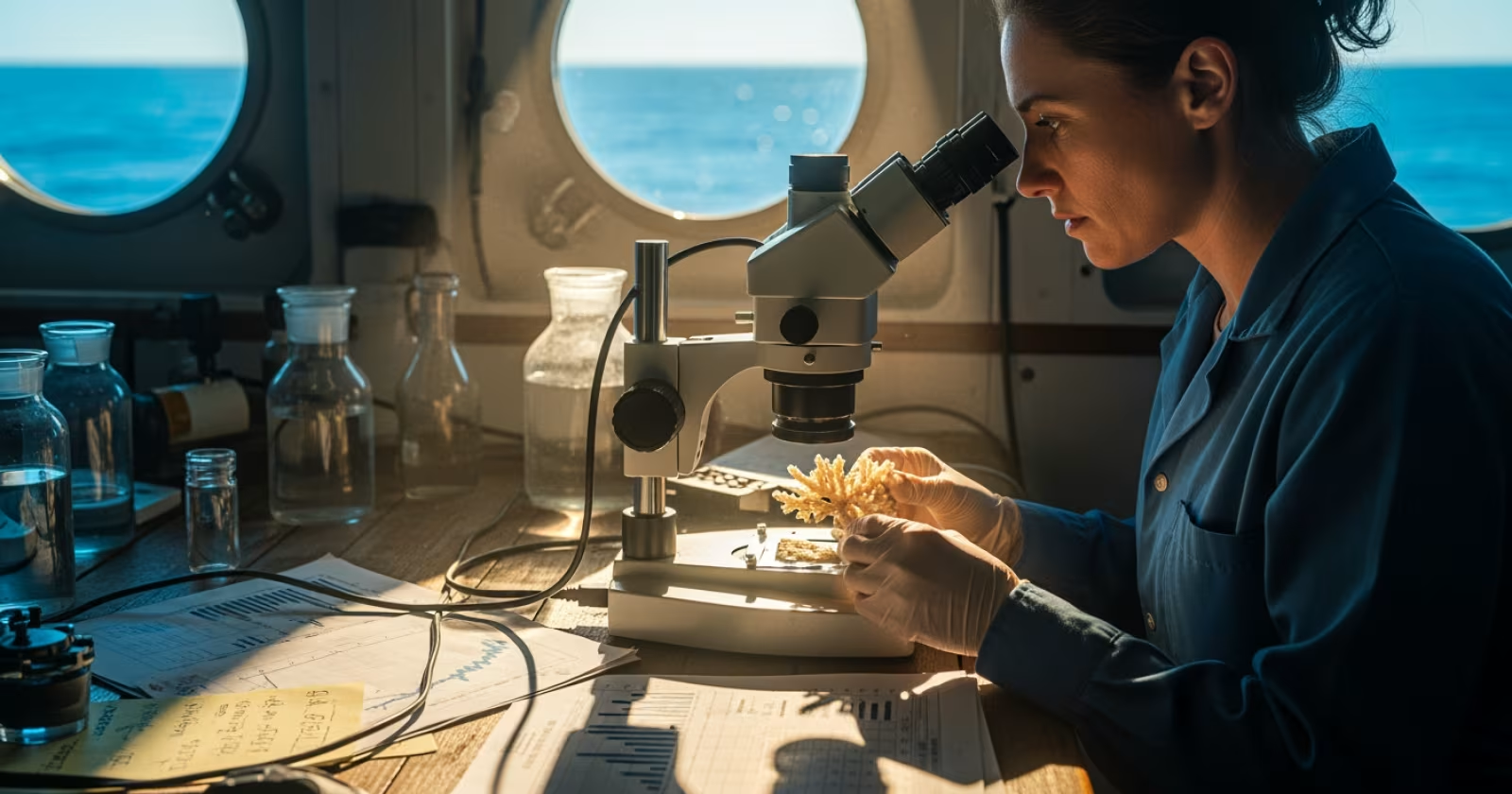
Over the last six years, UPSC has quietly but steadily increased the number of environment questions in Prelims — and two sub-topics keep reappearing in different forms. If you have been solving Previous Year Questions carefully, you already know that coral reefs and ocean chemistry are no longer “optional reading.” They are now core Prelims territory.
Where This Topic Sits in the UPSC Syllabus
Both coral reef bleaching and ocean acidification fall under the Environment and Ecology segment of General Studies. For Prelims, they appear under “General issues on Environmental Ecology, Biodiversity and Climate Change.” For Mains, they connect to GS-III under “Conservation, environmental pollution and degradation.”
| Exam Stage | Paper | Syllabus Section |
|---|---|---|
| Prelims | General Studies | Environment – Biodiversity, Climate Change |
| Mains | GS-III | Conservation, Environmental Pollution and Degradation |
| Mains | GS-I | Physical Geography – Oceanography (indirect) |
These topics have appeared directly or indirectly in Prelims at least 8-10 times since 2015. UPSC often frames questions around the science behind bleaching, the organisms involved, or the chemical process of acidification. Related syllabus topics include climate change, marine biodiversity, carbon cycle, and international environmental agreements.
Understanding Coral Reefs — The Living Foundations
Coral reefs are underwater structures built by tiny marine animals called coral polyps. These polyps are soft-bodied organisms related to jellyfish. They secrete calcium carbonate (limestone) to form a hard external skeleton. Over thousands of years, these skeletons pile up and create the massive reef structures we see today.
What makes corals special is their partnership with microscopic algae called zooxanthellae. These algae live inside coral tissue. They perform photosynthesis and provide up to 90% of the coral’s energy needs. In return, the coral gives the algae a safe home and nutrients. This is a classic example of mutualistic symbiosis — both organisms benefit.
The bright colours of coral reefs? Those come from zooxanthellae, not the coral itself. The coral animal is actually transparent. Remember this — UPSC has tested this fact before.
What Exactly Is Coral Bleaching?
When ocean water gets too warm — even by 1 to 2 degrees Celsius above the normal summer maximum — corals get stressed. Under stress, they expel the zooxanthellae from their tissue. Without these colourful algae, the coral turns white. This is coral bleaching.
Bleaching does not mean the coral is dead. It means the coral is starving and highly vulnerable. If normal temperatures return within a few weeks, zooxanthellae can recolonise the coral and recovery is possible. But if the stress continues, the coral dies. Mass bleaching events in 2016, 2020, and again in 2024-2026 devastated reefs across the tropics, including India’s Gulf of Mannar, Lakshadweep, and Andaman and Nicobar Islands.
Other causes of bleaching include pollution, excessive sedimentation, changes in salinity, and disease. But rising sea surface temperature linked to climate change is the dominant driver globally.
Ocean Acidification — The Other CO₂ Problem
Most students study CO₂ in the context of global warming. But here is what many miss: the ocean absorbs roughly 25-30% of all CO₂ released by human activities. This sounds helpful — it slows atmospheric warming. But it comes at a serious cost to marine life.
When CO₂ dissolves in seawater, it forms carbonic acid. This lowers the pH of the ocean. Since pre-industrial times, ocean pH has dropped from about 8.2 to 8.1. That may seem tiny, but pH is a logarithmic scale. A drop of 0.1 means a 26% increase in acidity. This process is called ocean acidification.
Why does this matter for corals? Coral polyps build their skeletons using calcium carbonate. In more acidic water, calcium carbonate dissolves more easily and is harder to form. So corals grow slower, their skeletons weaken, and existing reef structures begin to erode. The same problem affects shellfish, sea urchins, and any marine organism that builds a calcium-based shell or skeleton.
The Double Threat — Why UPSC Loves This Combination
I have noticed that UPSC increasingly frames questions that test whether you understand the interconnection between bleaching and acidification. They are not two separate problems. They are two consequences of the same root cause — excess CO₂ from fossil fuel burning.
Warming waters cause bleaching. Dissolved CO₂ causes acidification. Together, they create a lethal combination for coral ecosystems. The IPCC Special Report on Oceans (2019) warned that even at 1.5°C of global warming, 70-90% of tropical coral reefs could be lost. At 2°C warming, that figure rises to over 99%.
For UPSC, this is a goldmine for question-setting. The examiner can test biology (symbiosis), chemistry (pH, carbonic acid), geography (reef locations), ecology (biodiversity), and governance (international agreements) — all from one topic cluster.
India’s Coral Reef Regions — Must-Know for Prelims
India has four major coral reef areas. You should know these by heart:
- Gulf of Kutch — northernmost coral reef region in India; fringing reefs
- Gulf of Mannar — between India and Sri Lanka; one of the most biodiverse marine regions in India
- Lakshadweep Islands — only true atoll reefs in India; built on coral formations
- Andaman and Nicobar Islands — fringing reefs and barrier reefs; richest coral diversity in India
The Coral Reef Monitoring Network under the Ministry of Environment monitors these areas. India also participates in the International Coral Reef Initiative (ICRI). These institutional facts are frequently tested in Prelims statements.
Previous Year UPSC Questions on This Topic
Q1. With reference to coral reefs, consider the following statements:
1. Coral reefs are found only in tropical waters.
2. Zooxanthellae provide food to coral polyps through photosynthesis.
Which of the statements given above is/are correct?
(a) 1 only (b) 2 only (c) Both 1 and 2 (d) Neither 1 nor 2
(UPSC Prelims Pattern — Environment)
Answer: (b) 2 only. While most coral reefs are in tropical waters, cold-water corals exist in deeper, cooler oceans (e.g., Norwegian coast). Statement 2 is correct — zooxanthellae are photosynthetic algae that supply energy to coral polyps. UPSC often uses the word “only” to trap students. Cold-water corals are a fact worth remembering.
Q2. “Ocean acidification is sometimes called the ‘evil twin’ of global warming.” Discuss the causes, impacts, and India’s vulnerability to ocean acidification.
(UPSC Mains Pattern — GS-III, 15 marks)
Model Answer Approach: Begin by defining ocean acidification and linking it to CO₂ absorption. Explain the chemistry — CO₂ + H₂O → H₂CO₃ → lower pH. Discuss impacts on coral reefs, shellfish, marine food chains, and fishing communities. For India’s vulnerability, mention the four reef regions, dependence of coastal communities on marine resources, and the threat to Lakshadweep’s atoll structure. Conclude with reference to SDG 14 (Life Below Water) and India’s National Action Plan on Climate Change.
Q3. Consider the following: Which of the following is/are the possible consequence(s) of ocean acidification?
1. Decreased ability of marine organisms to form shells
2. Increased coral reef growth
3. Disruption of marine food chains
(a) 1 only (b) 1 and 3 only (c) 2 and 3 only (d) 1, 2 and 3
(UPSC Prelims Pattern — Environment)
Answer: (b) 1 and 3 only. Acidification makes it harder for organisms to build calcium carbonate structures — so statement 1 is correct and statement 2 is wrong (reef growth decreases, not increases). Statement 3 is correct because disruption at the base of the food chain (plankton with calcium shells) affects the entire marine ecosystem.
Key Points to Remember for UPSC
- Zooxanthellae are photosynthetic algae living inside coral polyps — their expulsion causes bleaching and the white appearance.
- Ocean pH has dropped by 0.1 units since pre-industrial times, representing a 26% increase in acidity.
- Bleaching is caused by temperature stress; acidification is caused by dissolved CO₂ — both stem from fossil fuel emissions.
- India has four major coral reef zones: Gulf of Kutch, Gulf of Mannar, Lakshadweep, and Andaman and Nicobar Islands.
- Lakshadweep has India’s only true atoll formations built entirely on coral.
- At 2°C global warming, over 99% of tropical coral reefs may be lost (IPCC estimate).
- Ocean acidification affects all calcium carbonate-dependent marine organisms, not just corals.
- India is part of the International Coral Reef Initiative (ICRI) — this is a factual point UPSC can test.
This topic sits at the intersection of science, ecology, and governance — exactly where UPSC likes to frame its toughest questions. I would recommend making a single consolidated note that covers the biology, the chemistry, the geography, and the policy aspects together. Practice at least five PYQs from the environment section each week. A clear understanding of this topic will help you handle not just direct questions, but also statement-based traps that UPSC designs around marine ecosystems.
Get fastest alerts on Results, Admit Cards & Govt Jobs directly on your phone.