Every year, 3 to 7 questions in UPSC Prelims come directly from Art and Culture. Yet most aspirants treat this section as an afterthought, cramming temple names and dance forms a week before the exam. After analysing over 15 years of previous year questions, I can tell you that UPSC follows clear, recognisable patterns in this subject — and understanding those patterns gives you a real edge.
Where This Topic Sits in the UPSC Syllabus
Art and Culture falls under General Studies Paper I in both Prelims and Mains. In Prelims, it is part of “Indian Heritage and Culture, History and Geography of the World and Society.” In Mains GS-I, the syllabus specifically mentions “Indian culture will cover the salient aspects of Art Forms, Literature and Architecture from ancient to modern times.”
| Exam Stage | Paper | Syllabus Line |
|---|---|---|
| Prelims | GS Paper I | Indian Heritage and Culture |
| Mains | GS-I | Art Forms, Literature, Architecture — Ancient to Modern |
Between 2011 and 2026, UPSC asked roughly 60 to 75 questions on Art and Culture in Prelims alone. That is an average of 4 to 5 questions per year. Some years, like 2014 and 2019, saw 7 or more questions from this section.
What the PYQ Data Tells Us — High-Frequency Zones
When I group all Art and Culture PYQs into clusters, a clear picture emerges. UPSC loves certain sub-topics far more than others. Here are the zones that appear most frequently.
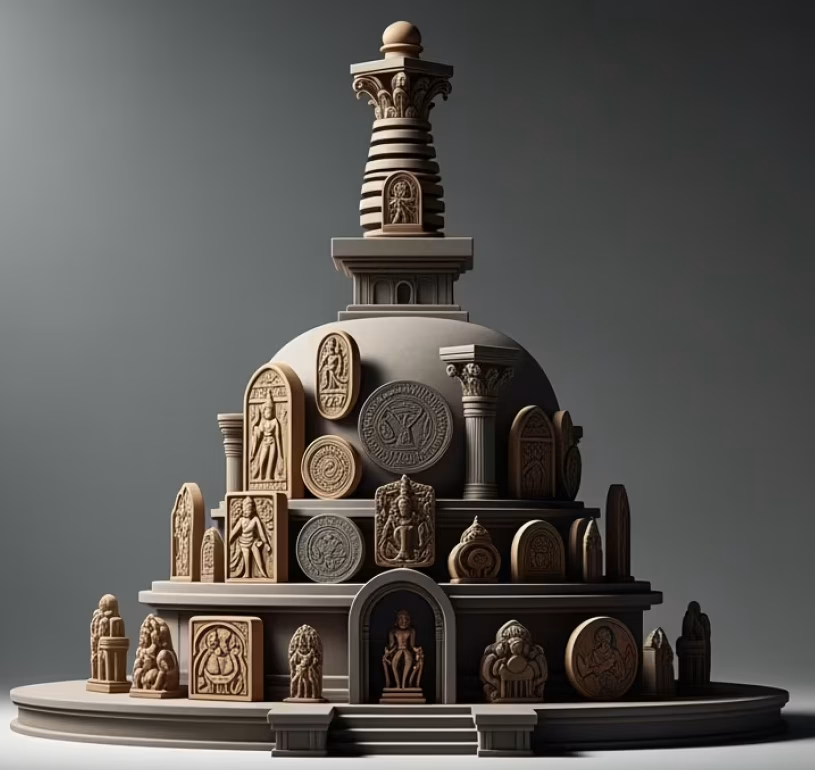
Temple Architecture and Sculpture is the single most tested area. Questions on Dravidian vs Nagara style, rock-cut caves, and specific temples like Khajuraho, Mahabalipuram, and Ellora have appeared repeatedly. UPSC often frames these as matching-type or statement-based questions.
Classical and Folk Performing Arts come next. Classical dance forms — especially their associated states, Guru-Shishya lineages, and key features — are tested almost every alternate year. Folk art forms from tribal and rural India have gained prominence since 2017.
Buddhist, Jain, and Hindu Art is another favourite. Questions on Gandhara vs Mathura school, Ajanta-Ellora paintings, and Jain architectural sites are high-probability picks. UPSC often tests whether you can distinguish between schools of art based on their features.
UNESCO World Heritage Sites in India have appeared in at least 8 out of the last 15 Prelims papers. Any newly inscribed site is almost guaranteed to be tested within two years of its inscription.
GI-tagged crafts and intangible cultural heritage have emerged as a newer trend since 2020. Questions on Pattachitra, Warli, Madhubani, and similar art forms are becoming more common.
Specific Topics I Expect for 2026
Based on what has not been asked recently and what aligns with current cultural developments, here are the areas I would prioritise if I were sitting for Prelims this year.
Hoysala Temples: The Sacred Ensembles of Hoysala were inscribed as a UNESCO World Heritage Site in 2023. UPSC has a strong tendency to ask about recent inscriptions. Expect a question on Belur, Halebidu, or Somanathapura — focusing on their architectural features like soapstone carvings and stellate plans.
Santiniketan: Inscribed in 2023 as well, Rabindranath Tagore’s vision of Santiniketan connects art, education, and nationalism. A question linking it to the Bengal School of Art or Tagore’s philosophy is highly probable.
Moidams of Ahom Dynasty: Added to the tentative UNESCO list and receiving attention, the burial mounds of the Ahom kings in Assam represent a less-explored area. UPSC loves testing Northeast India topics.
Chola Bronzes and Lost-Wax Technique: The cire perdue (lost-wax) method has been asked before, but Chola bronze iconography — particularly Nataraja — remains under-tested relative to its importance.
Miniature Painting Schools: Mughal, Rajasthani, Pahari, and Deccan schools. UPSC has asked about these sporadically. A comparative question — distinguishing features of each school — fits the current trend of analytical Prelims questions.
Indian Textile Traditions: Pashmina, Banarasi silk, Kanchipuram, Pochampally Ikat, and Chanderi have all received GI tags. With India promoting traditional textiles on global platforms, this sub-topic is ripe for testing.
How UPSC Frames Art and Culture Questions — Traps to Watch
Understanding how questions are framed is half the battle. UPSC uses several recurring patterns in Art and Culture.
The matching pair format is common. You are given a list of art forms and a list of states, and you must match them. The trick here is that UPSC often includes one correct-looking but wrong pair. Always verify each pair independently.
The “Consider the following statements” format appears frequently. Two or three statements are given, and you must identify which are correct. In Art and Culture, one statement usually contains a subtle factual error — a wrong dynasty, a wrong material, or a wrong geographical location.
The negative framing trap is another classic. A question asks “Which of the following is NOT correctly matched?” This tests precision, not general awareness. You must know exact details, not vague associations.
I always tell my students — in Art and Culture, UPSC does not reward those who have read widely. It rewards those who have read precisely. Knowing that Bharatanatyam originated in Tamil Nadu is not enough. You need to know its association with Devadasi tradition, the Natyashastra connection, and the role of Rukmini Devi Arundale in its revival.
A Smart Preparation Strategy for This Section
Do not try to memorise an entire Art and Culture book cover to cover. That approach fails every year. Instead, follow a targeted method.
First, solve every Art and Culture PYQ from 2011 to 2026. Note the exact sub-topic each question tests. You will see the pattern yourself. Second, read Nitin Singhania’s book selectively — focus on chapters that align with high-frequency zones I mentioned above. Third, make a personal table for each category. For example, create one table listing all classical dances with their state, key features, and associated instruments. Another for temple architecture comparing Nagara, Dravida, and Vesara styles.
Fourth, track UNESCO and GI tag announcements from 2024 and 2026. Any cultural development linked to India that made national news is fair game. Fifth, revise using your own notes, not the book. Your brain retains structured, self-written information far better than highlighted paragraphs.
Key Points to Remember for UPSC
- Temple architecture — Nagara (curvilinear shikhara, North India), Dravida (pyramidal vimana, South India), Vesara (hybrid, Deccan) — is the most tested Art and Culture sub-topic.
- Any UNESCO World Heritage Site inscribed in the last 3 years is high-probability for Prelims 2026.
- Gandhara art shows Greek influence and uses blue-grey schist stone; Mathura art uses spotted red sandstone and is purely indigenous in style.
- UPSC increasingly tests folk and tribal art forms — Warli (Maharashtra), Pattachitra (Odisha), Gond (Madhya Pradesh), Thangka (Sikkim).
- GI-tagged textiles and crafts are a growing trend area — know at least 10 major GI tags with their states.
- The Natyashastra by Bharata Muni is the foundational text for Indian performing arts — it defines rasa, bhava, and abhinaya.
- Always verify matching pairs independently. UPSC places one deliberately misleading pair in most Art and Culture questions.
Art and Culture is one of the few areas where focused effort over two to three weeks can reliably add 8 to 12 marks in Prelims. Start with the PYQ clusters, build your own revision tables, and stay updated on recent cultural developments. The patterns are there — you just need to follow them methodically.
Get fastest alerts on Results, Admit Cards & Govt Jobs directly on your phone.