
Every year, UPSC finds clever ways to blend science and economics into a single question — and agriculture is its favourite playground for doing so. If you understand how technology reshapes Indian farming, you unlock answers across at least three different syllabus areas in GS-III alone.
I have seen aspirants treat agricultural technology as a “current affairs” topic they can skim. That approach fails. The examiner expects you to connect a drone spraying pesticides in Telangana to food security policy, to economic growth data, and sometimes even to environmental concerns. Let me walk you through the entire landscape so you can handle any angle UPSC throws at you.

Where This Topic Sits in the UPSC Syllabus
Agricultural technology does not sit in one neat box. It cuts across multiple syllabus lines in both Prelims and Mains. Here is a clear mapping.
| Exam Stage | Paper | Syllabus Section |
|---|---|---|
| Prelims | General Studies | Science and Technology — developments and applications in everyday life |
| Mains | GS-III | Science and Technology — developments and their applications and effects in everyday life |
| Mains | GS-III | Agriculture — technology in aid of farmers |
| Mains | GS-III | Indian Economy — issues relating to planning, mobilization of resources, growth |
| Mains | GS-III | Food processing and related industries |
This topic has appeared in various forms in PYQs at least 8-10 times over the last decade. Questions range from factual Prelims MCQs on GM crops and nano-fertilizers to analytical Mains questions on how technology can double farmer income.
The Foundation — Why Indian Agriculture Needs a Technology Push
India has around 146 million operational farm holdings. Over 86% of these are small and marginal, meaning the landholding is less than 2 hectares. Traditional farming methods on such tiny plots often lead to low productivity and thin profit margins.
The average yield of rice in India is roughly 2.8 tonnes per hectare. Compare this with China at about 7 tonnes per hectare. This productivity gap is largely a technology gap. Bridging it is not optional — it is central to food security for 1.4 billion people.
The economic argument is equally strong. Agriculture contributes about 15% of India’s GDP but employs nearly 42% of the workforce. Raising productivity through technology is the only sustainable way to improve rural incomes without pulling every farmer off the land.
Key Technologies Reshaping Indian Farming
Let me break down the major technological areas that UPSC cares about. Each one connects science to economics in a testable way.
Precision Farming: This uses GPS, sensors, and data analytics to apply water, fertilizer, and pesticides in exact quantities at exact locations. Instead of flooding an entire field, a farmer irrigates only the patches that need water. The economic impact is lower input costs and higher output quality. The government’s Digital Agriculture Mission, launched with a budget of over Rs 2,800 crore, aims to build the digital infrastructure for this.
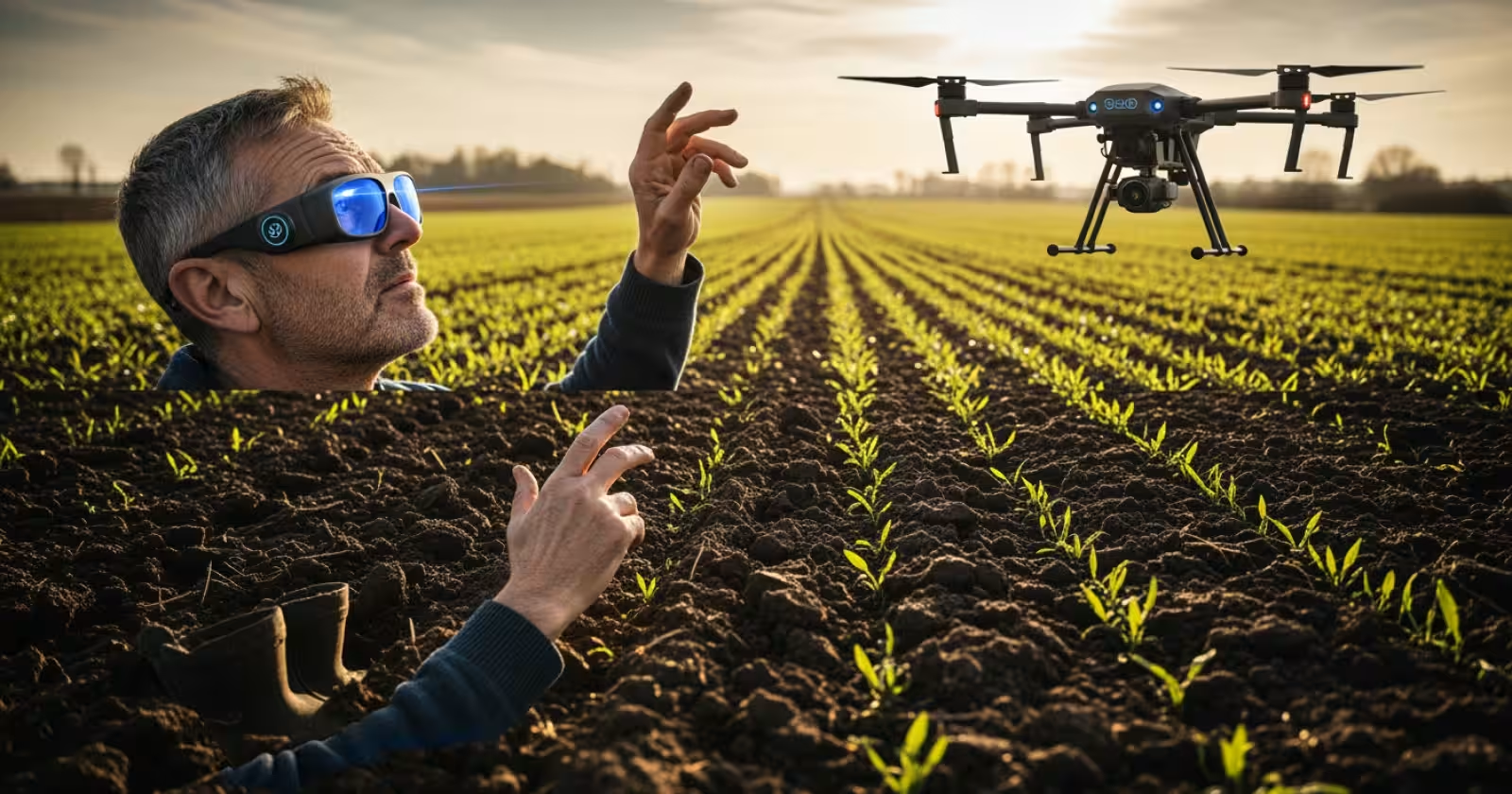
Drone Technology: The Kisan Drone initiative encourages using drones for crop health monitoring, pesticide spraying, and land mapping. Drones can spray pesticides 25-30 times faster than manual methods. DGCA regulations now allow agricultural drone operations with simplified permissions.
Biotechnology and GM Crops: Bt Cotton remains India’s only commercially approved genetically modified crop. It dramatically reduced bollworm damage and boosted cotton production. However, GM food crops like Bt Brinjal remain in regulatory limbo. The Genetic Engineering Appraisal Committee (GEAC) under the Ministry of Environment handles approvals. This is a classic UPSC question area — balancing scientific potential with environmental caution.
Nano Fertilizers: IFFCO’s nano urea and nano DAP represent a shift from bulk fertilizers to concentrated liquid versions. A 500 ml bottle of nano urea can replace a 45 kg bag of conventional urea. This reduces subsidy burden on the government, lowers soil degradation, and cuts logistics costs. UPSC has already asked about this in Prelims.
Artificial Intelligence and Big Data: AI models now predict crop diseases, estimate yields, and even advise on optimal sowing dates. The India Digital Ecosystem of Agriculture (IDEA) framework aims to create farmer-centric digital services using unique Farmer IDs linked to land records.
The Science-Economy Intersection — How UPSC Frames Questions
This is where most aspirants slip. UPSC rarely asks “What is precision farming?” directly. Instead, it frames questions at the intersection. For example, it may ask how technology adoption affects the fertilizer subsidy bill. Or how drone regulations impact small farmer access to modern tools.
When you write a Mains answer, I recommend using a simple framework. Start with the technology, explain the scientific principle briefly, then connect it to an economic outcome, and finally mention any policy dimension. This three-layer approach — science, economy, policy — is what fetches high marks in GS-III.
Consider this example structure for a question on nano fertilizers. First, explain the nanotechnology behind it — particles smaller than 100 nanometres that are absorbed more efficiently by plant stomata. Then show the economic impact — reduced subsidy burden, lower transport costs, higher nutrient-use efficiency. Finally, mention the policy angle — IFFCO’s role, government promotion, and the challenge of farmer awareness in remote areas.
Challenges and Criticisms — The Balanced View UPSC Expects
No technology answer is complete without discussing limitations. Here are the real challenges.
- Digital divide: Only about 31% of rural India has reliable internet access. Precision farming tools need connectivity that many villages lack.
- Cost barriers: A single agricultural drone costs Rs 5-10 lakh. Small farmers cannot afford this without subsidies or cooperative models.
- Skill gap: Operating GPS-guided equipment or interpreting AI-based advisories requires training that most farmers have not received.
- Regulatory delays: GM crop approvals take years due to biosafety concerns. This stalls research and commercial adoption.
- Data privacy: Farmer data collected through digital platforms raises concerns about misuse by corporations or agencies.
When writing Mains answers, mentioning two or three of these challenges shows the examiner that you think beyond surface-level enthusiasm about technology.
Government Schemes and Institutional Framework
UPSC frequently links technology questions to government initiatives. Keep these in your notes.
The Sub-Mission on Agricultural Mechanization (SMAM) provides subsidies for purchasing modern equipment. The National Mission on Sustainable Agriculture promotes climate-smart technologies. ICAR — the Indian Council of Agricultural Research — develops and tests new agricultural technologies through its network of Krishi Vigyan Kendras across the country.
NABARD finances technology adoption in rural areas through refinancing schemes for banks. The e-NAM platform uses technology to connect agricultural markets digitally, though its actual adoption remains uneven across states.
Key Points to Remember for UPSC
- Agricultural technology in UPSC spans three GS-III syllabus lines — science, agriculture, and economy. Prepare it as a cross-cutting theme, not an isolated topic.
- India’s 86% small and marginal farmer base makes technology affordability and accessibility the central policy challenge.
- Nano urea reduces both fertilizer subsidy burden and soil degradation — a point that connects fiscal policy to environmental science.
- Bt Cotton is India’s only approved GM crop. GEAC under MoEFCC is the regulatory body. GM food crops remain unapproved.
- The Digital Agriculture Mission and IDEA framework are the latest government pushes — expect questions on these in 2026.
- Always present a balanced view in Mains: technology potential plus adoption challenges plus equity concerns.
- Drone regulations by DGCA and the Kisan Drone scheme are high-probability Prelims areas for factual questions.
Understanding agricultural technology as a connected web — rather than isolated facts — will serve you well across multiple questions in a single Mains paper. I suggest making a one-page mind map linking each technology to its economic impact, relevant scheme, and potential criticism. That single page can power answers for three to four different question types. Start building that map today, and revise it once every two weeks as new developments emerge.