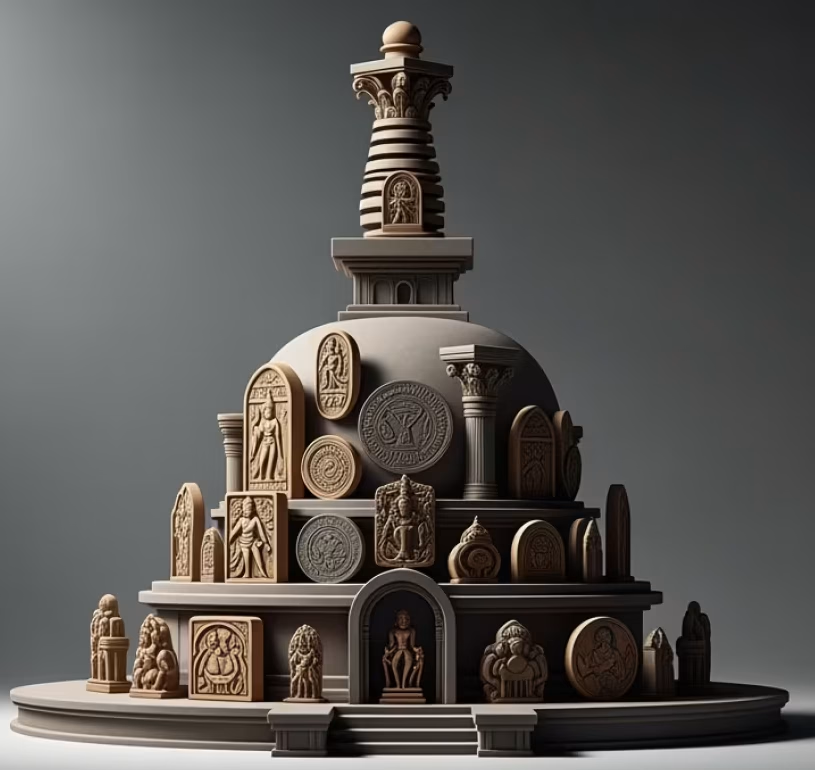

Every year, at least one or two questions in UPSC Prelims come from Indian temple architecture — and most aspirants lose marks simply because they confuse the three main styles. I spent years teaching Art and Culture to IAS aspirants, and I can tell you that once you understand the underlying classification logic, these questions become almost effortless.
This piece gives you a complete framework for understanding Indian temple styles. I will walk you through the Nagara, Dravida, and Vesara traditions — their origins, features, differences, and the exact examples UPSC loves to test.
Where This Sits in the UPSC Syllabus
Temple architecture falls under GS Paper-I (Mains) in the section on Indian culture covering salient aspects of Art Forms, Literature, and Architecture from ancient to modern times. In Prelims, it appears under Indian Heritage and Culture. UPSC has asked direct questions on this topic at least 8-10 times in the last 15 years. Related syllabus topics include sculpture traditions, rock-cut architecture, and the cultural contributions of various dynasties.
The Three-Style Framework You Must Know
Indian temple architecture is broadly classified into three styles based on geography and the shape of the main tower (called the Shikhara or Vimana). The three styles are Nagara (North Indian), Dravida (South Indian), and Vesara (a hybrid found in the Deccan region). Think of it like this — if the Vindhyas are your dividing line, Nagara dominates the north, Dravida rules the south, and Vesara sits right in between.
This geographic division is a simplification, but it works perfectly for UPSC. Let me break down each style.
Nagara Style — The Curving Towers of the North
The Nagara style developed across North India from roughly the 5th century CE onward. Its most recognizable feature is the curvilinear Shikhara — a tower that curves inward as it rises, like a beehive or a mountain peak. Nagara temples typically do not have elaborate boundary walls or entrance gateways. The temple sits on a raised platform called a Jagati.
The ground plan is usually square with projections on the sides, giving it a cruciform shape. The main hall for worshippers is called the Mandapa, and the inner sanctum where the deity resides is the Garbhagriha. Over the Garbhagriha sits the Shikhara. One key point UPSC tests — Nagara temples generally lack the large Gopuram (gateway tower) that defines South Indian temples.
Sub-types of the Nagara Shikhara include Latina (a single curving tower), Phamsana (a broader, shorter tower with straight edges), and Valabhi (with a rectangular roof). The Kandariya Mahadeva Temple at Khajuraho and the Sun Temple at Konark are classic Nagara examples you should remember.
Dravida Style — The Pyramidal Precision of the South
The Dravida style flourished in Tamil Nadu, Karnataka, and Andhra Pradesh. Its defining feature is the pyramidal Vimana — a stepped tower that rises in clearly defined horizontal tiers called Talas. Unlike the curving Nagara Shikhara, the Dravida Vimana has straight edges and a systematic, layered look.
Dravida temples are typically enclosed within a compound wall. The entrance is marked by towering Gopurams — massive gateway structures that often dwarf the main Vimana itself. This is the opposite of Nagara temples, where the main tower is the tallest structure. A water tank or temple tank is usually present inside the compound.
The Brihadeshwara Temple at Thanjavur, built by Chola king Rajaraja I, is the finest example. The Shore Temple at Mahabalipuram (Pallava period) is another frequently tested example. Remember that Pallava, Chola, Pandya, and later Vijayanagara dynasties all contributed to the evolution of this style.
Vesara Style — The Deccan Hybrid
The Vesara style is sometimes called the Chalukyan style or the Deccan style. It blends elements of both Nagara and Dravida traditions. The Chalukyas of Badami, the Rashtrakutas, and the Hoysalas were its chief patrons. Geographically, it dominated present-day Karnataka and parts of Maharashtra.
Vesara temples often have a Dravida-style plan at the base but a Nagara-style superstructure. The Hoysala temples at Belur and Halebidu are textbook Vesara examples. They are famous for their star-shaped platforms and incredibly detailed sculptural work. The Durga Temple at Aihole, with its apsidal (semi-circular) plan, is another important example UPSC has tested.
Quick Comparison Table
| Feature | Nagara (North) | Dravida (South) | Vesara (Deccan) |
|---|---|---|---|
| Tower Shape | Curvilinear Shikhara | Pyramidal Vimana | Mix of both |
| Gopuram (Gateway) | Absent or small | Tall, dominant | Varies |
| Compound Wall | Usually absent | Present, elaborate | Sometimes present |
| Base Platform | Jagati (raised) | Upapitha | Star-shaped (Hoysala) |
| Key Patrons | Chandellas, Solankis | Pallavas, Cholas | Chalukyas, Hoysalas |
| Famous Example | Kandariya Mahadeva | Brihadeshwara | Hoysaleshwara |
Previous Year UPSC Questions on This Topic
Q1. With reference to the difference between the culture of Rigvedic Aryans and Indus Valley people, which of the following is/are correct? (UPSC Prelims 2017) — While this question focused on cultural differences, UPSC often pairs architecture identification with civilizational context. The underlying testing pattern is your ability to distinguish features of different traditions, exactly the skill temple classification builds.
Q2. Consider the following: 1.935 CE — Rajaraja Chola builds Brihadeshwara 2. Nagara temples lack Gopurams 3. Vesara is associated with Hoysalas. Which of the above statements is/are correct? Variations of this appear frequently. Statement 2 and 3 are correct. Rajaraja began construction around 1003 CE, not 935 CE — this is a classic UPSC trap. Always verify dates for Chola temples.
Q3. (Mains GS-I) Discuss the salient features of the Nagara and Dravida styles of temple architecture. How did the Vesara style emerge as a synthesis of both? (15 marks) For this answer, I advise my students to draw a simple comparison table, describe each style with two specific temple examples, and end with how the Chalukyas geographically and artistically bridged the two traditions. Keep the answer under 250 words with clear paragraphs.
Key Points to Remember for UPSC
- Nagara = curvilinear tower, no Gopuram, raised platform (Jagati), found north of the Vindhyas.
- Dravida = pyramidal stepped tower (Vimana), tall Gopurams, compound wall with temple tank, found south of Krishna river.
- Vesara = hybrid style, patronised by Chalukyas, Rashtrakutas, and Hoysalas in the Deccan belt.
- In Dravida temples, the Gopuram is often taller than the main Vimana — this is a frequently tested fact.
- Hoysala temples are known for star-shaped platforms and soapstone carvings — not granite like Chola temples.
- Aihole is called the “cradle of Indian temple architecture” because early experimental forms of all three styles are found there.
- The Latina, Phamsana, and Valabhi are sub-types of the Nagara Shikhara — not separate styles.
Understanding these three styles gives you a reliable mental map for answering any temple-related question UPSC throws at you. As a next step, I recommend picking up photographs of five temples from each style and practising identification — visual memory sticks far better than text alone. Build this habit now, and Art and Culture will consistently give you easy marks in 2026 and beyond.