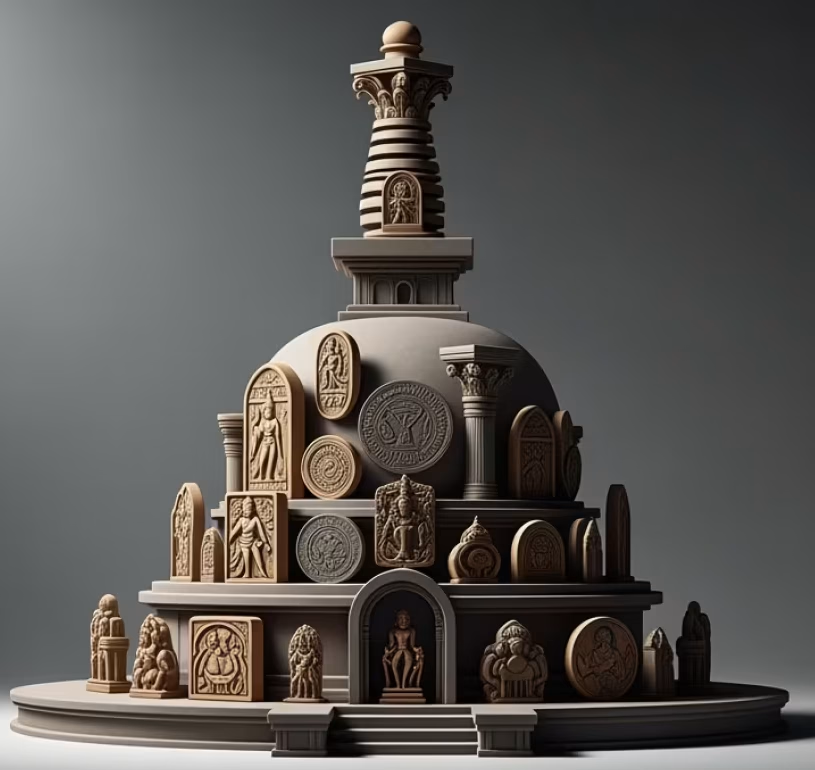
Every single year, at least one or two questions on heritage sites quietly appear in the UPSC Preliminary exam — and most aspirants realise the pattern only after losing marks. I have spent years tracking these questions, and the patterns are sharper than you might expect. Let me walk you through exactly what UPSC tests, how it frames questions, and which sites you should prioritise for 2026.
Where This Topic Sits in the UPSC Syllabus
UNESCO World Heritage Sites fall under multiple papers. In Prelims, they appear under Art and Culture and also under Environment and Biodiversity (for Natural Sites). In Mains, they connect to GS Paper I under Indian Culture — salient aspects of Art Forms, Literature, and Architecture from ancient to modern times. Occasionally, GS Paper III picks up natural and mixed sites under Environment and Conservation.
| Exam Stage | Paper | Syllabus Section |
|---|---|---|
| Prelims | General Studies | Indian Heritage and Culture; Environment and Ecology |
| Mains | GS-I | Indian Culture — Art Forms, Architecture, Literature |
| Mains | GS-III | Conservation, Environmental Pollution and Degradation |
Since 2015, I have counted at least 18 direct or indirect questions on heritage sites across Prelims papers. The frequency has increased after 2019, coinciding with India’s aggressive push for new nominations.
How India’s World Heritage List Has Grown
India currently has 43 UNESCO World Heritage Sites as of 2026 — 35 Cultural, 7 Natural, and 1 Mixed. This makes India the sixth-largest holder of World Heritage Sites globally. The journey started in 1983, when the first batch of sites was inscribed: Agra Fort, Ajanta Caves, Ellora Caves, and Taj Mahal were among them.
The most recent additions include Santiniketan (inscribed in 2023) and the Sacred Ensembles of the Hoysala (inscribed in 2024). For 2026, aspirants should watch India’s Tentative List closely — sites like Nalanda Mahavihara’s extension and proposals from the Northeast are under active consideration.
Understanding the nomination process matters. A country first places a site on its Tentative List. Then it prepares a detailed dossier. ICOMOS (International Council on Monuments and Sites) evaluates cultural nominations, while IUCN (International Union for Conservation of Nature) evaluates natural ones. The final decision rests with the World Heritage Committee, which meets annually.
The Clear Patterns UPSC Follows
After analysing questions from 2010 to 2026, I have identified five distinct patterns that UPSC uses when testing this topic.
Pattern 1 — Matching Sites with States or Features. UPSC loves giving you a list of 3-4 sites and asking you to match them with their correct states, dynasties, or geographical features. The 2015 Prelims question on cultural sites and their locations is a classic example. The trick here is that UPSC often includes one lesser-known site to eliminate guesswork.
Pattern 2 — Testing Recently Inscribed Sites. Any site inscribed in the 2-3 years before the exam is a high-probability question. When Jaipur was inscribed in 2019, a related question appeared in 2020 Prelims. When Dholavira was inscribed in 2021, it appeared in 2022. Expect questions on Santiniketan and Hoysala temples in 2026.
Pattern 3 — Natural Sites Mixed with Environment Questions. UPSC does not always label a question as “heritage.” It might ask about the Western Ghats in an ecology context, or about Kaziranga within a biodiversity hotspot question. You need to know both the ecological significance and the heritage status.
Pattern 4 — Criteria-Based Questions. UNESCO uses 10 selection criteria (6 cultural, 4 natural). UPSC has tested whether students understand what makes a site qualify. For instance, a site can be inscribed for “outstanding universal value” — and UPSC might test what that phrase actually means.
Pattern 5 — Statements-Based Elimination. The most common format is three statements about a site, and you must identify which are correct. These statements typically mix factual details (dynasty, location, architectural style) with one subtly wrong claim.
High-Priority Sites for 2026
Based on patterns, here are the sites I would focus on most if I were sitting for the exam this year. These are either recently inscribed, frequently tested, or connected to current developments.
Santiniketan — Inscribed in 2023 as a cultural site. Built by Rabindranath Tagore, it represents a unique model of a residential school and university rooted in ancient Indian traditions. UPSC can link this to questions on Indian education reform, the Bengal Renaissance, or Tagore’s philosophy.
Sacred Ensembles of the Hoysala — The three Hoysala temples at Belur, Halebidu, and Somanathapur were inscribed in 2024. The Hoysala dynasty ruled parts of present-day Karnataka. Their temples are known for intricate soapstone carvings and stellate (star-shaped) plans. Expect a match-the-following or statement-based question.
Dholavira — An Indus Valley Civilisation site in Gujarat’s Rann of Kutch. Inscribed in 2021, it is notable for its sophisticated water management system and its unique signboard with Harappan script. UPSC can combine this with questions on ancient Indian urban planning.
Ramappa Temple — Inscribed in 2021, this Kakatiya-era temple in Telangana features floating bricks and intricate carvings. Its engineering innovation makes it a favourite for UPSC question-setters.
Western Ghats and Sundarbans — These natural sites appear repeatedly because they connect to biodiversity, climate change, and conservation — all high-priority GS-III topics.
Previous Year UPSC Questions on This Topic
Q1. With reference to the cultural history of India, consider the following statements: 1) The__(site)__ was built by the Kakatiya dynasty. 2) It features floating bricks made of specific materials. Which of the statements given above is/are correct?
(UPSC Prelims 2022 — GS Paper I)
Answer: Both statements are correct. The Ramappa Temple (Rudreshwara Temple) was commissioned by a Kakatiya general in the 13th century. Its bricks are made from a mixture that makes them light enough to float on water. UPSC tested this because it was inscribed just one year before the exam — confirming the “recently inscribed” pattern.
Q2.935. Which of the following is/are among the UNESCO World Heritage Sites? 1)935 Khangchendzonga National Park 2) Sundarbans National Park. Select the correct answer.
(UPSC Prelims 2020 — GS Paper I)
Answer: Both are UNESCO World Heritage Sites. Khangchendzonga is India’s only Mixed heritage site (both natural and cultural criteria). Sundarbans is a natural site. The question tested whether aspirants knew the heritage status of national parks — blending environment with culture.
Q3. Discuss the significance of textile traditions of India with reference to UNESCO’s Intangible Cultural Heritage list. How do they reflect India’s cultural diversity?
(UPSC Mains 2023 — GS Paper I, 15 marks)
Model Answer Approach: This question expanded the heritage concept beyond monuments. A strong answer would cover specific inscribed traditions like Kumbh Mela and Yoga, then connect textile traditions (though not all are inscribed) to regional identities, trade history, and artisan communities. The examiner wanted depth on how intangible heritage reflects social diversity — not just a list of sites.
Key Points to Remember for UPSC
- India has 43 UNESCO World Heritage Sites — 35 Cultural, 7 Natural, 1 Mixed (Khangchendzonga).
- The World Heritage Convention was adopted in 1972. India ratified it in 1977.
- ICOMOS evaluates cultural nominations; IUCN evaluates natural ones.
- Recently inscribed sites (last 2-3 years) have the highest probability of appearing in Prelims.
- Natural heritage sites often appear disguised as environment or biodiversity questions in GS-III.
- India’s Tentative List currently has over 50 entries — questions sometimes come from this list too.
- Know at least the state, dynasty/period, and one unique feature for each of the 43 sites.
- Dholavira and Ramappa Temple are strong candidates for 2026 repeat or linked questions.
Your Next Step
The most effective way to prepare this topic is to make a single-page chart of all 43 sites with four columns: Name, State, Type (Cultural/Natural/Mixed), and One Key Fact. Stick it on your wall and revise it weekly. Combine this with a quick scan of India’s Tentative List from the UNESCO website. This topic rewards memory — and memory rewards repetition. Spend 30 minutes this week building that chart, and you will have a lasting edge in Prelims.