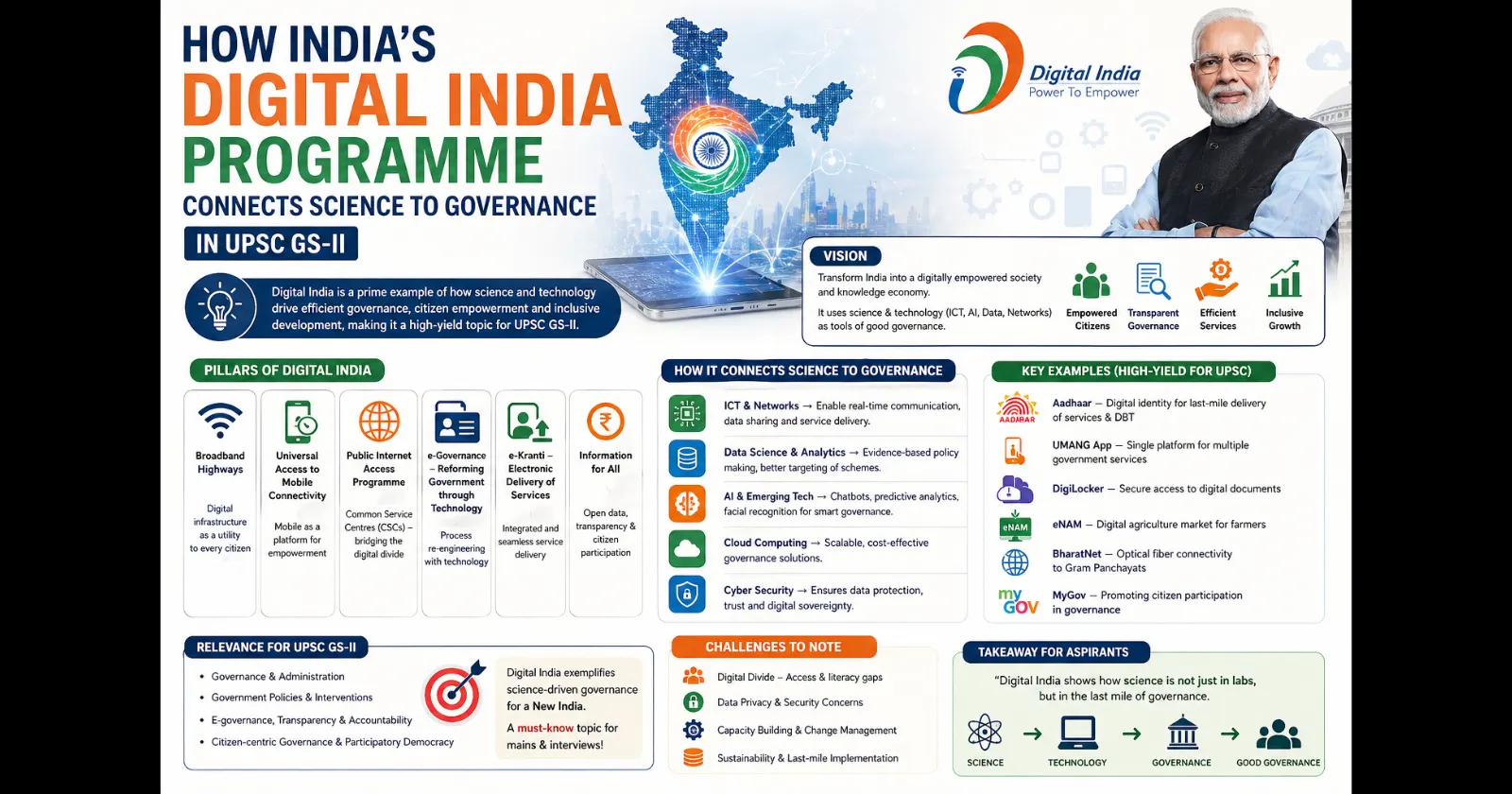
How India’s Digital India Programme Connects Science to Governance in UPSC GS-II

How India's Digital India Programme Connects Science to Governance in UPSC GS-II

Technology is no longer just about gadgets and apps. For UPSC aspirants, it has become a bridge between how governments function and how citizens experience that functioning. The Digital India Programme sits right at this intersection, and understanding it deeply can help you answer questions across multiple dimensions of GS-II. Where This Topic Sits in … Read more

The India Space Programme Milestones That UPSC Has Tested Across 10 Years of Papers

The India Space Programme Milestones That UPSC Has Tested Across 10 Years of Papers

If there is one science and technology topic UPSC loves to revisit, it is India’s space programme. Between 2014 and 2024, questions on ISRO missions, satellite types, and launch vehicles have appeared in almost every single Prelims paper. I have tracked these patterns closely, and the insights are genuinely useful for anyone preparing in 2026. … Read more

The Environmental Law Cases in India That UPSC Uses as Analytical Question Springboards

The Environmental Law Cases in India That UPSC Uses as Analytical Question Springboards

If you have ever read a UPSC Mains GS-III answer on environment and felt it lacked depth, chances are it was missing one thing — landmark case law. The UPSC examiner does not directly ask you to cite Supreme Court judgments, but the aspirants who score highest almost always weave them into their analytical answers. … Read more

The Wildlife Protection Act Provisions That UPSC Prelims Tests in Specifically Detailed Ways

The Wildlife Protection Act Provisions That UPSC Prelims Tests in Specifically Detailed Ways

Every year, at least one or two questions in UPSC Prelims quietly test your knowledge of a single law — and most aspirants lose marks here because they studied it only at the surface level. The Wildlife Protection Act, 1972, is one of those laws where the examiner goes deep into specific provisions, schedules, and … Read more

The Make in India and PLI Scheme Questions — How UPSC Tests Their Impact and Challenges

The Make in India and PLI Scheme Questions — How UPSC Tests Their Impact and Challenges

Two flagship industrial policies have reshaped how India thinks about manufacturing — and UPSC has taken notice. Over the past six years, the examiner has repeatedly tested aspirants on the logic, outcomes, and limitations behind these schemes. If you understand the economic reasoning, answering these questions becomes straightforward. Where This Topic Sits in the UPSC … Read more

The Tax Structure of India That UPSC Has Tested Across 6 Different Angle Types

The Tax Structure of India That UPSC Has Tested Across 6 Different Angle Types

Most aspirants study taxation as a single chapter in Economy. But if you look at past UPSC papers carefully, you will notice something interesting — the Commission does not ask about taxes from just one direction. I have tracked at least six distinct angles from which tax-related questions appear, spanning Prelims, GS-III Mains, and even … Read more

How Economic History Under British India Connects to Present-Day Policy in UPSC Questions

How Economic History Under British India Connects to Present-Day Policy in UPSC Questions

Most UPSC aspirants study British economic policies and modern Indian economic reforms in separate chapters. But the examiner increasingly wants you to draw a straight line between the two — and that is where marks are won or lost. Understanding colonial economic exploitation is not just about history. It directly shapes how we think about … Read more

The 5 Geographic Regions of India Every Aspirant Needs to Know in Detail for UPSC

The 5 Geographic Regions of India Every Aspirant Needs to Know in Detail for UPSC

India’s physical geography is not just about memorising mountain names and river origins. It shapes our monsoons, decides our agriculture, influences our defence strategy, and even determines where our industries are located. If you understand India’s landforms well, you unlock answers across multiple UPSC papers — from Geography to Economy to Internal Security. I have … Read more

The Disaster Geography of India That Connects GS-I Physical to GS-III Disaster Management

The Disaster Geography of India That Connects GS-I Physical to GS-III Disaster Management

Most UPSC aspirants study physical geography and disaster management as two separate chapters. That is a mistake I see students make every single year. The tectonic plates that shape India’s mountains are the same forces that trigger its earthquakes. The monsoon winds that define its climate zones are the same systems that cause its floods. … Read more

How Rainfall Patterns of India Connect Geography to Agriculture in UPSC GS-III

How Rainfall Patterns of India Connect Geography to Agriculture in UPSC GS-III

Every grain of rice on your plate has a direct connection to a cloud that formed over the Arabian Sea months ago. Understanding this chain — from moisture-laden winds to harvested crops — is one of the most rewarding exercises for any UPSC aspirant preparing GS-III. I have seen students study rainfall and agriculture as … Read more