How India’s Digital India Programme Connects Science to Governance in UPSC GS-II
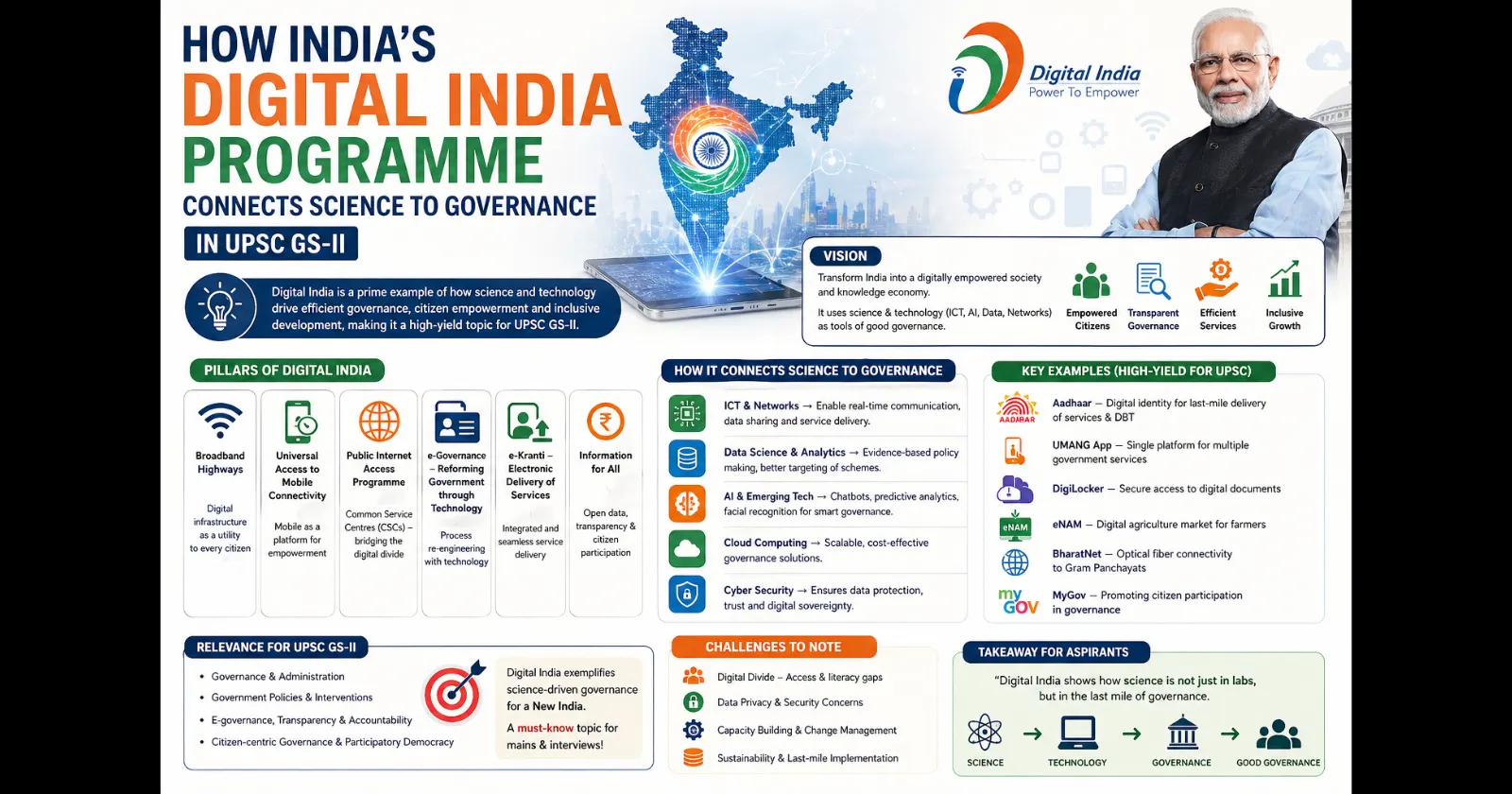
How India's Digital India Programme Connects Science to Governance in UPSC GS-II

Technology is no longer just about gadgets and apps. For UPSC aspirants, it has become a bridge between how governments function and how citizens experience that functioning. The Digital India Programme sits right at this intersection, and understanding it deeply can help you answer questions across multiple dimensions of GS-II. Where This Topic Sits in … Read more


The Defence Technology Indigenisation Chapter That Connects Science to Security in UPSC

The Defence Technology Indigenisation Chapter That Connects Science to Security in UPSC

India spent over ₹6.2 lakh crore on defence in 2026-26, and a growing share of that money now stays within the country. For UPSC aspirants, this single shift — from importing weapons to building them at home — connects two massive GS-III themes that examiners love to test together. I have seen this topic appear … Read more

How India’s Nuclear Policy Connects Science, Security, and International Relations in UPSC

How India's Nuclear Policy Connects Science, Security, and International Relations in UPSC

Few topics in the UPSC syllabus cut across three General Studies papers the way India’s nuclear policy does. If you understand this one subject well, you can answer questions in science and technology, internal security, and international relations — all from a single knowledge base. I have seen aspirants treat nuclear policy as a “current … Read more

Why India’s Himalayan Ecology Chapter Connects Geography, Environment, and Policy in UPSC

Why India's Himalayan Ecology Chapter Connects Geography, Environment, and Policy in UPSC

Few topics in the UPSC syllabus sit at the crossroads of three General Studies papers the way the Himalayas do. If you understand Himalayan ecology well, you are simultaneously preparing for physical geography, environmental conservation, and governance — and that is a rare advantage in this exam. I have seen aspirants treat the Himalayas as … Read more

How Economic History Under British India Connects to Present-Day Policy in UPSC Questions

How Economic History Under British India Connects to Present-Day Policy in UPSC Questions

Most UPSC aspirants study British economic policies and modern Indian economic reforms in separate chapters. But the examiner increasingly wants you to draw a straight line between the two — and that is where marks are won or lost. Understanding colonial economic exploitation is not just about history. It directly shapes how we think about … Read more

How Land Reform History Connects Ancient Agrarian Economy to UPSC GS-III Policy Today

How Land Reform History Connects Ancient Agrarian Economy to UPSC GS-III Policy Today

From the Mauryan Empire’s careful revenue collection to the heated debates in India’s first Parliament about abolishing zamindari, land has always been at the heart of Indian governance. If you are preparing for UPSC, understanding this long arc of land policy is not optional — it is the backbone of several GS-III questions on agriculture, … Read more

How Monsoon Variability Connects Geography to Agriculture, Economy, and Policy in UPSC

How Monsoon Variability Connects Geography to Agriculture, Economy, and Policy in UPSC

Every year, nearly 60% of India’s net sown area depends entirely on rainfall — and that rainfall is dictated by one powerful system: the monsoon. If you are preparing for UPSC in 2026, understanding monsoon variability is not optional — it is the thread that ties your Geography, Economy, Agriculture, and Governance answers together. I … Read more

The Disaster Geography of India That Connects GS-I Physical to GS-III Disaster Management

The Disaster Geography of India That Connects GS-I Physical to GS-III Disaster Management

Most UPSC aspirants study physical geography and disaster management as two separate chapters. That is a mistake I see students make every single year. The tectonic plates that shape India’s mountains are the same forces that trigger its earthquakes. The monsoon winds that define its climate zones are the same systems that cause its floods. … Read more

The World Geography That Connects to India’s Foreign Policy in UPSC GS-II Questions

The World Geography That Connects to India's Foreign Policy in UPSC GS-II Questions

Every year, UPSC asks foreign policy questions that cannot be answered without a solid grip on world geography. If you think GS-II is only about schemes, governance, and the Constitution, you are missing a huge scoring area — the intersection of maps and diplomacy. I have seen hundreds of aspirants struggle with questions on the … Read more

How India’s Major Port Geography Connects to Both Trade Policy and Security in UPSC

How India's Major Port Geography Connects to Both Trade Policy and Security in UPSC

India has a coastline stretching over 7,500 kilometres, and yet most UPSC aspirants study ports as isolated geography facts. The real exam edge comes when you connect port locations to India’s trade routes, foreign policy, and maritime security — because that is exactly how UPSC frames its questions across multiple papers. I have seen aspirants … Read more