
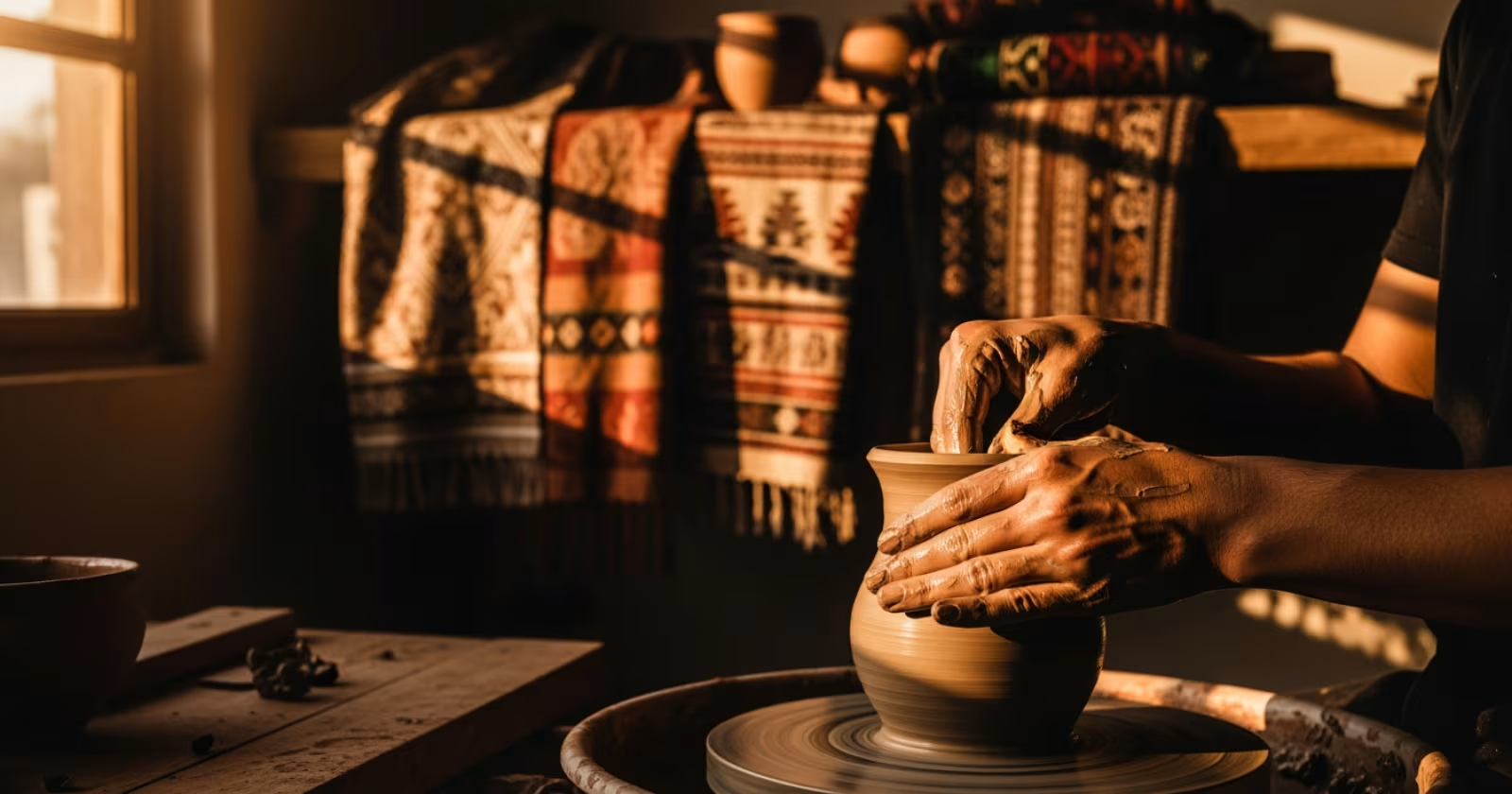
If you have ever wondered why a single topic keeps appearing across Prelims, GS-I, and GS-III in different avatars, Geographical Indications is your answer. I have seen aspirants treat GI tags as a simple current affairs fact, memorise a few names, and move on — only to lose marks when UPSC frames the same concept as an economy or trade question.
Where This Topic Sits in the UPSC Syllabus
This is one of those rare topics that cuts across multiple papers. UPSC loves it precisely because it tests whether you can connect dots between culture and economics. Let me map it out clearly for you.
| Exam Stage | Paper | Syllabus Section |
|---|---|---|
| Prelims | General Studies | Indian Culture, Economy — IPR and Trade |
| Mains | GS-I | Indian Culture — Art Forms, Salient Features |
| Mains | GS-III | Indian Economy — IPR, Inclusive Growth, Industrial Policy |
| Mains | GS-II | International Relations — WTO and TRIPS |
In Prelims, UPSC has asked direct factual questions about specific GI-tagged products. In Mains, the examiner shifts gear and asks you to analyse the economic impact of GI protection on rural livelihoods or tribal art. Between 2015 and 2026, GI-related questions have appeared at least 6 to 8 times in various forms.
What Exactly Is a Geographical Indication
A Geographical Indication (GI) is a sign or tag given to products that originate from a specific geographical region. The product must have qualities, reputation, or characteristics that are essentially linked to that place. Think of Darjeeling Tea — its flavour comes from the unique soil, altitude, and climate of the Darjeeling hills. No other region can replicate it exactly.
In India, GI tags are governed by the Geographical Indications of Goods (Registration and Protection) Act, 1999. The GI Registry is located in Chennai under the Controller General of Patents, Designs, and Trademarks. India enacted this law to comply with its obligations under the TRIPS Agreement of the WTO, which came into effect in 1995.
A GI tag does not grant ownership to a single person. It belongs to the community of producers in that region. This is a point UPSC loves to test — GI is a collective intellectual property right, not an individual one.
Why UPSC Connects GI Tags to Art and Culture
India had over 600 registered GI products by early 2026. A large number of these are traditional handicrafts, textiles, and food products rooted in centuries of cultural practice. When UPSC asks about Pochampally Ikat or Madhubani paintings or Thanjavur paintings, they are testing your knowledge of Indian art. But the moment the question frame shifts to “how does GI protection help artisan communities,” you are in GS-III territory.
I always tell my students to study GI products in pairs — know the cultural story and the economic angle. For example, Banarasi Sarees represent the weaving tradition of Varanasi (GS-I, Art and Culture). But the GI tag protects weavers from cheap machine-made imitations flooding the market (GS-III, Economy). One product, two papers.
The Economic Logic Behind GI Protection
GI tags serve several economic purposes that UPSC expects you to understand. First, they act as a market differentiation tool. A GI-tagged Alphonso Mango from Ratnagiri commands a higher price than a generic mango. This price premium directly benefits small and marginal farmers.
Second, GI protection prevents misappropriation. Before Darjeeling Tea received its GI tag, tea from other regions was being sold under the Darjeeling name internationally. The GI tag gave legal tools to fight this.
Third, GI tags promote rural and semi-urban economies. Products like Tirupathi Laddu, Kangra Tea, and Mysore Silk generate livelihoods for thousands of families. UPSC has increasingly focused on inclusive growth and rural livelihoods — GI fits perfectly into this theme.
Fourth, there is an export promotion angle. GI-tagged products have a recognised identity in international markets. The government has been pushing GI products under initiatives like the One District One Product (ODOP) scheme, linking them to Districts as Export Hubs.
How UPSC Frames These Questions — Patterns I Have Noticed
In Prelims, you will see straightforward match-the-following questions. UPSC gives you a list of products and states and asks you to pair them correctly. They also test whether a product is a GI or not, or whether a particular statement about GI law is true or false.
In Mains, the framing changes dramatically. A GS-I question might ask you to discuss the intangible cultural heritage of a region and its preservation — GI tags become part of your answer. A GS-III question might ask about intellectual property rights and their role in India’s economic growth. Here, GI is one of the tools you discuss alongside patents and trademarks.
I have also seen UPSC use GI in the context of international trade disputes. The EU and India have had different positions on GI protection under WTO negotiations. The EU wants stronger GI protection globally, while some countries prefer trademark-based systems. This is a GS-II International Relations angle.
Common GI Products Every Aspirant Must Know
You do not need to memorise all 600+ GI products. Focus on those that are frequently in news or represent major cultural traditions. Here are categories I recommend studying:
- Textiles: Banarasi Sarees (UP), Pochampally Ikat (Telangana), Kancheepuram Silk (Tamil Nadu), Pashmina (J&K), Chanderi Fabric (MP)
- Handicrafts: Bidriware (Karnataka), Blue Pottery of Jaipur (Rajasthan), Aranmula Kannadi (Kerala)
- Agricultural Products: Darjeeling Tea (West Bengal), Mahabaleshwar Strawberry (Maharashtra), Banaganapalle Mangoes (Andhra Pradesh), Kashmir Saffron (J&K)
- Food Items: Tirupathi Laddu (Andhra Pradesh), Ratlami Sev (MP), Hyderabad Haleem (Telangana)
When you revise, group them by state and by type. This helps you answer both factual Prelims questions and descriptive Mains answers about a state’s cultural economy.
Limitations and Challenges — The Critical Angle
UPSC rewards balanced answers. GI protection in India faces real challenges. Many artisan communities are unaware that their product has a GI tag or how to use it commercially. The enforcement mechanism is weak — obtaining a GI tag is one thing, but stopping counterfeits in local markets is another.
There is also an inter-state dispute dimension. The Rosogolla dispute between West Bengal and Odisha is a well-known example. Both states claimed the sweet as their own. Such disputes reveal the complexity of assigning geographical origin to products with shared cultural roots.
Additionally, the economic benefits of GI tags have not reached the grassroots uniformly. Studies have shown that middlemen often capture the price premium while primary producers see minimal gains. This is a point worth raising in any Mains answer on rural economy or inclusive growth.
Key Points to Remember for UPSC
- GI is a collective community right, not an individual intellectual property right — this distinction is frequently tested.
- The GI Act 1999 was enacted to comply with India’s obligations under the TRIPS Agreement of WTO.
- GI Registry is in Chennai, and registration is valid for 10 years, renewable indefinitely.
- Darjeeling Tea was India’s first registered GI product (2004).
- GI tags bridge Art and Culture (GS-I) with Economy (GS-III) — always prepare both dimensions together.
- The ODOP scheme and export promotion policies are actively linking GI products to India’s trade strategy.
- Enforcement and awareness at the grassroots level remain the biggest challenges in India’s GI framework.
Understanding how a single concept spans multiple UPSC papers gives you a real advantage in both Prelims and Mains. I would suggest making a consolidated chart of 30 to 40 major GI products, grouped by state and type, and revising it once every two months. This small habit will help you handle surprise questions with confidence — and it builds the kind of interdisciplinary thinking that UPSC consistently rewards.
Get fastest alerts on Results, Admit Cards & Govt Jobs directly on your phone.