
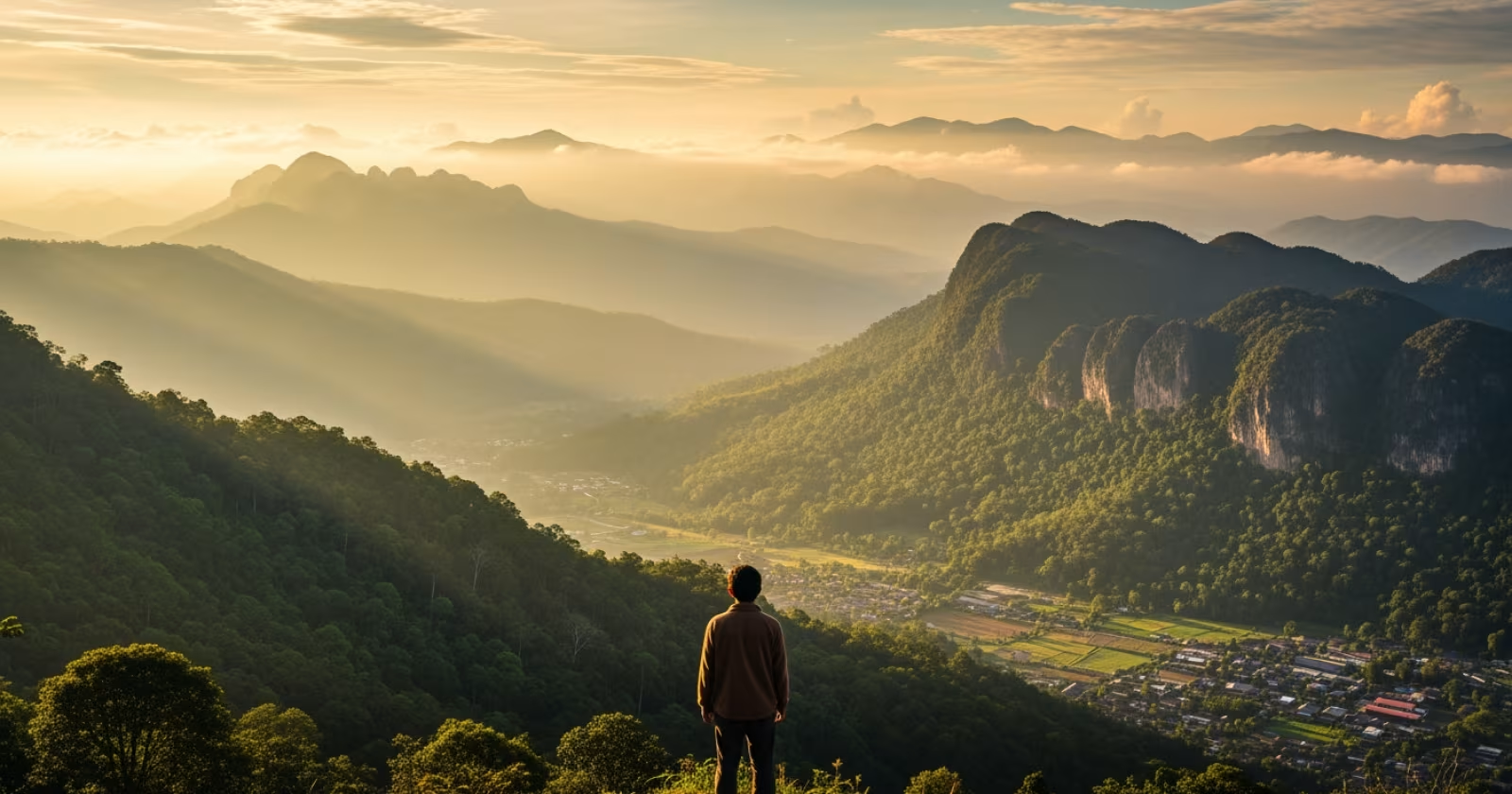
Few topics in the UPSC syllabus cut across as many papers as the Western Ghats do. I have seen aspirants treat this as a “Geography-only” chapter and then struggle when it appears in an Environment question or a Culture-linked essay. Let me walk you through every dimension of this topic so you never face that surprise.
Where This Topic Sits in the UPSC Syllabus
The Western Ghats are not confined to one paper. UPSC has asked questions on this topic from at least three different angles. Here is a clear mapping.
| Exam Stage | Paper | Syllabus Section |
|---|---|---|
| Prelims | General Studies | Indian Physical Geography; Biodiversity and Environment |
| Mains | GS-I | Physical Geography of India — Distribution of key natural resources |
| Mains | GS-III | Conservation, Environmental Pollution and Degradation; Biodiversity |
| Mains | GS-I | Indian Culture — Salient aspects of Art Forms, Literature (tribal and regional culture) |
| Mains | GS-III | Disaster Management (landslides, floods in Western Ghats region) |
This topic has appeared in Prelims and Mains roughly 8-10 times in the last 15 years, directly or indirectly. Related topics include biodiversity hotspots, UNESCO World Heritage Sites, Ecologically Sensitive Areas (ESAs), and tribal welfare.
The Geography Foundation — Understanding the Physical Landscape
The Western Ghats stretch about 1,600 kilometres along India’s western coast. They run through six states — Gujarat, Maharashtra, Goa, Karnataka, Kerala, and Tamil Nadu. Their average elevation is around 1,200 metres, with Anamudi in Kerala being the highest peak at 2,695 metres.
These are not fold mountains. They are a faulted edge of the Deccan Plateau, formed when the ancient landmass of Gondwana broke apart. This is why the western slope is steep and the eastern slope is gentle. Rivers like the Godavari, Krishna, and Kaveri originate here and flow eastward into the Bay of Bengal. The Ghats act as a barrier to the southwest monsoon, creating heavy rainfall on the windward side and a rain shadow region on the leeward side.
For UPSC Geography, remember this: the Western Ghats influence India’s rainfall pattern, river systems, soil types, and agricultural zones all at once. A single mountain range shapes half the peninsula’s hydrology.
The Environment Dimension — Biodiversity Hotspot and ESA Debate
The Western Ghats are one of the 36 global biodiversity hotspots. They host over 7,400 species of flowering plants, 139 mammal species, 508 bird species, and 179 amphibian species. A large percentage of these are endemic — meaning they are found nowhere else on Earth.
UNESCO designated 39 serial sites across the Western Ghats as a World Heritage Site in 2012. This recognition was based on their outstanding universal value for biological diversity.
The real UPSC-relevant debate centres on the Gadgil Committee (2011) and the Kasturirangan Committee (2013). Professor Madhav Gadgil recommended that the entire Western Ghats region be declared an Ecologically Sensitive Area. His report was considered too strict by state governments and local communities. The Kasturirangan Committee then offered a compromise. It recommended that about 37% of the Western Ghats be classified as ESA, focusing on natural landscapes rather than human-settled areas.
As of 2026, the final notification of ESA boundaries remains a contested issue. States like Kerala and Karnataka have raised concerns about restrictions on mining, quarrying, and construction. This tension between conservation and livelihood is a classic GS-III Mains theme.
The Cultural Thread — Why GS-I Culture Matters Here
Many aspirants miss the cultural angle entirely. The Western Ghats are home to dozens of tribal communities — the Toda of the Nilgiris, the Irula, the Kota, the Kurumba, and the Paniya among others. These communities have unique art forms, languages, and governance systems that UPSC can ask about under GS-I (Society and Culture).
The region also has deep religious and architectural significance. The rock-cut caves of Ajanta and Ellora sit on the edge of the Western Ghats in Maharashtra. Temples and sacred groves (Devarakadu in Karnataka, Kavus in Kerala) represent a blend of ecology and faith that has preserved forest patches for centuries. Sacred groves are a brilliant example of community-driven conservation, and UPSC has tested this concept multiple times.
The spice trade that shaped India’s maritime history was rooted in Western Ghats biodiversity. Pepper, cardamom, and cinnamon from Kerala’s Ghats attracted Arab, Portuguese, and Dutch traders. This connects the Ghats to Medieval Indian History and even International Relations in a broad sense.
Disaster Management and Climate Change Link
The 2018 Kerala floods and the 2019 Wayanad landslides brought the Western Ghats into the disaster management discourse. Unregulated quarrying, deforestation, and encroachment into ecologically fragile zones were identified as contributing factors. The Gadgil Committee had, in fact, warned about exactly these risks years earlier.
Climate change is increasing the intensity of rainfall events in the Western Ghats. This makes landslides and flash floods more frequent. For GS-III Mains, you should be able to connect environmental degradation in the Ghats to disaster vulnerability. This is the kind of integrated answer that scores well.
Previous Year UPSC Questions on This Topic
Q1. With reference to the Western Ghats, consider the following statements: 1) They are younger than the Eastern Ghats. 2) They are a UNESCO World Heritage Site. 3) They form the source of all west-flowing rivers of peninsular India. Which of the above is/are correct?
(UPSC Prelims 2016 — General Studies)
Answer: Statement 2 is correct. Statement 1 is incorrect — the Western Ghats, as a faulted edge of the Deccan Plateau, are geologically older than the Eastern Ghats in terms of formation process. Statement 3 is tricky — most major rivers originating in the Western Ghats flow eastward, not westward. Short west-flowing rivers do originate here, but the statement’s wording makes it misleading.
Explanation: UPSC loves testing misconceptions about Indian physical geography. The key trap here is the assumption that a western mountain range feeds western rivers. Understanding the asymmetric profile of the Ghats — steep west, gentle east — helps you answer such questions confidently.
Q2. Discuss the recommendations of the Kasturirangan Committee on the Western Ghats. How do they differ from the Gadgil Committee report?
(UPSC Mains 2014 — GS-III)
Answer: The Gadgil Committee recommended declaring the entire Western Ghats as an Ecologically Sensitive Area with three zones of varying restriction levels. The Kasturirangan Committee narrowed this to about 37% of the total area, focusing on natural landscapes and excluding inhabited settlements and plantations. Gadgil’s approach was precautionary and science-driven. Kasturirangan’s approach tried to balance ecology with economic interests of local communities. The Kasturirangan report became the basis for government draft notifications, though implementation has faced resistance from multiple state governments concerned about livelihood impacts on farmers, plantation workers, and mining communities.
Explanation: This question tests your ability to compare two policy approaches to the same problem. The examiner wants to see that you understand the trade-off between strict environmental protection and socio-economic realities. Always mention specific differences rather than vague statements.
Q3. How do sacred groves contribute to biodiversity conservation in India? Illustrate with examples from the Western Ghats region.
(UPSC Mains 2018 pattern — GS-III)
Answer: Sacred groves are patches of forest protected by local communities based on religious and cultural beliefs. In the Western Ghats, Karnataka’s Devarakadu and Kerala’s Kavus are well-documented examples. These groves harbour rare and endemic species because hunting, logging, and grazing are traditionally prohibited. They serve as gene pools and seed banks for surrounding degraded forests. Studies have shown that some sacred groves in the Western Ghats contain plant species that have disappeared from nearby reserve forests. This community-based conservation model predates modern environmental law and offers lessons for participatory forest management under schemes like Joint Forest Management.
Explanation: This question bridges culture and environment — exactly the kind of cross-cutting approach UPSC favours for the Western Ghats. Mentioning specific grove types by name and linking them to modern conservation policy shows depth.
Key Points to Remember for UPSC
- The Western Ghats span six states and are one of 36 global biodiversity hotspots with high endemism in amphibians and flowering plants.
- They are a faulted edge of the Deccan Plateau, not a fold mountain — this distinction is a Prelims favourite.
- The Gadgil Committee wanted 100% ESA coverage; Kasturirangan reduced it to roughly 37%, and final notification remains pending in 2026.
- Major peninsular rivers like Godavari, Krishna, and Kaveri originate in the Western Ghats but flow eastward due to the gentle eastern slope.
- Sacred groves (Devarakadu, Kavus) are examples of community-driven conservation that UPSC can ask under both Environment and Culture.
- The spice biodiversity of the Western Ghats shaped India’s medieval maritime trade — a History connection worth remembering.
- Post-2018 Kerala floods, the Western Ghats became a Disaster Management topic linked to ecological mismanagement.
The Western Ghats are one of those rare topics where a single chapter can strengthen your answers across three or four GS papers. I would suggest making a consolidated note that maps each sub-topic — physical features, biodiversity, committee reports, tribal culture, disasters — to the specific paper where it is most likely to be asked. This kind of cross-paper preparation is what separates average answers from high-scoring ones. Start with the Gadgil and Kasturirangan reports, and build outward from there.
Get fastest alerts on Results, Admit Cards & Govt Jobs directly on your phone.