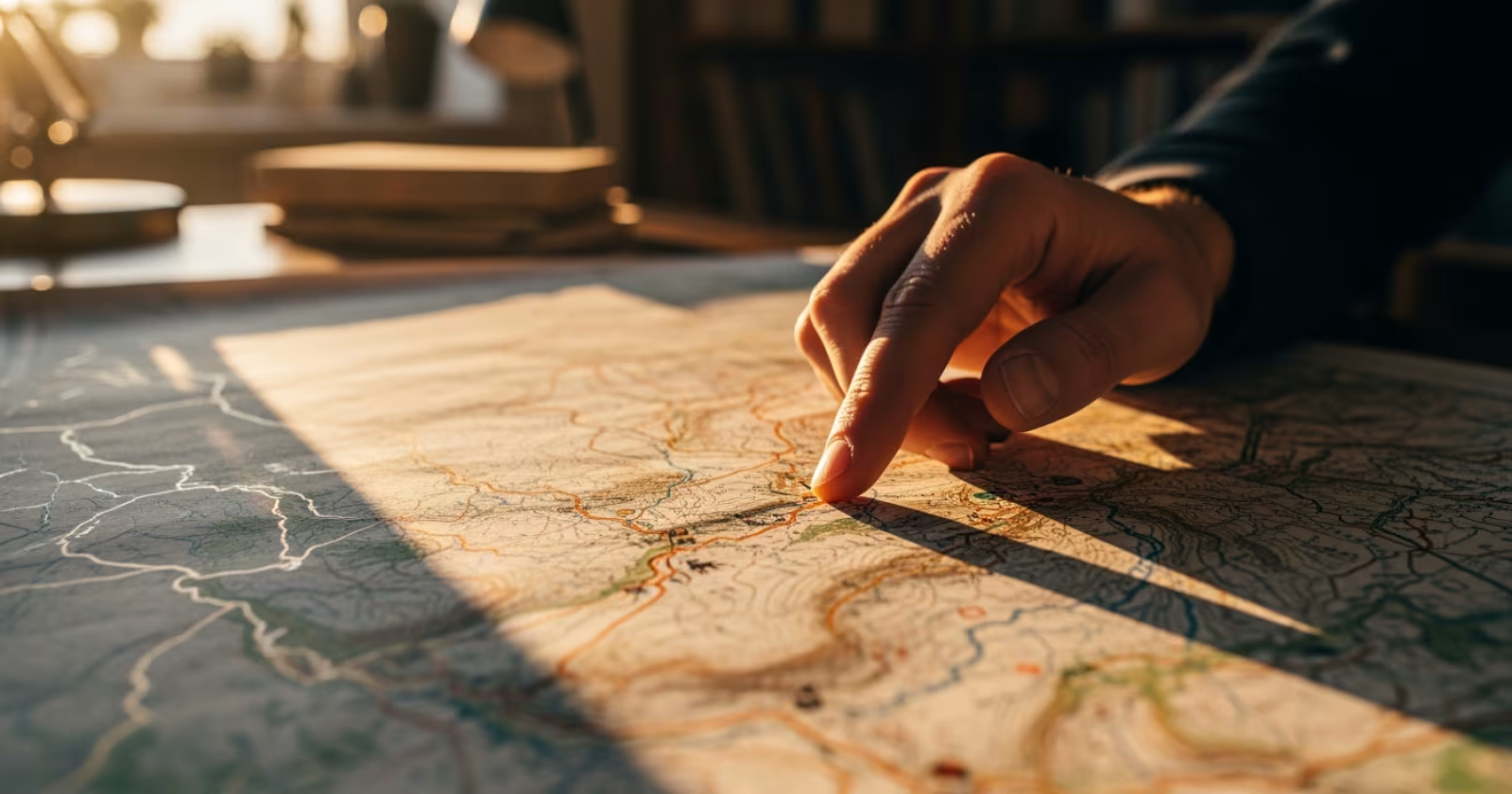
Most aspirants read geography like a story — paragraph after paragraph, line after line. But the UPSC examiner does not think in paragraphs. The examiner thinks in maps. Once I understood this difference, my own approach to teaching geography changed forever, and so did the results of my students.
This article walks you through a practical method of building what I call “map-based thinking” — a habit of visualizing spatial relationships every time you encounter a geography fact. By the end, you will have a clear system to apply this in your daily preparation for the 2026 Prelims cycle.
Where This Topic Sits in the UPSC Syllabus
Geography is a high-scoring subject in both Prelims and Mains. In Prelims, it falls under General Studies Paper I. In Mains, it connects to GS Paper I (Physical Geography) and GS Paper III (Environment, Disaster Management). Map-based questions have appeared consistently over the past decade.
| Exam Stage | Paper | Relevant Syllabus Areas |
|---|---|---|
| Prelims | GS Paper I | Indian and World Physical Geography, Climate, Rivers, Passes |
| Mains | GS Paper I | Salient features of World Physical Geography, Distribution of Key Natural Resources |
| Mains | GS Paper III | Disaster Management, Environment and Ecology linkages |
Questions on river systems, mountain passes, boundary lines, ocean currents, and location of national parks appear almost every year. Between 2015 and 2026, at least 8-12 Prelims questions annually required spatial awareness that only a map-trained mind can answer quickly.
Why Reading Alone Fails in Geography
Here is the core problem. You read that the Shivalik Hills run from Jammu to Arunachal Pradesh. You underline it. You revise it. But when UPSC asks “Which of the following states does the Shivalik range NOT pass through?”, you freeze. You are unsure about the exact states in between.
This happens because textual memory is weak for spatial data. Your brain stores “Jammu to Arunachal” as a sentence, not as a line on a map. Without the visual anchor, elimination becomes guesswork. Map-based thinking fixes this by converting every geographical fact into a mental image tied to location.
What Exactly Is Map-Based Thinking
Map-based thinking is the habit of asking one question every time you read a geography fact: “Where exactly is this on the map?” It means you never accept a fact as complete until you have seen it, traced it, or drawn it on a map.
This is not about memorizing the entire atlas. It is about building a mental coordinate system. When you read about the Palk Strait, your brain should instantly see the narrow water between Tamil Nadu and Sri Lanka. When you read about the Siachen Glacier, you should see it sitting north of the NJ9842 point on the Line of Control.
Over weeks of practice, this becomes automatic. Facts stop being isolated sentences. They become part of a connected spatial web in your mind.
A Step-by-Step Method to Build This Habit
I have used this method with hundreds of students, and I will share it exactly as I teach it in class.
Step 1 — Get a blank outline map of India. Print 30 copies at once. You will use one almost every day. Keep a separate set of world outline maps too.
Step 2 — Daily map marking. Every evening, take whatever geography you studied that day and mark the key locations on a blank map. Studied river systems? Draw the Godavari and its tributaries from memory. Studied soil types? Shade the regions. Do not look at the atlas while marking. Check afterwards.
Step 3 — Neighbour awareness. Every time you mark a location, note what lies to its north, south, east, and west. If you mark Rann of Kutch, note that Rajasthan is to the northeast and the Arabian Sea to the southwest. This builds relational memory.
Step 4 — Layered maps. Once a week, take one blank map and mark multiple themes on it — rivers, national parks, and tribal areas of the same region. This reveals connections that textbooks never show you explicitly. You will notice, for example, that many national parks in central India sit along river valleys.
Step 5 — Prelims question practice with atlas open. When solving previous year papers, keep an atlas next to you. For every geography question, find the relevant location on the map — even if you got the answer right. This reinforces spatial memory at the moment of highest attention.
Which Maps Matter Most for Prelims
You do not need to master every map in the atlas. Focus your energy on these high-yield categories:
- River systems of India — origin points, tributaries, confluence cities, and which states they flow through
- Mountain passes — especially in the Northeast, Jammu and Kashmir, and Himachal Pradesh
- National Parks and Tiger Reserves — state-wise location, nearby rivers or hills
- Ocean currents — warm vs cold, direction of flow in Atlantic, Pacific, Indian Ocean
- Boundary lines and neighbours — India shares borders with seven countries; know exact states touching each
- Agro-climatic zones — soil types, rainfall patterns, and cropping regions
The Orient BlackSwan School Atlas and NCERT Atlas together cover almost everything you need. No expensive resource is required.
How This Changes Your Elimination Game
UPSC Prelims is ultimately about elimination. When you have strong spatial memory, you can eliminate wrong options with confidence — even for topics you have not revised recently.
For instance, if a question asks which national park is located in the Eastern Ghats, and you can mentally see the map of peninsular India, you can immediately rule out parks in Western Ghats, Central Highlands, or the Terai. Your accuracy jumps not because you memorized more facts, but because your brain organizes facts spatially.
I have seen students improve their geography accuracy from 50-55% to 75-80% within three months of consistent map practice. The investment is just 15-20 minutes per day.
Common Mistakes to Avoid
Do not treat map work as a separate activity from your main study. Integrate it into every reading session. If you study the Himalayas from NCERT, mark the ranges on a map the same day — not “someday later.”
Do not rely only on coloured, pre-marked maps. The real learning happens when you draw on a blank map from memory and then check. The act of recalling and placing a location strengthens long-term retention far more than passive looking.
Do not skip world geography maps. UPSC has increasingly asked about straits, international water bodies, African and South American geography, and global climate patterns. A rough mental map of the world is essential.
Key Points to Remember for UPSC
- Spatial memory is stronger and more durable than textual memory for geography facts.
- Use blank outline maps daily — mark from memory first, then verify with the atlas.
- Always note what lies to the north, south, east, and west of any location you study.
- Layer multiple themes on one map weekly to discover hidden connections between topics.
- River systems, mountain passes, national parks, and ocean currents are the highest-yield map categories for Prelims.
- Solve PYQs with an atlas beside you — even for questions you answer correctly.
- 15-20 minutes of focused map work daily can improve geography accuracy by 20-25% over three months.
Geography rewards those who see the subject as a map, not a textbook. Start today with one blank outline map of India and whatever chapter you are currently reading. Mark five locations from memory, check them, and repeat tomorrow. This small daily habit, done honestly over the coming weeks, will change how your brain processes every geography question you face in the 2026 Prelims.
Get fastest alerts on Results, Admit Cards & Govt Jobs directly on your phone.