
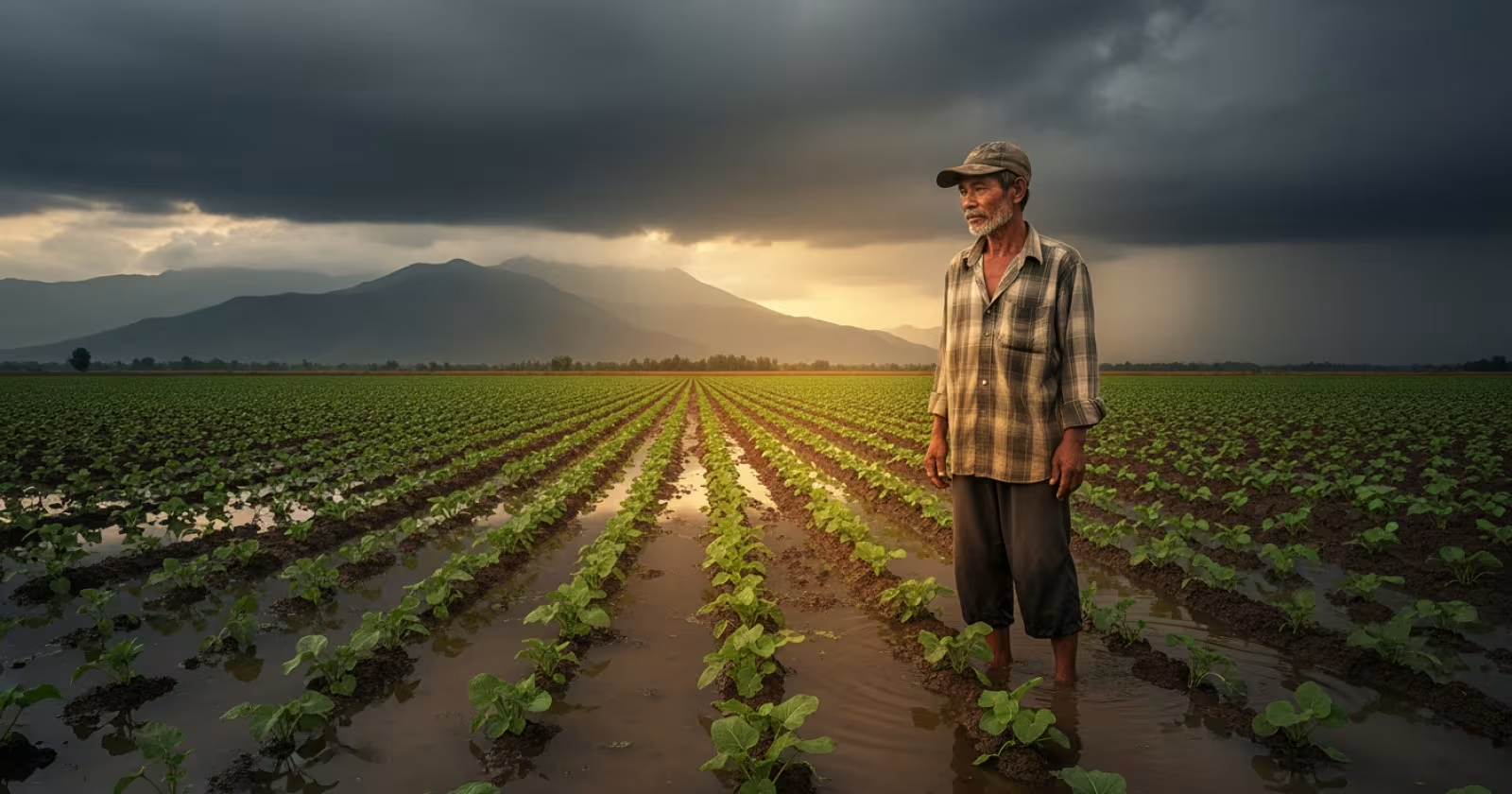
Every year, nearly 60% of India’s net sown area depends entirely on rainfall — and that rainfall is dictated by one powerful system: the monsoon. If you are preparing for UPSC in 2026, understanding monsoon variability is not optional — it is the thread that ties your Geography, Economy, Agriculture, and Governance answers together.
I have seen aspirants treat the monsoon as a simple Geography topic. They memorise the dates of onset and withdrawal and move on. But UPSC does not ask you to recall dates. It asks you to connect the monsoon to farmer distress, GDP fluctuations, fiscal policy, and even India’s foreign trade balance. Let me walk you through this interconnected web.
Where This Topic Sits in the UPSC Syllabus
Monsoon variability is a rare cross-cutting topic. It appears directly or indirectly in at least three General Studies papers. Here is a quick mapping:
| Exam Stage | Paper | Syllabus Section |
|---|---|---|
| Prelims | General Studies | Indian and World Geography — Physical, Social, Economic |
| Mains | GS-I | Salient features of World Physical Geography; Distribution of key natural resources |
| Mains | GS-III | Major crops, irrigation; Economics of agriculture; Disaster management |
| Mains | GS-II | Government policies and interventions for development |
The topic has appeared in Prelims through factual questions on ENSO, jet streams, and the Indian Ocean Dipole. In Mains, it surfaces as analytical questions linking climate patterns to food security or rural economy. Expect at least one question every alternate year touching this theme.
Understanding the Indian Monsoon Mechanism
The Indian monsoon is a seasonal reversal of winds caused by differential heating of land and sea. Between June and September, moisture-laden winds blow from the Indian Ocean towards the Indian subcontinent. This is the Southwest Monsoon, responsible for about 75% of India’s annual rainfall.
Two branches drive this system. The Arabian Sea branch hits the Western Ghats first, causing heavy orographic rainfall in Kerala, Karnataka, and Konkan. The Bay of Bengal branch curves around the eastern coast and moves up the Ganga plains. The monsoon trough — a low-pressure zone running from the Thar Desert to the Bay of Bengal — determines where rain belts sit on any given day.
When this trough shifts northward or southward, entire regions experience floods or drought. This shifting is what we mean by monsoon variability — and it is not random. It is governed by large-scale ocean-atmosphere interactions.
Key Drivers of Monsoon Variability
Three global phenomena shape how much rain India gets in any given year.
El Nino Southern Oscillation (ENSO): When sea surface temperatures in the central Pacific Ocean rise abnormally (El Nino), the Indian monsoon tends to weaken. Historically, major drought years like 1972, 1987, and 2009 coincided with strong El Nino events. The opposite phase, La Nina, generally brings above-normal rainfall.
Indian Ocean Dipole (IOD): This refers to the temperature difference between the western and eastern Indian Ocean. A positive IOD can counteract El Nino’s negative effect. In 2019, for example, a strong positive IOD helped India receive surplus rainfall despite El Nino conditions earlier in the year.
Madden-Julian Oscillation (MJO): This is a 30-60 day cycle of enhanced and suppressed rainfall moving eastward across the tropics. When an active MJO phase passes over the Indian Ocean, it can trigger heavy rainfall spells over India.
For UPSC, you do not need to be a meteorologist. But you must understand that these factors interact, and predicting the monsoon is never straightforward. The India Meteorological Department (IMD) uses statistical and dynamical models that account for all three.
How Monsoon Variability Hits Agriculture
India’s Kharif season — rice, pulses, cotton, sugarcane, soybean — is entirely monsoon-dependent. A delayed onset by even two weeks can disrupt sowing schedules across Maharashtra, Madhya Pradesh, and Uttar Pradesh. Farmers who have already invested in seeds and fertilisers face immediate losses.
Excess rainfall is equally damaging. Waterlogging destroys standing crops, especially in low-lying areas of Bihar, Assam, and eastern UP. The 2023 and 2024 seasons showed this clearly — some districts faced drought while neighbouring ones experienced floods within the same state.
This spatial unevenness is the real challenge. National-level rainfall may be “normal,” but district-level distribution can be wildly skewed. UPSC Mains questions increasingly test whether you understand this nuance.
The Economic Ripple Effect
Agriculture contributes roughly 15% of India’s GDP but employs over 42% of the workforce. When the monsoon fails, the impact goes far beyond farms. Rural demand drops, which affects FMCG companies, two-wheeler sales, and even rural banking.
Food inflation spikes when monsoon is poor. Vegetables like onion and tomato, which are highly weather-sensitive, see price shocks. The Reserve Bank of India closely monitors monsoon forecasts because food inflation directly influences its interest rate decisions. In your GS-III answers, connecting monsoon to inflation and monetary policy shows depth.
On the fiscal side, governments increase spending on drought relief, crop insurance payouts under Pradhan Mantri Fasal Bima Yojana (PMFBY), and MGNREGA wages during poor monsoon years. This strains state budgets, particularly in agrarian states like Rajasthan, Madhya Pradesh, and Telangana.
Policy Responses and Their UPSC Relevance
India has developed a layered policy response to monsoon variability over the decades. Understanding these policies helps you answer questions on governance and disaster management.
PMFBY provides crop insurance to farmers at subsidised premiums. However, its effectiveness is debated — claim settlement delays and low awareness in remote areas remain serious concerns. For a balanced Mains answer, mention both the scheme’s reach and its gaps.
National Action Plan on Climate Change (NAPCC) includes the National Water Mission, which aims to increase water use efficiency by 20%. The Per Drop More Crop initiative under this mission promotes micro-irrigation to reduce monsoon dependency.
Watershed development programmes and the revival of traditional water harvesting systems (like johads in Rajasthan and tankas in Gujarat) are gaining policy attention. ICAR has also been developing drought-resistant and flood-tolerant crop varieties — Sahbhagi Dhan (rice) is a notable example.
The broader shift is towards climate-resilient agriculture. In 2026, with climate change intensifying monsoon unpredictability, expect UPSC to frame questions around adaptation strategies rather than just describing the monsoon mechanism.
Connecting the Dots for Mains Answers
The best UPSC answers on this topic do not treat geography, economy, and policy as separate silos. When a question asks about “challenges to food security in India,” your answer becomes stronger if you trace the chain: monsoon variability → crop failure → food inflation → rural distress → fiscal burden → policy response.
Similarly, a question on “climate change and Indian agriculture” expects you to discuss how warming oceans are altering ENSO patterns, how this changes monsoon behaviour, and what India’s policy toolkit looks like. Practice writing 250-word answers that move through this chain smoothly.
Key Points to Remember for UPSC
- ENSO, IOD, and MJO are the three primary drivers of monsoon variability — they can reinforce or cancel each other’s effects.
- National-level rainfall data can be misleading; district-level spatial distribution matters more for understanding agricultural impact.
- A poor monsoon triggers a chain reaction: crop loss → food inflation → RBI monetary policy response → fiscal strain on state governments.
- PMFBY is India’s main crop insurance tool, but claim settlement and awareness gaps limit its effectiveness.
- Climate-resilient agriculture — including drought-tolerant seeds, micro-irrigation, and watershed management — represents India’s adaptation strategy.
- The monsoon trough position determines daily rainfall distribution and is key to understanding floods and droughts within the same season.
- Western Ghats receive orographic rainfall from the Arabian Sea branch; the Ganga plains depend on the Bay of Bengal branch.
This topic rewards aspirants who think in connections rather than compartments. Pick any previous year question on agriculture, food security, or climate change — you will find the monsoon lurking in the background. Build a short notes sheet that maps monsoon variability to at least five related UPSC topics, and revise it before both Prelims and Mains. Steady, connected preparation on themes like this is what separates average answers from the ones that score.
Get fastest alerts on Results, Admit Cards & Govt Jobs directly on your phone.