
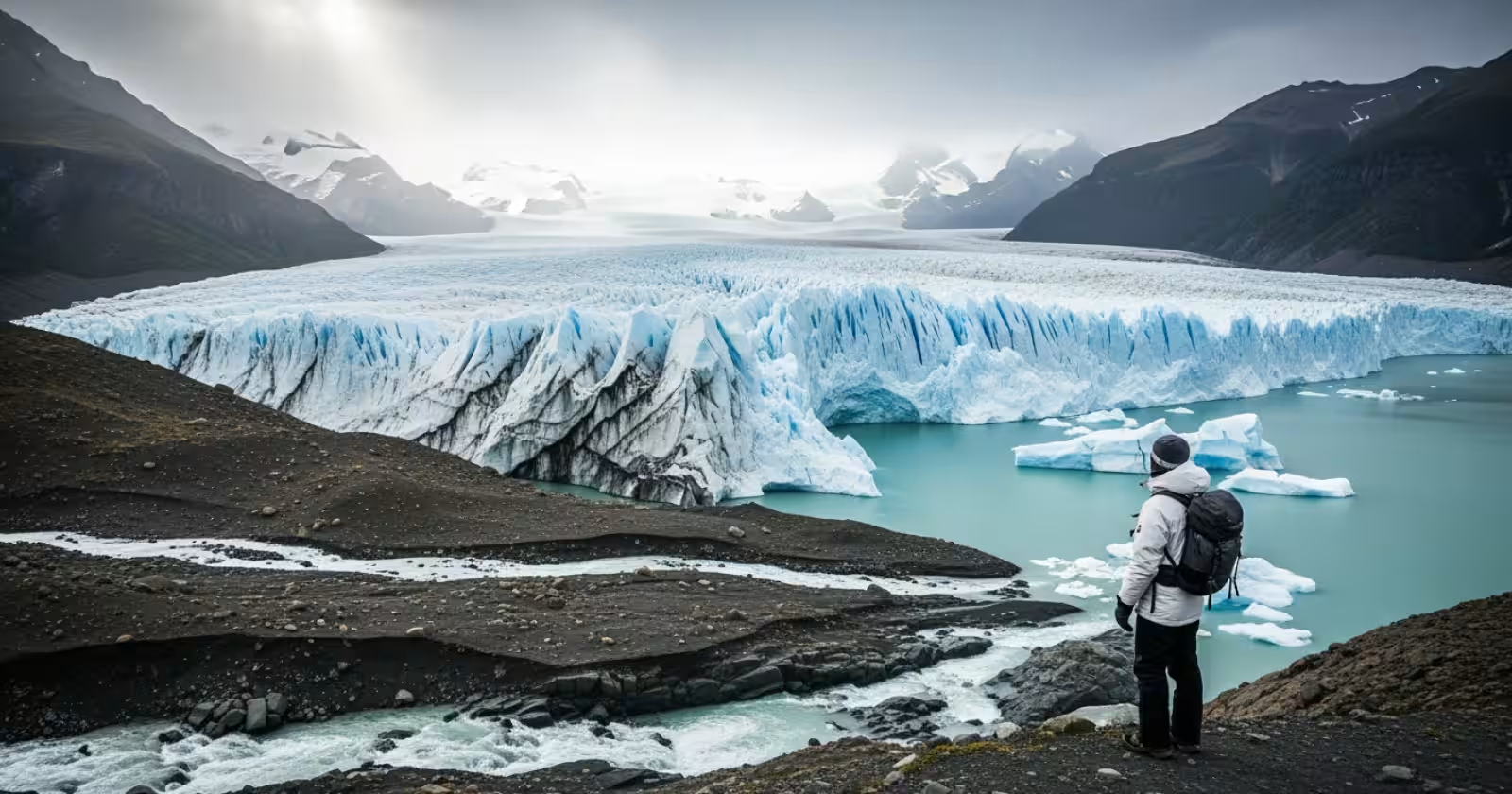
India’s rivers begin as ice. When that ice disappears, so does the water that feeds over a billion people. This single chain of cause and effect makes glacier melting one of the most policy-relevant environment topics for any UPSC aspirant studying GS-III.
Where This Topic Sits in the UPSC Syllabus
I have seen this topic appear across multiple papers over the years. It is not confined to one neat box. Glacier melting sits at the intersection of environment, geography, disaster management, and even international relations.
| Exam Stage | Paper | Syllabus Section |
|---|---|---|
| Prelims | General Studies | Physical Geography — Glaciers, Climate Change |
| Mains | GS-I | Physical Geography — Distribution of Water Resources |
| Mains | GS-III | Environment — Conservation, Climate Change, Disaster Management |
| Mains | GS-II | International Relations — Transboundary Water Disputes |
Related topics include cloud bursts, GLOFs (Glacial Lake Outburst Floods), National Action Plan on Climate Change, and the Jal Jeevan Mission. UPSC has asked direct and indirect questions on glacier retreat at least 5-6 times since 2013.
Understanding the Basics — What Is Glacier Melting?
A glacier is a large, slow-moving mass of compressed ice formed over centuries from snowfall. Glaciers store freshwater. When global temperatures rise, glaciers lose more ice in summer than they gain in winter. This net loss is called glacier retreat or glacier melting.
India hosts around 9,575 glaciers, mostly in the Himalayan region. The Hindu Kush Himalaya (HKH) region is often called the “Third Pole” because it holds the largest ice reserve outside the Arctic and Antarctic. According to ICIMOD’s 2023 assessment, Himalayan glaciers are melting 65% faster than the previous decade.
This is not a distant phenomenon. The Gangotri glacier, which feeds the Ganga, has been retreating at roughly 10-30 metres per year. The Siachen glacier, strategically vital, shows similar trends.
The Direct Link Between Glaciers and Water Security
Water security means reliable access to adequate quantities of acceptable quality water. For India, Himalayan glaciers feed rivers like the Ganga, Indus, Brahmaputra, Yamuna, and their tributaries. These rivers supply drinking water, irrigation, and hydropower to hundreds of millions.
In the short term, faster melting means more water flowing downstream. This sounds positive, but it creates floods, landslides, and GLOFs. The 2013 Kedarnath disaster and the 2021 Chamoli flood are direct examples. In the long term, once glaciers shrink beyond a point, river flows decline permanently. This is the real threat — rivers becoming seasonal or drying up.
Consider this: the Indus basin gets nearly 40% of its water from glacier and snow melt. If glaciers vanish, the agricultural economy of Punjab, Haryana, and parts of Rajasthan faces collapse. The Ganga basin, supporting over 500 million people, faces similar risks.
Policy Responses — What India Has Done
I always tell my students to connect environmental issues to government policy. UPSC loves this bridge between problem and response.
The National Action Plan on Climate Change (NAPCC), launched in 2008, has eight missions. The National Water Mission specifically targets a 20% improvement in water use efficiency. The National Mission for Sustaining the Himalayan Ecosystem directly addresses glacier monitoring and conservation.
The National Water Policy 2012 recognises climate change as a factor affecting water availability. It recommends integrated water resource management and basin-level planning. The Jal Jeevan Mission, while primarily about tap water connections, indirectly depends on sustained river flows — which depend on glaciers.
India also participates in international frameworks. The IPCC Assessment Reports provide scientific backing for policy. India’s updated NDCs (Nationally Determined Contributions) under the Paris Agreement include emission reduction targets that aim to slow down global warming and, by extension, glacier melting.
GLOFs — The Disaster Management Angle
When glaciers melt, water collects behind natural dams of ice and debris, forming glacial lakes. When these dams break, the sudden release of water causes a Glacial Lake Outburst Flood. India has over 2,400 glacial lakes, and NDMA has identified several as high-risk.
For GS-III, you must understand GLOFs as both an environmental and disaster management topic. The 2021 Chamoli disaster in Uttarakhand killed over 200 people and destroyed two hydropower projects. This single event connects glacier melting to infrastructure planning, environmental impact assessments, and disaster preparedness.
NDMA guidelines recommend early warning systems, restriction on construction in high-risk zones, and community-based disaster risk reduction. These are direct answer points for mains questions.
The Transboundary Dimension
Himalayan glaciers do not respect national borders. The Indus originates in Tibet, flows through India, and sustains Pakistan. The Brahmaputra flows from China through India into Bangladesh. Glacier melting can trigger transboundary water conflicts.
The Indus Water Treaty of 1960 between India and Pakistan was designed for a stable hydrological regime. Climate change disrupts this stability. If glacier-fed rivers change their flow patterns, existing treaties may become inadequate. This connects the topic to GS-II international relations as well.
How to Use This Topic in UPSC Answers
I recommend a layered approach. When you write about water security, begin with the source — glaciers. When you write about climate change impacts, use glacier melting as a concrete Indian example. When you write about disaster management, reference GLOFs and specific incidents like Kedarnath or Chamoli.
For essay papers, glacier melting works as a powerful case study under themes like “Climate Justice,” “Development vs Environment,” or “Water as a Strategic Resource.” For ethics papers, it raises questions of intergenerational equity — are we consuming water resources that belong to future generations?
Key Points to Remember for UPSC
- India has approximately 9,575 glaciers, mostly in the Himalayan region often called the “Third Pole.”
- Himalayan glaciers are retreating 65% faster than the previous decade, according to ICIMOD data.
- Short-term impact of glacier melting is floods and GLOFs; long-term impact is permanent reduction in river flows.
- The Indus basin receives nearly 40% of its water from glacier and snowmelt, making it highly vulnerable.
- NAPCC’s National Mission for Sustaining the Himalayan Ecosystem directly deals with glacier monitoring.
- Over 2,400 glacial lakes exist in India, several classified as high-risk for outburst floods by NDMA.
- Glacier melting has transboundary implications, potentially straining treaties like the Indus Water Treaty.
- The 2021 Chamoli disaster is a ready-made case study connecting glaciers to disaster management and infrastructure policy.
This topic rewards the aspirant who can think across papers. Practice writing one answer that connects glaciers to water security, one that connects them to disaster management, and one that links them to international relations. Building these cross-paper connections now will save you valuable time in the examination hall and help you write more integrated, high-scoring answers.
Get fastest alerts on Results, Admit Cards & Govt Jobs directly on your phone.