
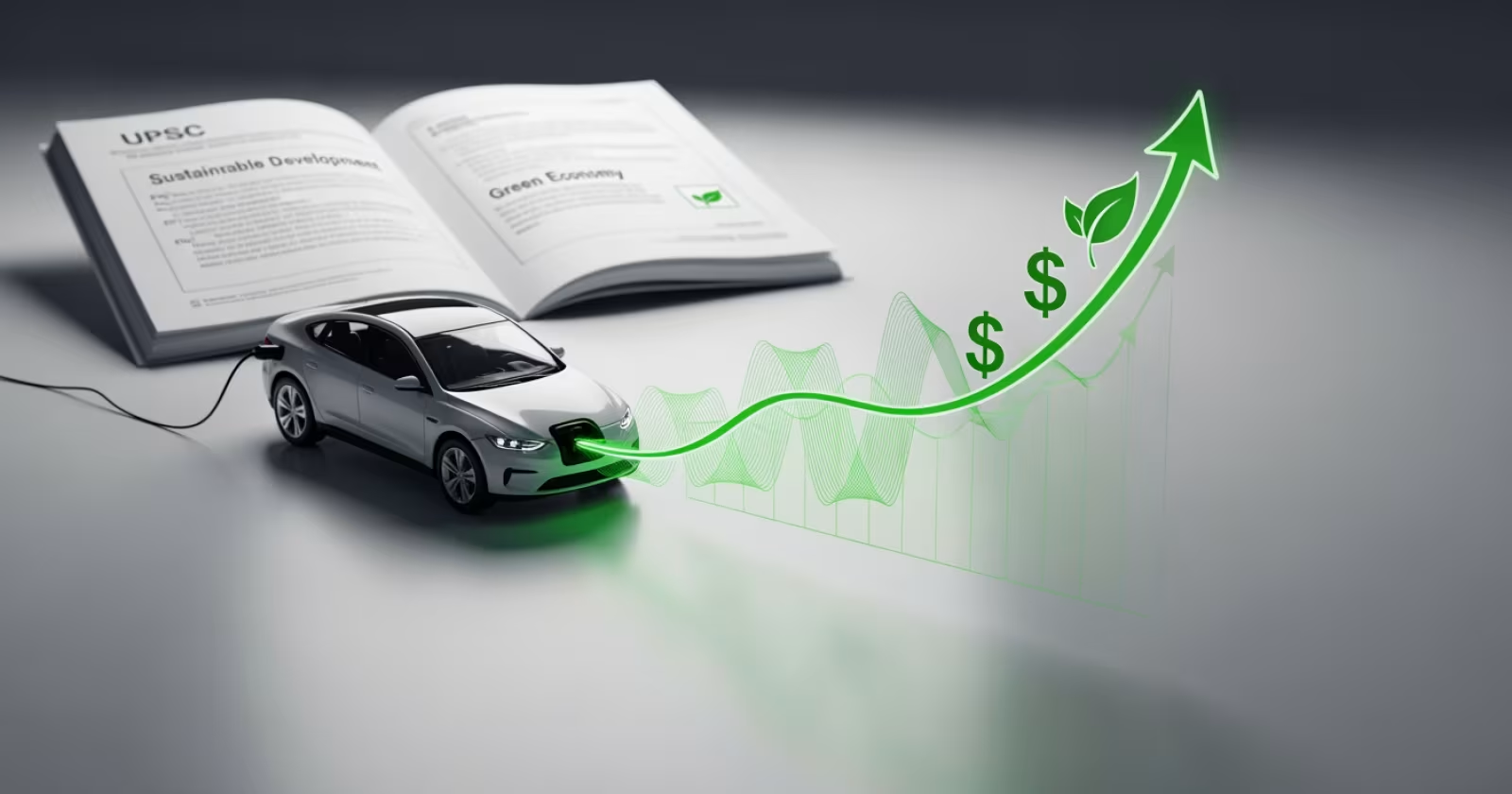
Five years ago, UPSC rarely asked a direct question about lithium-ion batteries or EV charging infrastructure. Today, these topics appear across Prelims, Mains GS-III, and even Essay papers. If you have been ignoring the clean technology space in your preparation, this is your signal to course-correct.
I have spent over fifteen years tracking how UPSC shifts its question patterns, and the trend is unmistakable. The Commission now treats clean technology and electric vehicles not as isolated science topics but as deeply interconnected economy-environment themes. Let me walk you through exactly what you need to know, how the syllabus frames it, and how past questions have tested this area.
Where This Topic Sits in the UPSC Syllabus
Clean technology and electric vehicles sit at the intersection of multiple syllabus areas. The primary home is GS-III, but connections extend to GS-II (government policies) and even GS-I (urbanisation). Here is a clear mapping.
| Exam Stage | Paper | Syllabus Section |
|---|---|---|
| Prelims | General Studies | Economic Development, Environmental Ecology, Science and Technology |
| Mains | GS-III | Indian Economy — Infrastructure: Energy; Conservation, Environmental Pollution and Degradation |
| Mains | GS-III | Science and Technology — Developments and their Applications in Everyday Life |
| Mains | GS-II | Government Policies and Interventions for Development |
The topic has appeared in various forms at least 8 to 10 times since 2015 in both Prelims and Mains. Related syllabus themes include renewable energy, climate change commitments under Paris Agreement, and sustainable development.
Understanding Clean Technology from the Basics
Clean technology refers to any process, product, or service that reduces negative environmental impacts. This includes renewable energy sources like solar and wind, energy-efficient manufacturing, waste management innovations, and low-emission transport systems. Electric vehicles fall squarely within this definition.
For UPSC, you do not need to understand the engineering details of a battery cell. What you need to understand is the policy ecosystem, the economic rationale, and the environmental impact. Think of clean technology as a bridge topic — it connects India’s climate commitments with its industrial policy and energy security goals.
Why Electric Vehicles Matter for the Indian Economy
India imports over 85 percent of its crude oil requirement. This creates a massive current account deficit burden and exposes the economy to global price shocks. Every time oil prices spike, India’s fiscal math suffers. Electric vehicles directly address this vulnerability by reducing dependence on imported fossil fuels.
The National Electric Mobility Mission Plan (NEMMP) 2020 was the first major policy push. It aimed to achieve national fuel security by promoting hybrid and electric vehicles. This was followed by the FAME Scheme (Faster Adoption and Manufacturing of Electric Vehicles), launched in 2015 and extended as FAME-II in 2019. FAME-II had an outlay of Rs 10,000 crore and focused on incentivising electric two-wheelers, three-wheelers, and buses.
By 2026, India has moved further. The PM E-DRIVE scheme has replaced FAME-II with a broader focus that includes charging infrastructure and electric ambulances. The Production Linked Incentive (PLI) scheme for Advanced Chemistry Cell battery storage aims to build domestic manufacturing capacity for lithium-ion batteries. NITI Aayog has also pushed for battery swapping policies to make EVs accessible to delivery and ride-hailing fleets.
The Environment Angle — Where Economy Meets Ecology
UPSC loves questions that force you to think across domains. Clean technology is a perfect example. The economic argument for EVs is fuel savings and manufacturing jobs. The environmental argument is emission reduction and cleaner urban air.
India’s Nationally Determined Contributions (NDCs) under the Paris Agreement include reducing the emissions intensity of GDP by 45 percent by 2030 (from 2005 levels) and achieving 50 percent cumulative electric power from non-fossil fuel sources. The transport sector accounts for roughly 13 percent of India’s CO2 emissions. Shifting to electric mobility is one of the most direct ways to cut this share.
Green hydrogen is another clean technology area that UPSC has begun testing. The National Green Hydrogen Mission, launched in 2023 with an outlay of Rs 19,744 crore, aims to make India a global hub for green hydrogen production. Green hydrogen is produced using renewable energy to split water through electrolysis — no fossil fuels involved. It can power heavy transport, steel manufacturing, and fertiliser production.
The Carbon Credit and Market Mechanism Connection
India’s Carbon Credit Trading Scheme (CCTS), notified under the Energy Conservation Act 2001 (amended in 2022), creates a domestic carbon market. Companies that adopt clean technologies and reduce emissions below a set baseline can earn carbon credits. These credits can be traded, creating a financial incentive for green investment.
This is a favourite area for UPSC Mains questions because it tests your understanding of market-based environmental regulation. The examiner wants to see whether you can explain how economic instruments — not just command-and-control regulations — can drive environmental outcomes.
Key Challenges UPSC Expects You to Analyse
No UPSC answer is complete without a balanced discussion. Here are the critical challenges you must be able to articulate.
- Lithium and cobalt dependency: India lacks domestic reserves of key battery minerals. Most supply comes from China, Australia, and the Democratic Republic of Congo. This creates a new form of import dependency.
- Charging infrastructure gaps: Urban areas are slowly getting chargers, but rural and semi-urban India remains largely unserved. Range anxiety is real for consumers.
- Grid readiness: If millions of EVs charge simultaneously, the electricity grid must be robust enough. India’s grid still relies on coal for over 70 percent of generation.
- E-waste from batteries: Lithium-ion batteries have a limited lifespan. Without proper recycling infrastructure, EVs could create a new environmental problem.
- Affordability: Despite subsidies, electric cars remain more expensive than petrol equivalents. Two-wheelers have seen better adoption because the price gap is smaller.
Previous Year UPSC Questions on This Topic
Q1. With reference to India’s efforts towards clean energy, consider the following statements:
1. The FAME scheme provides incentives for electric and hybrid vehicles.
2. India has set a target of 500 GW non-fossil fuel energy capacity by 2030.
Which of the statements given above is/are correct?
(a) 1 only (b) 2 only (c) Both 1 and 2 (d) Neither 1 nor 2
(UPSC Prelims Pattern — GS)
Answer: (c) Both 1 and 2. FAME specifically targets electric and hybrid vehicles through demand incentives and charging infrastructure support. India’s updated NDC targets 500 GW of non-fossil fuel installed capacity by 2030, announced at COP26 Glasgow. This question tests whether aspirants track India’s climate commitments alongside specific policy schemes.
Q2. “The shift to electric vehicles in India is as much an economic imperative as it is an environmental one.” Discuss with reference to India’s energy security and climate commitments.
(UPSC Mains Pattern — GS-III, 15 marks)
Model Approach: Begin with India’s oil import bill and its impact on the current account deficit. Link to NEMMP and FAME schemes as policy responses. Discuss NDC targets and transport sector emissions. Then address challenges — mineral dependency, grid capacity, and affordability. Conclude by showing how clean technology policy must balance economic growth with environmental sustainability. The examiner looks for an integrated argument, not separate lists of economic and environmental points.
Q3. What is green hydrogen? Discuss its potential and challenges for India’s energy transition.
(UPSC Mains Pattern — GS-III, 10 marks)
Model Approach: Define green hydrogen clearly — produced via electrolysis using renewable energy. Mention the National Green Hydrogen Mission and its targets. Discuss applications in steel, fertiliser, and heavy transport. Address challenges: high production cost, electrolyser availability, water requirement, and storage difficulties. This question tests whether you understand emerging energy technologies beyond solar and wind.
Key Points to Remember for UPSC
- FAME-II has been succeeded by PM E-DRIVE scheme in 2024 — know the shift in focus from demand incentives to infrastructure and fleet electrification.
- India’s NDC targets include 45 percent reduction in emissions intensity of GDP by 2030 and 500 GW non-fossil fuel capacity — these numbers appear repeatedly in Prelims.
- The PLI scheme for Advanced Chemistry Cell batteries aims to reduce import dependence on China for lithium-ion cells.
- Carbon Credit Trading Scheme under the amended Energy Conservation Act 2022 creates a domestic compliance carbon market — a new and testable concept.
- Green hydrogen is produced using renewable energy and electrolysis — distinguish it from grey hydrogen (natural gas) and blue hydrogen (with carbon capture).
- The transport sector contributes roughly 13 percent of India’s CO2 emissions — electrification of this sector directly supports climate goals.
- E-waste from EV batteries is an emerging environmental concern — mention it in any balanced Mains answer on electric mobility.
The convergence of economy and environment in UPSC questions is not a passing trend. It reflects how real-world governance works — no policy exists in isolation. Make sure you study clean technology as a cross-cutting theme, not a standalone topic. A good next step is to read the latest Economic Survey chapter on energy transition and map each data point to a potential UPSC question. Steady, structured preparation on themes like this will serve you well across multiple papers.
Get fastest alerts on Results, Admit Cards & Govt Jobs directly on your phone.