
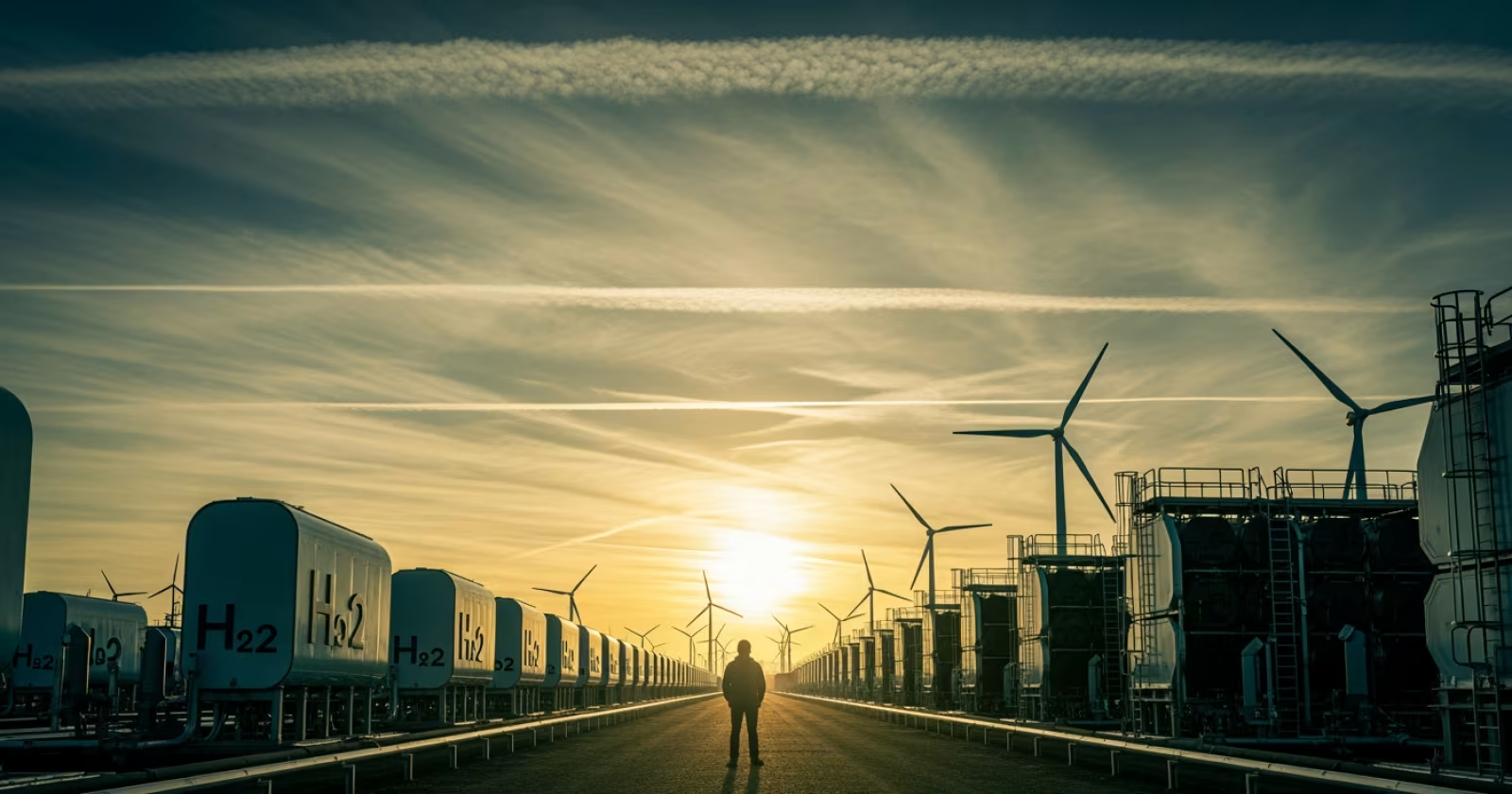
Every second Environment question in recent UPSC Prelims papers has a technology angle. If you have been ignoring clean energy concepts like green hydrogen and fuel cells, you are leaving easy marks on the table. Let me walk you through everything UPSC expects you to know about this rapidly growing area.
Where This Topic Sits in the UPSC Syllabus
Green hydrogen and clean technology fall squarely under GS Paper III for Mains — specifically under “Conservation, Environmental Pollution and Degradation” and “Science and Technology — developments and their applications.” For Prelims, questions appear under the Environment and Science & Technology sections of General Studies.

| Exam Stage | Paper | Syllabus Section |
|---|---|---|
| Prelims | General Studies | Environment & Ecology; Science & Technology |
| Mains | GS-III | Conservation, Environmental Pollution; Infrastructure — Energy |
| Mains | GS-III | Science & Technology developments and applications |
Since 2021, UPSC has asked at least one question per year on hydrogen energy, fuel cells, or clean technology classifications. This topic also connects to Indian Economy (energy security), International Relations (climate commitments), and Governance (National Hydrogen Mission).
Understanding Hydrogen by Colour — The Basics
Hydrogen itself is a colourless gas. The “colours” refer to how it is produced. This distinction is the single most tested concept in this area. Let me break it down clearly.
Grey hydrogen is produced from natural gas through a process called steam methane reforming. It releases carbon dioxide as a byproduct. About 95% of the world’s hydrogen today is grey hydrogen.
Blue hydrogen is also produced from natural gas, but the carbon dioxide released is captured and stored underground using Carbon Capture and Storage (CCS) technology. It is cleaner than grey but not emission-free.
Green hydrogen is produced by splitting water into hydrogen and oxygen using electricity from renewable sources like solar or wind. The process is called electrolysis. Since renewable energy powers it, the entire chain produces virtually zero carbon emissions. This is the gold standard UPSC questions focus on.
There are also less common categories — pink hydrogen (nuclear-powered electrolysis), turquoise hydrogen (methane pyrolysis), and brown hydrogen (from coal). For UPSC, focus primarily on grey, blue, and green.
Why Green Hydrogen Matters for India
India imports over 85% of its crude oil and about 50% of its natural gas. This creates massive energy insecurity. Green hydrogen offers a way to reduce fossil fuel dependence in sectors that are hardest to decarbonise — steel, cement, heavy transport, and fertilisers.
India’s National Green Hydrogen Mission, launched in January 2023, targets production of 5 million metric tonnes of green hydrogen per year by 2030. The mission has an outlay of approximately Rs 19,744 crore. It aims to make India a global hub for green hydrogen production and export.
Under this mission, two key financial schemes operate. SIGHT (Strategic Interventions for Green Hydrogen Transition) provides incentives for electrolyser manufacturing and green hydrogen production. The second scheme supports pilot projects in steel, mobility, shipping, and other end-use sectors.
India’s vast solar energy potential — especially in Rajasthan, Gujarat, and Tamil Nadu — gives it a natural advantage. Cheap renewable electricity is the biggest cost factor in green hydrogen production. If solar power costs keep falling, India could produce some of the cheapest green hydrogen in the world by 2030.
Key Clean Technologies UPSC Is Testing
Green hydrogen does not exist in isolation. UPSC links it to a broader clean technology ecosystem. Here are the connected technologies you must understand.
Electrolysers are the machines that split water into hydrogen and oxygen. Two main types appear in exams — Proton Exchange Membrane (PEM) electrolysers and Alkaline electrolysers. PEM is more efficient but expensive. Alkaline is cheaper but slower.
Fuel cells work in reverse — they combine hydrogen and oxygen to produce electricity, with water as the only byproduct. Think of them as clean batteries that never run out as long as hydrogen is supplied. India is testing hydrogen fuel cell buses in cities like Delhi and Leh.
Carbon Capture, Utilisation and Storage (CCUS) is relevant because blue hydrogen depends on it. UPSC has asked about CCUS independently as well. The technology captures CO2 at the source and either stores it underground or converts it into useful products.
Battery Energy Storage Systems (BESS) connect to this topic because renewable energy is intermittent. To produce green hydrogen consistently, you need storage. India’s push for grid-scale battery storage complements its hydrogen ambitions.
Challenges India Faces
Green hydrogen currently costs about $4-5 per kilogram to produce in India. To compete with grey hydrogen, the cost needs to fall below $2 per kilogram. This is expected by 2030, but it depends on cheaper electrolysers and abundant renewable power.
Water availability is a concern. Electrolysis requires large volumes of purified water. In a water-stressed country like India, this raises questions about competing demands between agriculture, drinking water, and hydrogen production. Using seawater with desalination is one proposed solution, but it adds cost.
Storage and transportation of hydrogen is technically difficult. Hydrogen is extremely light and must be stored at very high pressure or very low temperature. India lacks the pipeline infrastructure for hydrogen distribution. Building this will require massive investment.
There is also a skills gap. India needs trained engineers and technicians for electrolyser manufacturing, fuel cell assembly, and hydrogen plant operations. The mission includes provisions for skilling, but implementation will take time.
Previous Year UPSC Questions on This Topic
Q1. With reference to green hydrogen, consider the following statements: (1) It is produced by electrolysis of water using renewable energy. (2) It produces carbon dioxide as a byproduct. Which of the statements given above is/are correct?
(UPSC Prelims 2022 — General Studies)
Answer: Only statement 1 is correct. Green hydrogen is produced by electrolysis powered by renewable energy. The only byproduct is oxygen, not carbon dioxide. This is precisely what makes it “green.” UPSC tests whether you confuse green hydrogen with grey or blue variants. Always remember — green means zero carbon in production.
Q2. Discuss the potential of hydrogen fuel cells as an alternative to fossil fuels in India’s transport sector. What are the challenges?
(UPSC Mains 2023 pattern — GS-III)
Answer: Hydrogen fuel cells convert hydrogen into electricity with water as the only emission. For India’s transport sector, they offer range advantages over battery EVs — especially for heavy trucks, buses, and railways. India has piloted hydrogen fuel cell buses under the National Hydrogen Mission. However, challenges remain: high production cost of green hydrogen, lack of refuelling infrastructure, expensive fuel cell components (platinum catalysts), and competition from rapidly improving lithium-ion battery vehicles. A phased approach — starting with public transport fleets in select cities — is the most practical path. The examiner wants you to balance potential with realistic limitations.
Q3. What is the National Green Hydrogen Mission? Examine its significance in the context of India’s climate commitments under the Paris Agreement.
(UPSC Mains 2024 pattern — GS-III)
Answer: The National Green Hydrogen Mission targets 5 MMT annual green hydrogen production by 2030 with an investment outlay of nearly Rs 19,744 crore. Its significance lies in India’s updated NDC (Nationally Determined Contribution) under the Paris Agreement — to reach 50% cumulative non-fossil fuel electricity capacity by 2030 and achieve net-zero by 2070. Green hydrogen decarbonises hard-to-abate sectors like steel and fertilisers, which account for significant industrial emissions. The mission also reduces import dependence on fossil fuels, strengthening energy security. Link this answer to India’s climate diplomacy, the International Solar Alliance, and the LiFE (Lifestyle for Environment) initiative for a well-rounded response.
Key Points to Remember for UPSC
- Green hydrogen = electrolysis + renewable energy. Zero carbon emissions in production. Only byproduct is oxygen.
- National Green Hydrogen Mission targets 5 MMT per year by 2030 with approximately Rs 19,744 crore outlay.
- SIGHT scheme under the mission incentivises both electrolyser manufacturing and hydrogen production.
- Grey hydrogen (natural gas, no carbon capture) is the most common form globally — about 95% of total production.
- Cost parity target for green hydrogen is below $2/kg — currently around $4-5/kg in India.
- Water availability and storage infrastructure are the two biggest practical challenges for India.
- Fuel cells combine hydrogen and oxygen to generate electricity — they are not the same as electrolysers, which do the reverse.
- Connect this topic to India’s Paris Agreement NDCs, net-zero 2070 target, and energy security for Mains answers.
Green hydrogen and clean technology are no longer fringe topics — they sit at the centre of India’s energy transition story and UPSC’s evolving question patterns. I recommend making a single consolidated note covering hydrogen types, the National Mission, fuel cells, and CCUS together. Practice at least two Mains-style answers linking clean technology to India’s climate commitments. This will prepare you for both factual Prelims questions and analytical Mains questions in one go.