
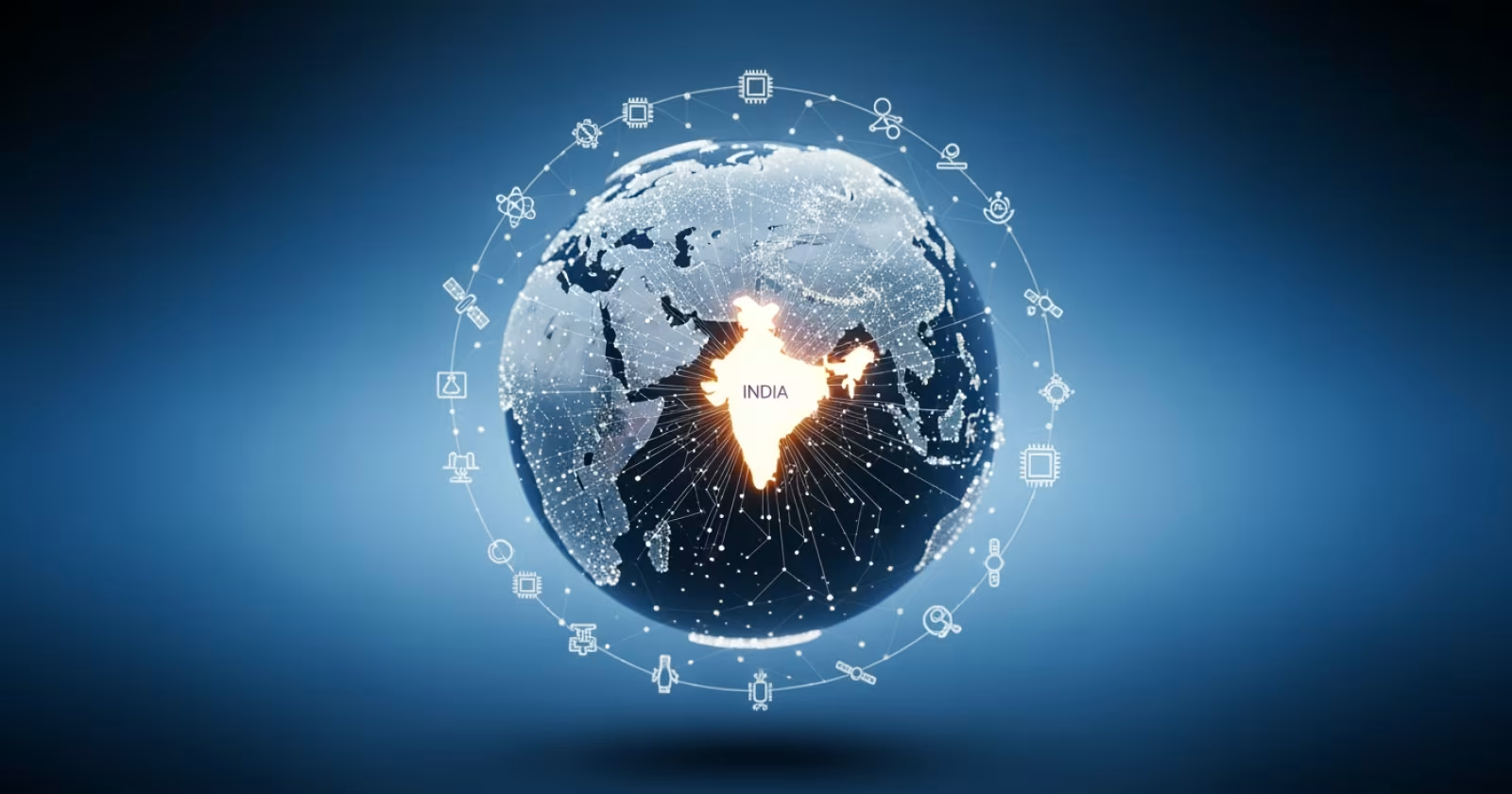
India launched a satellite for Bhutan in 2024. It signed semiconductor agreements with Japan. It co-developed missile technology with partner nations. These are not just science stories — they are foreign policy moves. And UPSC has been testing this intersection for years, often catching aspirants off guard.
If you have been studying Science and Technology and International Relations in separate silos, this article will show you why that approach leaves marks on the table. I will walk you through the concept of technology diplomacy, how India uses it, and exactly how UPSC frames questions at this crossroads of GS-II and GS-III.
Where This Topic Sits in the UPSC Syllabus
This topic does not sit neatly in one paper. It straddles two General Studies papers, and that is precisely why it confuses many aspirants. Let me clarify the mapping.
| Exam Stage | Paper | Syllabus Section |
|---|---|---|
| Prelims | General Studies | Science and Technology — developments and their applications in everyday life |
| Mains | GS-II | International Relations — bilateral, regional, and global groupings involving India |
| Mains | GS-III | Science and Technology — developments, indigenisation, and new technology |
| Mains | GS-II | Effect of policies and politics of developed and developing countries on India’s interests |
In Prelims, you may face factual questions about technology agreements or export control regimes. In Mains, expect analytical questions that ask you to evaluate how technology shapes India’s strategic partnerships. Questions on this theme have appeared at least 8 to 10 times in the last decade across both papers.
What Technology Diplomacy Actually Means
Technology diplomacy refers to the use of scientific and technological capabilities as tools of foreign policy. A country shares, withholds, co-develops, or regulates technology to achieve diplomatic goals. Think of it as soft power backed by hard capability.
For India, this is not new. When ISRO launched satellites for South Asian neighbours under the SAARC Satellite project in 2017, it was not just a space mission. It was a neighbourhood-first policy delivered through a rocket. When India shares UPI technology with other countries, it is projecting digital capability as a form of influence.
The concept works in both directions. India also seeks technology — nuclear reactor designs from France, semiconductor fabrication know-how from the United States, and 5G partnerships with multiple nations. Each of these deals carries diplomatic weight.
Key Dimensions of India’s Technology Diplomacy in 2026
Let me break this into the major areas UPSC cares about most.
Space Diplomacy: ISRO has launched satellites for over 30 countries. The commercial arm, NewSpace India Limited (NSIL), is now a player in the global launch market. India’s Chandrayaan and Mangalyaan missions elevated its status in multilateral space forums. The Artemis Accords signed with the US in 2023 opened doors for deeper collaboration in lunar exploration.
Nuclear Diplomacy: India’s civil nuclear agreements — starting with the India-US Nuclear Deal of 2008 — remain a landmark example. India is not a signatory to the NPT, yet it secured a waiver from the Nuclear Suppliers Group (NSG). This was pure diplomacy enabled by India’s credible technology record. India’s membership bid in the NSG remains a live diplomatic issue, especially with China blocking it.
Digital and Fintech Diplomacy: India’s Unified Payments Interface (UPI) has been adopted or is being explored by countries like Singapore, UAE, France, and Sri Lanka. The India Stack model — Aadhaar, UPI, DigiLocker — is being studied by developing nations as a governance template. This is a new frontier of influence.
Defence Technology Partnerships: The Quad grouping (India, US, Japan, Australia) has a dedicated Critical and Emerging Technologies working group. India signed the Initiative on Critical and Emerging Technology (iCET) with the US in 2023, covering AI, quantum computing, semiconductors, and space. BrahMos missile exports to the Philippines marked India’s entry into the defence export market as a credible supplier.
Climate Technology Diplomacy: India co-founded the International Solar Alliance (ISA) with France. This was a masterstroke — India positioned itself as a leader in renewable energy cooperation among developing nations. The Coalition for Disaster Resilient Infrastructure (CDRI) is another India-led initiative that blends technology with multilateral diplomacy.
Export Control Regimes — A Must-Know Area
UPSC loves testing awareness of multilateral technology control regimes. These are groups of countries that regulate the export of sensitive technologies to prevent proliferation. India has joined three of the four major regimes.
Missile Technology Control Regime (MTCR): India joined in 2016. This enabled access to high-end missile technology and cleared the path for BrahMos exports. Wassenaar Arrangement: India joined in 2017. It governs dual-use technologies and conventional arms. Australia Group: India joined in 2018. It controls chemical and biological weapon precursors.
The fourth regime — the Nuclear Suppliers Group — remains elusive. China continues to block India’s entry, linking it to Pakistan’s simultaneous admission. This is a diplomatic battle that plays out at the intersection of technology and geopolitics.
How UPSC Frames Questions on This Theme
I have seen three patterns in the way UPSC approaches this topic. First, factual Prelims questions about specific regimes, agreements, or organisations. Second, GS-II Mains questions asking you to evaluate a bilateral technology partnership. Third, GS-III questions asking you to link indigenisation efforts with strategic autonomy.
The key mistake aspirants make is treating these as pure IR or pure Sci-Tech questions. The examiner wants you to connect both. When you write about iCET, do not just list what it covers — explain why the US chose India, what India gains strategically, and what risks dependency on foreign technology creates.
Previous Year UPSC Questions on This Topic
Q1. What is the significance of India’s membership in the Missile Technology Control Regime (MTCR)? Discuss its implications for India’s defence and foreign policy.
(UPSC Mains 2016 — GS-II)
Answer: India’s MTCR membership in 2016 was significant on multiple fronts. It gave India access to high-end missile technology from member nations, facilitating indigenous programmes. It enabled export of the BrahMos missile system, opening a new dimension in defence diplomacy. Strategically, it strengthened India’s credentials as a responsible nuclear power despite not being an NPT signatory. It also improved India’s case for NSG membership. The membership signalled a shift in how the West viewed India — from a proliferation concern to a strategic partner in non-proliferation.
Explanation: This question tested whether aspirants could go beyond the factual aspect of MTCR membership and analyse its diplomatic and strategic implications. The examiner expected connections between technology access, defence exports, and India’s standing in the global non-proliferation order.
Q2. Consider the following statements about the Wassenaar Arrangement: 1) It controls the transfer of conventional arms and dual-use goods. 2) India became a member in 2018. 3) It replaced the COCOM established during the Cold War. Which of the above are correct?
(UPSC Prelims Style — GS)
Answer: Statements 1 and 3 are correct. India joined the Wassenaar Arrangement in 2017, not 2018 (that was the Australia Group). The Wassenaar Arrangement was established in 1996 and replaced COCOM, which was a Cold War-era export control mechanism targeting the Soviet bloc.
Explanation: UPSC frequently tests the year of India’s admission to various regimes and their specific mandates. Aspirants should maintain a clear table distinguishing MTCR, Wassenaar, Australia Group, and NSG by year of India’s entry, purpose, and membership status.
Q3. Evaluate the role of the International Solar Alliance in furthering India’s climate diplomacy and its strategic interests in the Global South.
(UPSC Mains 2019 — GS-II)
Answer: The ISA, co-founded by India and France in 2015, aims to mobilise solar energy investment in countries lying between the Tropics of Cancer and Capricorn. For India, the ISA serves multiple purposes. It positions India as a leader in climate action without accepting binding emission cuts. It strengthens ties with African and Pacific Island nations — key voting blocs in multilateral forums. It creates markets for Indian solar manufacturers. The ISA also gives India a platform-building role in global governance, similar to what China achieves through the Belt and Road Initiative but through a climate-positive framework. However, critics argue that ISA’s actual project delivery has been slow and funding remains inadequate.
Explanation: This question required aspirants to blend climate policy, foreign policy, and economic interests into a single coherent answer. The examiner was looking for an understanding of how multilateral initiatives serve national strategic goals beyond their stated objectives.
Key Points to Remember for UPSC
- India is a member of MTCR (2016), Wassenaar Arrangement (2017), and Australia Group (2018), but not the NSG — China blocks entry.
- The India-US iCET agreement (2023) covers AI, quantum computing, semiconductors, and space — a landmark in technology diplomacy.
- ISRO’s commercial launches and satellite diplomacy (SAARC Satellite) are examples of space being used as a foreign policy tool.
- UPI’s international expansion is a new form of digital diplomacy, projecting Indian fintech capability globally.
- The International Solar Alliance and CDRI are India-led multilateral initiatives that combine technology with diplomatic influence in the Global South.
- BrahMos export to the Philippines (2022) was India’s first major defence technology export, enabled by MTCR membership.
- Always connect technology topics to their diplomatic implications in Mains answers — UPSC rewards interdisciplinary thinking.
Understanding how technology and diplomacy feed into each other gives you an edge that most aspirants miss. For your next study session, pick any one India bilateral relationship — say India-Japan or India-France — and map every technology agreement within it. You will see how deeply intertwined these domains are. That single exercise will prepare you for at least two to three possible Mains questions across GS-II and GS-III.
Get fastest alerts on Results, Admit Cards & Govt Jobs directly on your phone.