
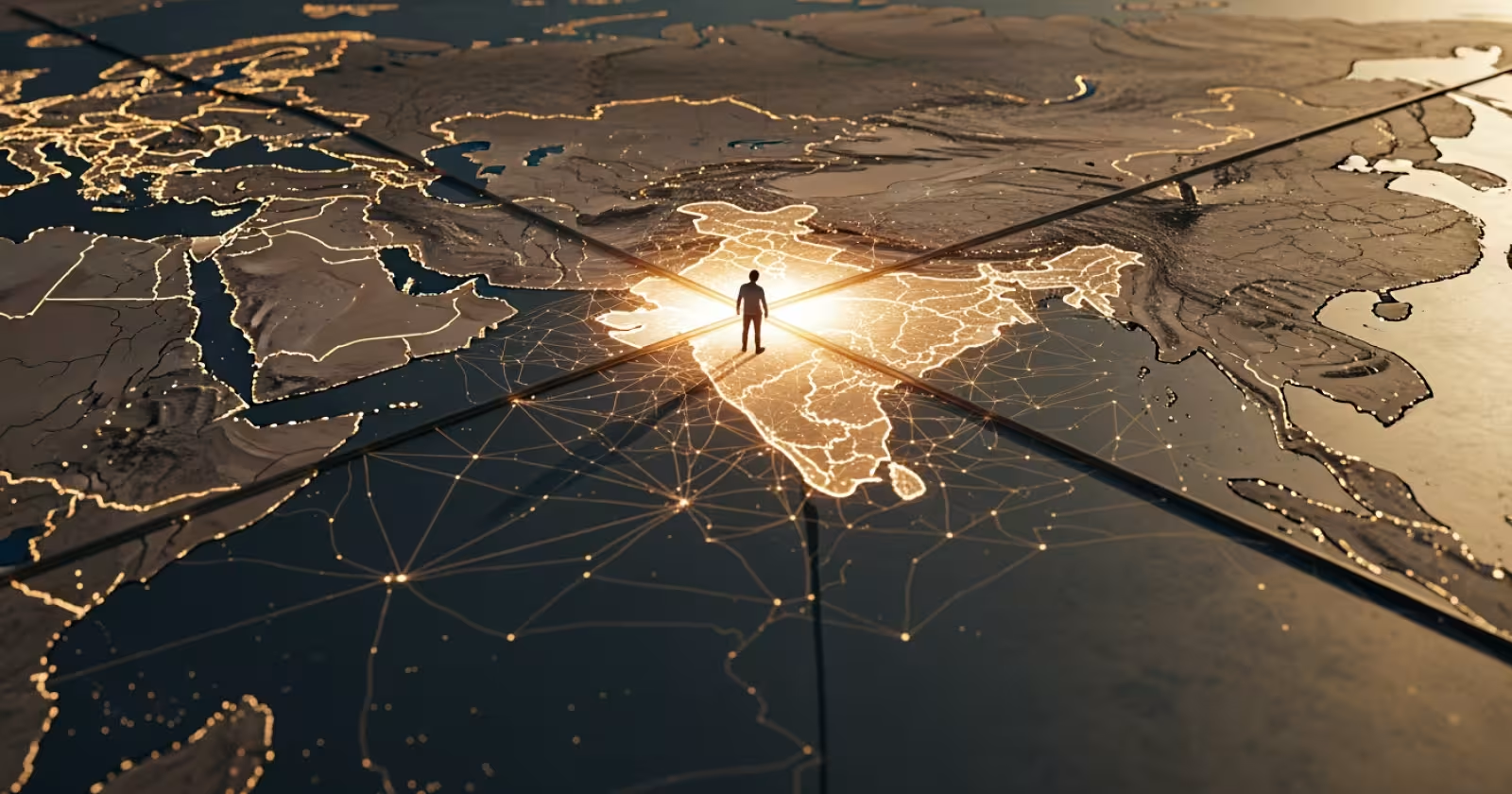
Every year, UPSC asks foreign policy questions that cannot be answered without a solid grip on world geography. If you think GS-II is only about schemes, governance, and the Constitution, you are missing a huge scoring area — the intersection of maps and diplomacy.
I have seen hundreds of aspirants struggle with questions on the Strait of Hormuz, the South China Sea, or India’s neighbourhood policy simply because they never studied geography with a geopolitical lens. In this piece, I will walk you through exactly how world geography feeds into India’s foreign policy questions and how you should prepare for it.
Where This Topic Sits in the UPSC Syllabus
This topic bridges two papers. The geographical foundation comes from GS-I, while the foreign policy application sits firmly in GS-II. Prelims also tests factual awareness of straits, countries, and groupings regularly.
| Exam Stage | Paper | Syllabus Section |
|---|---|---|
| Prelims | General Studies | Indian and World Geography — Physical, Social, Economic |
| Mains | GS-I | Salient features of World Physical Geography |
| Mains | GS-II | India and its Neighbourhood Relations; Bilateral, Regional and Global Groupings; Effect of Policies of Developed and Developing Countries on India’s Interests |
UPSC has asked at least 15-20 questions in the last decade that required combined knowledge of geography and foreign policy. The trend is increasing, especially after the Indo-Pacific concept gained prominence.
Why Geography Is the Foundation of Foreign Policy
Foreign policy does not exist in a vacuum. It is shaped by where a country is located, what resources surround it, and which trade routes pass through its neighbourhood. India sits at the crossroads of the Indian Ocean, shares borders with seven countries, and lies close to some of the world’s most contested waterways.
Think of it this way — India’s Look East Policy (now Act East Policy) exists because Southeast Asia is geographically accessible through the northeastern corridor and the Bay of Bengal. India’s interest in Central Asia is driven by energy resources and the landlocked geography of that region. India’s tension with China is fundamentally about the Himalayan border geography.
When UPSC frames a question like “Discuss India’s Indo-Pacific strategy,” the examiner expects you to mention the geographic stretch from the east coast of Africa to the western Pacific. Without that spatial understanding, your answer will remain shallow.
Key Geographic Chokepoints Every Aspirant Must Know
A chokepoint is a narrow passage of water that controls access to a larger body of water. India’s trade — especially oil imports — depends on several such chokepoints. UPSC loves testing awareness of these.
- Strait of Hormuz — Between Iran and Oman. Nearly 40% of the world’s seaborne oil passes through here. India imports a large share of its crude oil via this strait.
- Strait of Malacca — Between Malaysia, Indonesia, and Singapore. This is the shortest sea route between the Indian Ocean and the Pacific Ocean. Any disruption here directly affects India-East Asia trade.
- Bab-el-Mandeb — Between Yemen and Djibouti. Connects the Red Sea to the Gulf of Aden. India has a naval base interest in Djibouti’s neighbourhood for this reason.
- Suez Canal — Connects the Mediterranean Sea to the Red Sea. India’s trade with Europe depends heavily on this route.
- Mozambique Channel — Between Mozambique and Madagascar. Relevant to India’s engagement with island nations and east African trade.
When you read about India signing defence agreements with Oman, or establishing a logistics base in Agalega (Mauritius), the underlying driver is geographic access to these chokepoints.
India’s Land Borders and Their Foreign Policy Implications
India shares land borders with Pakistan, China, Nepal, Bhutan, Bangladesh, and Myanmar. Each border has a distinct geographical character that shapes the diplomatic relationship.
The India-China border runs along the Himalayas, including the disputed areas of Aksai Chin and Arunachal Pradesh. The Line of Actual Control (LAC) is not clearly demarcated, largely because the terrain — high-altitude deserts, glaciers, and mountain passes — makes precise mapping difficult. The Galwan Valley clash of 2020 and subsequent tensions are directly tied to this geographical ambiguity.
The India-Bangladesh border, in contrast, runs through flat riverine plains and the Sundarbans. Issues here are about river water sharing (Teesta, Ganga), illegal migration, and enclave management. The geography of shared rivers makes water diplomacy a permanent agenda item.
India-Nepal relations are influenced by the open border and the Himalayan watershed. Nepal’s geographic position between India and China (Tibet) gives it strategic buffer-state significance. When Nepal adopted a new map in 2020 including Lipulekh, Kalapani, and Limpiyadhura, it was fundamentally a geographic dispute with foreign policy consequences.
The Indian Ocean Region — Where Geography Meets Grand Strategy
India’s peninsular shape gives it a natural advantage in the Indian Ocean. The Indian Ocean is the world’s third-largest ocean and carries about 80% of global oil trade. India sits right in the middle of it.
This geographic position explains several foreign policy initiatives:
- SAGAR (Security and Growth for All in the Region) — India’s vision for cooperative maritime engagement with Indian Ocean littoral states.
- QUAD (India, USA, Japan, Australia) — A grouping shaped by the geographic spread of the Indo-Pacific. Each member nation sits at a strategic point along this arc.
- String of Pearls — A term describing China’s network of ports and military facilities from the South China Sea to the Horn of Africa. Gwadar (Pakistan), Hambantota (Sri Lanka), and Chittagong (Bangladesh) are key nodes. India views this as geographic encirclement.
- India’s island territories — Andaman and Nicobar Islands sit near the mouth of the Strait of Malacca. Lakshadweep overlooks the Arabian Sea trade routes. Both have massive strategic value.
In Mains answers, connecting India’s maritime initiatives to specific geographic locations dramatically improves your score. Examiners notice when a candidate understands the spatial logic behind policy.
How to Study This Overlap Effectively
I always advise my students to keep an atlas open while reading international relations. Here is a practical method that works well.
First, get a good-quality political map of the world and mark every country, strait, and ocean mentioned in your IR notes. Do this physically with a pen — not digitally. The act of marking builds spatial memory.
Second, when you read about any bilateral relationship (India-France, India-Japan, India-UAE), immediately identify the geographic link. France has territories in the Indian Ocean (Reunion Island). Japan depends on the Strait of Malacca for energy imports. UAE sits near the Strait of Hormuz. These connections make your answers multi-dimensional.
Third, practice writing Mains answers that begin with a geographic context. For example, if the question is about India-ASEAN relations, open with a line about the Bay of Bengal, the Mekong sub-region, or the Andaman Sea. This signals to the examiner that you think structurally.
Key Points to Remember for UPSC
- India’s foreign policy is fundamentally shaped by its geographic position — a peninsula in the Indian Ocean with Himalayan land borders to the north.
- The Strait of Hormuz and the Strait of Malacca are the two most exam-relevant chokepoints for India’s energy and trade security.
- The Andaman and Nicobar Islands give India a strategic presence near Southeast Asian sea lanes — this is a frequently tested fact in Prelims.
- China’s String of Pearls strategy is a geographic concept — learn the specific port locations (Gwadar, Hambantota, Djibouti, Kyaukpyu).
- River geography drives India’s bilateral relations with Nepal and Bangladesh more than most aspirants realise.
- The QUAD and SAGAR are best understood as geographic frameworks, not just diplomatic ones.
- Always connect GS-I geography knowledge to GS-II foreign policy answers — UPSC rewards inter-paper linkages.
Understanding the geographic backbone of India’s foreign policy transforms how you approach GS-II. It gives your answers depth, specificity, and a structural clarity that generic political analysis cannot. Start by mapping five key straits and five key border disputes this week. Build from there, and you will see the difference in your answer quality within a month.