Most aspirants spend weeks on Polity and Economy but barely give a few days to one section that has been delivering the biggest shocks in the UPSC exam hall since 2015. I have watched thousands of students walk out of the Prelims centre saying, “Those Art and Culture questions came from nowhere.” The truth is, they did not come from nowhere. They came from a pattern that very few people are tracking carefully.
Where This Topic Sits in the UPSC Syllabus
Art and Culture falls directly under GS Paper I for Mains, and it is a consistent presence in the Prelims General Studies paper. The syllabus line reads: “Indian culture will cover the salient aspects of Art Forms, Literature and Architecture from ancient to modern times.” That single line is deceptively vast. It covers everything from Gandhara sculpture to GI-tagged crafts of Northeast India.
| Exam Stage | Paper | Syllabus Section | Avg. Questions (2015-2026) |
|---|---|---|---|
| Prelims | General Studies | Indian Heritage and Culture | 8-14 per year |
| Mains | GS-I | Art Forms, Literature, Architecture | 1-2 questions per year |
| Mains | GS-I | World Heritage and Culture (overlap) | Occasional |
Between 2015 and 2026, Art and Culture questions in Prelims have ranged from 8 to as many as 14 in a single paper. That is a scoring band of roughly 26 to 46 marks in Prelims alone. No serious aspirant can afford to treat this as optional anymore.
Why Art and Culture Became the Surprise Zone
Before 2015, UPSC asked relatively straightforward questions on classical dances, famous temples, and well-known painters. You could manage with a standard textbook and some common sense. That changed dramatically around 2015-2016. The Commission began picking obscure topics — tribal art forms, lesser-known literary traditions, UNESCO Intangible Cultural Heritage items, and region-specific craft traditions that no single textbook covers comprehensively.
I believe the reason is simple. UPSC wants to test genuine cultural awareness, not rote memorisation. When everyone memorises the eight classical dance forms, UPSC asks about Chhau sub-styles. When everyone knows about Ajanta, UPSC asks about Badami cave inscriptions or Lepakshi temple bracket figures. The examiners are rewarding candidates who have gone beyond the obvious.
There is also a strong overlap with current affairs now. When India nominates a new element for UNESCO’s Representative List, or when a GI tag is awarded to a traditional craft, those items show up in the next Prelims. This current-affairs-culture crossover is where the maximum surprise element lies.
The Five Sub-Areas That Deliver Maximum Surprises
Based on my analysis of every Art and Culture question from 2015 to 2026, five sub-areas generate the most unexpected questions.
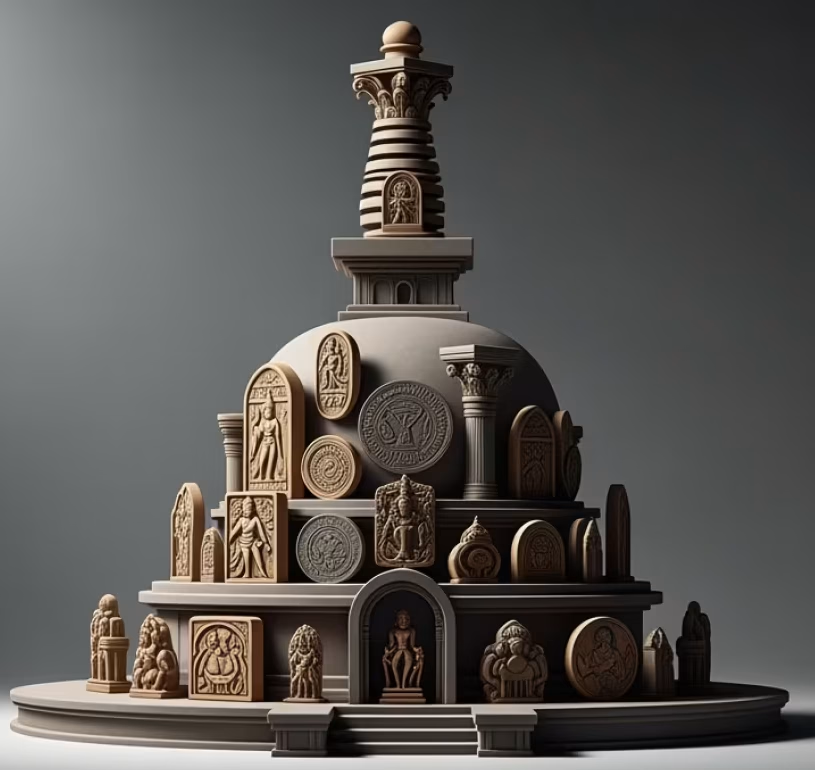
1. Buddhist, Jain, and Hindu Architectural Traditions: UPSC does not just ask “Who built Sanchi Stupa?” anymore. It asks about specific sculptural motifs, differences between Nagara and Dravida temple plans, and lesser-known rock-cut caves. Questions on Buddhist sites outside the mainstream circuit — like Tabo Monastery or Alchi Monastery in Ladakh — have appeared.
2. Classical and Folk Performing Arts: The eight classical dances are just the starting point. UPSC has gone deep into folk traditions — Yakshagana, Bhand Pather, Therukoothu, Lavani, and tribal dance forms of Central India. Music questions have covered Dhrupad, Carnatic ragas, and even specific musical instruments tied to regions.
3. Paintings and Visual Arts: Miniature painting schools — Kangra, Pahari, Rajasthani, Mughal, Deccan — are tested frequently. But UPSC has also asked about Warli, Gond, Madhubani, and Pattachitra in ways that require you to know their distinguishing features, not just their names.
4. Literary Heritage: Questions on Sangam literature, Sanskrit plays, Bhakti and Sufi literary traditions, and regional language classics appear regularly. The 2019 and 2020 papers had particularly tough questions on ancient literary works and their authors.
5. UNESCO and GI Tag-Linked Culture: Every new Indian entry on UNESCO’s World Heritage List, Intangible Cultural Heritage List, or the GI registry is a potential Prelims question. Durga Puja’s inscription in 2021, Kumbh Mela’s recognition, and India’s growing GI list have all been fair game. This is where current affairs and static culture merge.
How to Actually Prepare Without Losing Your Mind
I always tell my students: you cannot memorise all of Indian culture. That is not the goal. The goal is to build a framework and then fill it intelligently.
Start with one solid base text. Nitin Singhania’s book on Indian Art and Culture or the CCRT (Centre for Cultural Resources and Training) material gives you the skeleton. Read it once thoroughly. On your second reading, make visual notes — associate every art form with an image, a region, and a key feature. Culture is visual. If you are reading about Chola bronzes, look at a photograph of the Nataraja. Your retention will triple.
Next, maintain a running culture-current-affairs sheet. Every month, note down any UNESCO addition, GI tag, national award for art, or cultural festival that makes news. This sheet alone can fetch you 2-4 extra questions in Prelims.
For Mains, practice writing answers that connect cultural elements to broader themes — national integration, soft power, tourism economy, and preservation challenges. UPSC Mains does not want you to list facts. It wants you to show understanding of why culture matters in governance and society.
A Common Mistake That Costs Marks
Many aspirants prepare Art and Culture only for Prelims and ignore it for Mains. This is a costly error. In GS-I Mains, culture questions often carry 10 or 15 marks. A well-written answer on, say, the evolution of temple architecture or the role of Bhakti movement in social reform can be a strong scoring answer because most candidates write generic responses. If you add specific examples — names of temples, specific saints, actual literary works — you stand out immediately.
Another mistake is treating Art and Culture as a last-minute subject. Because it is perceived as “factual,” students postpone it until the final weeks. But the breadth of this section makes last-minute cramming ineffective. Spread your culture preparation across your entire preparation timeline. Even 20 minutes a day, consistently, works better than a 3-day marathon before the exam.
Key Points to Remember for UPSC
- Art and Culture has contributed 8-14 Prelims questions annually since 2015, making it one of the highest-yield static sections.
- UPSC has shifted from straightforward factual questions to nuanced, application-based ones that test deeper cultural awareness.
- The UNESCO-GI tag-current affairs overlap is the single most productive area for scoring surprise questions.
- Regional and tribal art forms — not just classical traditions — are now regularly tested.
- For Mains, connect cultural topics to governance themes like soft power, national integration, and heritage preservation policy.
- Visual learning dramatically improves retention for art, architecture, and painting-related topics.
- A monthly culture-current-affairs tracker is a simple habit that can directly translate into 4-8 extra marks in Prelims.
Art and Culture rewards the aspirant who engages with it steadily rather than frantically. Build your base with one reliable resource, stay updated with cultural current affairs, and practice connecting facts to larger themes for Mains answers. If you start integrating even a small daily dose of culture preparation into your schedule this week, you will find that the “surprise zone” starts feeling a lot less surprising — and a lot more like easy marks waiting to be collected.
Get fastest alerts on Results, Admit Cards & Govt Jobs directly on your phone.