
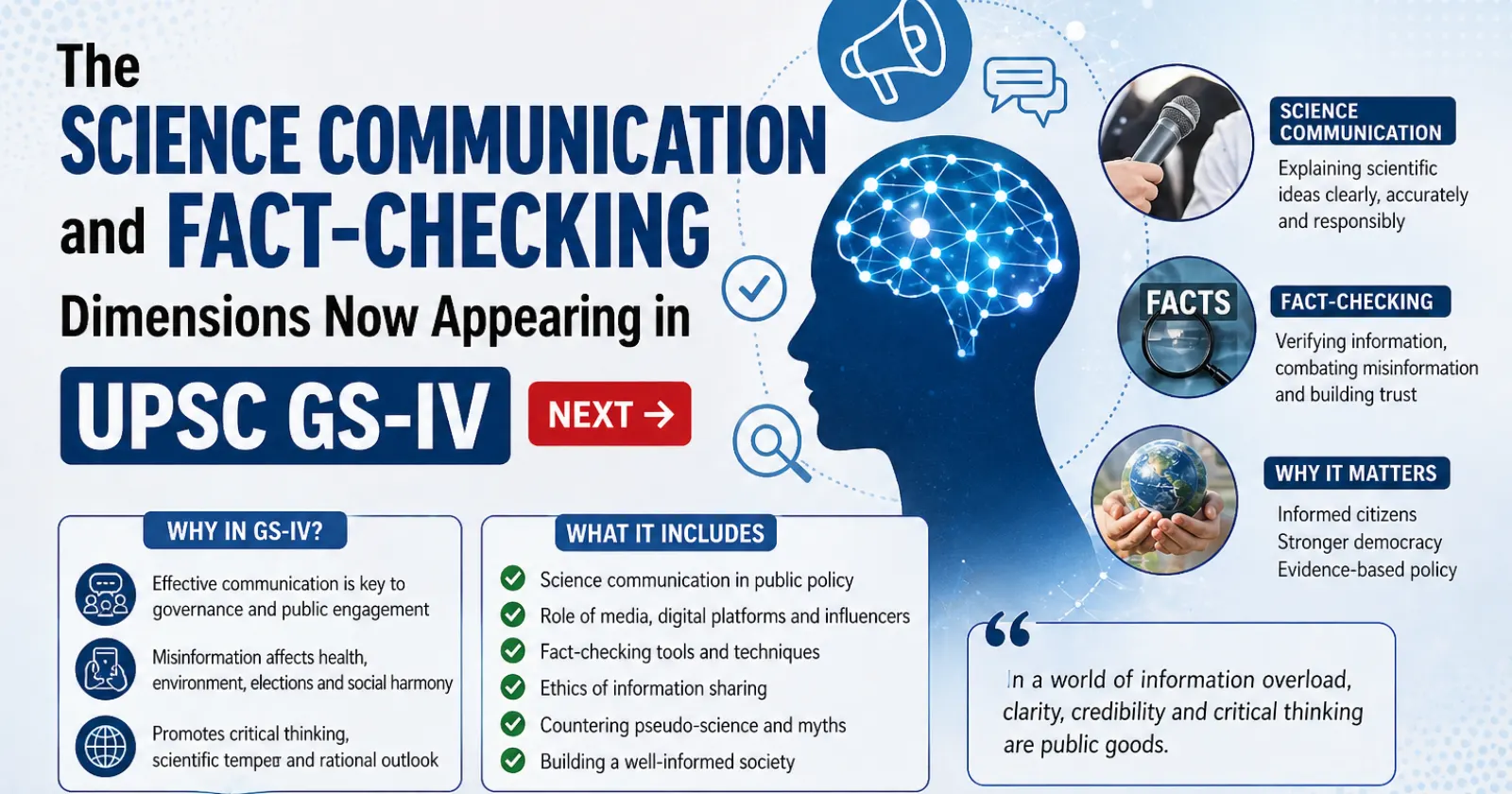
If you have been solving GS-IV papers from the last three years, you may have noticed something shifting quietly beneath the surface. The Ethics paper is no longer just about Gandhian philosophy, emotional intelligence, and case studies on bureaucratic dilemmas. A new thread has started appearing — one that connects science communication, the ethics of information, and the responsibility of public servants in an age of misinformation.
I want to walk you through this emerging dimension carefully. Whether you are attempting the exam in 2026 or building your foundation for next year, understanding this shift will give you a genuine edge in both case studies and essay-type answers.
Where This Topic Sits in the UPSC Syllabus
GS-IV is formally titled “Ethics, Integrity, and Aptitude.” The syllabus is broad by design, and UPSC has always used that breadth to introduce contemporary ethical questions. Science communication and fact-checking fall under multiple syllabus lines, which is exactly why they are attractive to the examiner.
| Exam Stage | Paper | Relevant Syllabus Line |
|---|---|---|
| Mains | GS-IV (Ethics) | Ethics and Human Interface — essence, determinants, consequences of ethics in human actions |
| Mains | GS-IV (Ethics) | Attitude — content, structure, function; influence on thought and behaviour |
| Mains | GS-IV (Ethics) | Aptitude and foundational values for Civil Service — objectivity, dedication to public service |
| Mains | GS-IV (Ethics) | Probity in Governance — information sharing and transparency |
| Mains | GS-III | Science and Technology — developments and their applications in everyday life |
The connection to GS-III is worth noting. UPSC often designs GS-IV case studies that borrow factual contexts from GS-I, II, or III. A case study about a district officer handling vaccine misinformation, for instance, tests your GS-III awareness and your GS-IV ethical reasoning simultaneously.
Why Science Communication Has Become an Ethics Question
During the COVID-19 pandemic, India witnessed a massive collision between scientific information and public belief. District magistrates, health officers, and IAS officers posted in rural areas had to communicate vaccine safety to populations that were deeply sceptical. This was not a science problem alone. It was an ethical challenge — how do you respect community beliefs while ensuring public health compliance?
Science communication, at its core, is about translating complex findings into language that ordinary citizens can understand and trust. When a civil servant communicates scientific information poorly — or worse, selectively — the consequences can be severe. Think of fluoride contamination advisories in Rajasthan, or disaster preparedness messaging during cyclones in Odisha. The officer’s duty is not just to relay facts but to do so with honesty, clarity, and empathy.
This is where the GS-IV syllabus line on objectivity and non-partisanship becomes directly relevant. A civil servant who amplifies unverified claims — even with good intentions — violates the foundational value of objectivity. UPSC is now testing whether aspirants understand this connection.
Fact-Checking as a Dimension of Probity
The syllabus explicitly mentions probity in governance, which includes transparency and information sharing. In 2026, information sharing is no longer a one-way street. Government officials operate in an environment where WhatsApp forwards, social media posts, and AI-generated content can shape public opinion faster than any official press release.
Fact-checking, in this context, is not just a media skill. It is a governance responsibility. When a Block Development Officer encounters a viral rumour about a government scheme — say, a false claim that PM-KISAN payments have been doubled — the ethical response involves verifying the claim, correcting it through official channels, and doing so without creating panic or distrust.
UPSC has started embedding these scenarios into case studies. The 2024 GS-IV paper included a case study where an officer had to decide whether to publicly correct a senior politician’s misleading health claim. This is fact-checking ethics in its purest form — balancing truth-telling with institutional hierarchy and public interest.
The Ethical Framework You Should Use
When you encounter a case study involving science communication or misinformation, I recommend building your answer around three pillars.
First, duty to truth. A civil servant’s primary obligation is to the public. The Second Administrative Reforms Commission emphasised that transparency is not optional — it is a foundational requirement of democratic governance. Any communication that distorts scientific evidence, even by omission, fails this test.
Second, empathy in delivery. Truth without empathy becomes arrogance. If a health officer dismisses tribal communities’ concerns about vaccination as “ignorance,” the communication fails ethically even if the science is correct. The GS-IV syllabus specifically lists compassion and tolerance as foundational values. Your answer must reflect this balance.
Third, institutional integrity. A civil servant does not speak as an individual. They represent the state. Sharing unverified information — even on a personal social media account — can erode public trust in institutions. This connects directly to the syllabus concept of dedication to public service.
How This Appears in Case Studies
Let me give you a realistic example of the kind of case study UPSC could frame. Imagine you are a District Collector in a coastal district. A cyclone warning has been issued by IMD, but a widely shared social media post claims the cyclone has changed direction and the district is safe. Local fishermen, trusting the post, plan to go to sea. What do you do?
This case study tests multiple things at once. It tests your understanding of science communication — can you explain meteorological uncertainty to non-experts? It tests your fact-checking instinct — do you verify the social media claim against IMD data? And it tests your ethical judgement — do you act cautiously to protect lives even if the viral post turns out to be partially correct?
The strongest answers will not just describe what to do. They will name the ethical values at play — objectivity, compassion, accountability — and explain how each value guides a specific action.
Previous Year UPSC Questions on This Topic
Q1. “What does ‘accountability’ mean in the context of public service? What measures can be adopted to ensure individual and collective accountability of public servants?” (UPSC Mains 2014 — GS-IV)
Answer: Accountability in public service means that every officer is answerable for their decisions, actions, and communications to the public and to oversight institutions. Individual accountability can be ensured through performance audits, RTI compliance, and social audits. Collective accountability requires institutional mechanisms like Citizens’ Charters, grievance redressal systems, and transparent decision-making processes. In the context of information sharing, accountability also means that officers must verify facts before communicating them publicly and must correct errors promptly when discovered.
Explanation: This question directly connects to the fact-checking dimension. The examiner wanted aspirants to go beyond textbook definitions and discuss practical mechanisms. In 2026, an updated answer should include the responsibility of officers in the digital information environment — verifying claims before amplifying them and using official channels to counter misinformation.
Q2. “Distinguish between ‘ethical management’ and ‘management of ethics.’ Is it possible to manage ethics in government?” (UPSC Mains 2015 — GS-IV)
Answer: Ethical management refers to conducting all management activities — planning, staffing, communicating — in accordance with ethical principles. Management of ethics refers to creating systems, codes, and training programmes that promote ethical behaviour within an organisation. Both are possible in government. Ethical management requires individual commitment from officers, while management of ethics requires institutional frameworks like ethics committees, whistleblower protections, and mandatory training on information integrity. In the current environment, managing ethics must also include protocols for official communication on social media and guidelines for handling misinformation.
Explanation: This question tests conceptual clarity. The science communication angle fits naturally here — an ethically managed government department would have clear protocols for how scientific information is communicated to the public, who verifies it, and how corrections are issued.
Q3. A senior officer in your department shares a social media post containing unverified health advice during a disease outbreak. The post goes viral and causes public confusion. As a junior officer who knows the information is inaccurate, what steps would you take? Identify the ethical issues involved. (Projected Case Study — GS-IV)
Answer: The ethical issues here include truth versus loyalty, institutional hierarchy versus public interest, and individual courage versus career risk. The first step is to verify the inaccuracy by consulting official health department data or WHO guidelines. Next, I would approach the senior officer privately, present the verified facts, and request a correction. If the officer refuses, I would escalate the matter to the department head while simultaneously ensuring that correct information reaches the public through official channels. The foundational values at play are objectivity, integrity, and courage of conviction. Remaining silent would violate my duty to the public, even if speaking up creates professional discomfort.
Explanation: This is the exact type of case study that reflects the new science communication and fact-checking dimension. UPSC wants to see whether you can identify the competing ethical values, propose a practical course of action, and justify it using the foundational values listed in the syllabus.
Key Points to Remember for UPSC
- Science communication is now an ethical responsibility of civil servants, not just a technical skill — it falls under probity, objectivity, and transparency in GS-IV.
- Fact-checking by public officials connects directly to the syllabus concepts of accountability and information sharing in governance.
- Case studies may combine GS-III scientific contexts with GS-IV ethical reasoning — prepare for cross-paper scenarios.
- The three-pillar framework — duty to truth, empathy in delivery, institutional integrity — can structure any answer on this theme.
- Always name the specific foundational values (objectivity, compassion, courage of conviction) when answering case studies on misinformation.
- The COVID-19 pandemic, disaster communication, and digital misinformation are the three most likely real-world contexts UPSC will draw from.
- Correcting a senior officer’s misinformation is a classic ethical dilemma format — practise framing answers that balance hierarchy with public duty.
This dimension of GS-IV is not a passing trend. As AI-generated content and digital misinformation grow more sophisticated, the ethical responsibilities of public servants in communicating verified, scientific information will only increase. Start integrating these ideas into your case study practice now. Pick one case study per week that involves an information dilemma, write a structured answer using the three-pillar framework, and review it against the foundational values in the syllabus. That single habit will prepare you for whatever UPSC frames in this space.
Get fastest alerts on Results, Admit Cards & Govt Jobs directly on your phone.