
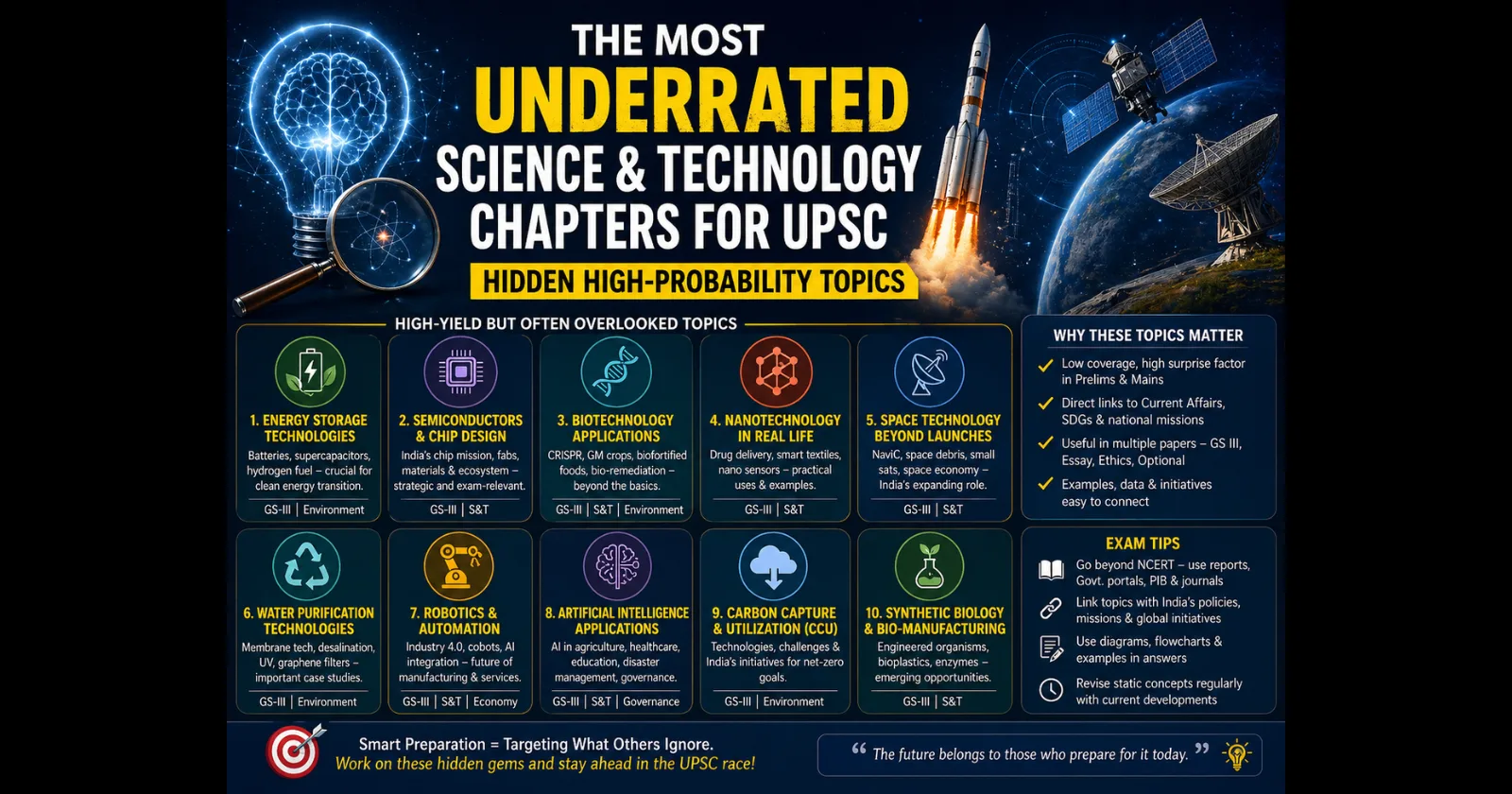
Every year, I see aspirants spend weeks on Biotechnology and Space Technology — and then lose marks on questions about topics they never even opened. The UPSC has a pattern of picking from corners of the Science and Technology syllabus that most students treat as “optional reading.” These are the chapters I want to walk you through today.
After tracking question papers from the last 12 years, I have identified several S&T areas that appear repeatedly but remain ignored in most preparation plans. If you give these topics even a few focused hours, your coverage improves dramatically — both for Prelims and GS-III Mains.
Where This Topic Sits in the UPSC Syllabus
Science and Technology is a broad area in the UPSC framework. It appears directly in two stages. In Prelims, it falls under General Studies Paper I — specifically under “General issues on Environmental Ecology, Biodiversity and Climate Change” and “General Science.” In Mains, it sits squarely in GS-III under “Science and Technology — developments and their applications and effects in everyday life.” It also overlaps with “Awareness in the fields of IT, Space, Computers, Robotics, Nanotechnology, Biotechnology.”
| Exam Stage | Paper | Syllabus Section |
|---|---|---|
| Prelims | General Studies I | General Science, Current Developments in S&T |
| Mains | GS-III | Science and Technology — developments, applications, effects in everyday life |
| Mains | GS-III | Awareness in IT, Space, Computers, Robotics, Nanotechnology, Bio-technology |
| Mains | GS-III | Intellectual Property Rights |
The catch is that most aspirants read only the “popular” parts — ISRO missions, nuclear energy, and basic biotech. The syllabus, however, is much wider. Let me show you what gets missed.
Nanotechnology — The Perennial Sleeper Topic
Nanotechnology has appeared in UPSC papers multiple times, yet most aspirants cannot explain what a nanometre actually means in practical terms. One nanometre is one-billionth of a metre. At this scale, materials behave differently — gold turns red, and substances become far more reactive.
For UPSC, you need to understand the applications. Nano-fertilisers are being tested in Indian agriculture. Nano-medicine allows targeted drug delivery — meaning medicine reaches only the diseased cells, not the whole body. The Government of India’s Nano Mission, under the Department of Science and Technology, has been funding research since 2007. Know the basics of carbon nanotubes, quantum dots, and nano-filters for water purification. These are not deep physics — they are application-level concepts that UPSC loves to test.
Intellectual Property Rights — More Science Than Law
Most aspirants dump IPR into the “Economy” or “Governance” bucket and study it superficially. But UPSC places it under Science and Technology in GS-III for a reason. The examiner wants you to understand how patents affect drug access, how geographical indications protect traditional knowledge, and how compulsory licensing works in India.
Study the difference between patents, copyrights, trademarks, and trade secrets. Understand India’s position in the TRIPS Agreement. Know what Section 3(d) of the Indian Patent Act does — it prevents “evergreening” of patents, which is when companies make minor changes to old drugs to extend patent life. The Novartis vs. Union of India case (2013) is a landmark here. This single topic connects Science, Economy, and Governance — making it a high-value area for answer writing.
Robotics and Artificial Intelligence — Beyond the Headlines
AI questions in UPSC are no longer about defining “machine learning.” The 2024 and 2026 papers showed a shift toward ethical and governance dimensions. You should understand what large language models do at a basic level, what algorithmic bias means, and why India’s approach to AI regulation matters.
Study NITI Aayog’s National Strategy for AI. Know the concept of “AI for All” — India’s stated goal of using AI for inclusive development rather than just corporate profit. Understand the risks: deepfakes, job displacement, surveillance concerns. For Mains, be ready to write about AI regulation frameworks — the EU AI Act is a useful comparison point. India has not yet passed a dedicated AI law as of 2026, which itself is a point worth mentioning in answers.
Defence Technology and Indigenous Development
DRDO, missile systems, and indigenous defence platforms appear in current affairs regularly, but aspirants rarely study the underlying technology. You do not need engineering-level knowledge. But you should understand the difference between ballistic and cruise missiles, what “beyond visual range” means for air combat, and why indigenous aircraft carriers matter strategically.
The LCA Tejas, INS Vikrant, and BrahMos missile system are not just news items — they represent India’s push for self-reliance in defence. Connect this to the Atmanirbhar Bharat framework. Know what DRDO’s major labs do. Understand the concept of dual-use technology — technology that has both civilian and military applications, like GPS or nuclear energy.
Nuclear Technology — Not Just Energy
Most aspirants memorise India’s three-stage nuclear programme and stop there. But UPSC has asked about nuclear waste management, breeder reactors, and India’s thorium reserves. Understand why India chose a three-stage programme — it is because we have limited uranium but vast thorium deposits. The entire programme is designed to eventually use thorium as fuel.
Also study nuclear applications beyond energy: medical isotopes for cancer treatment, food irradiation for preservation, and nuclear desalination. India’s position on the Nuclear Non-Proliferation Treaty (NPT) and the Nuclear Suppliers Group (NSG) connects this topic to International Relations — another cross-paper advantage.
Space Technology — The Parts You Skip
Everyone reads about Chandrayaan and Gaganyaan. Few study the commercial and strategic dimensions. Understand what IN-SPACe does — it is the body that allows private companies to use ISRO’s infrastructure. Know about the Indian Regional Navigation Satellite System (NavIC) and why having our own navigation system matters for sovereignty.
Small satellite launch vehicles (SSLV), space debris management, and the Outer Space Treaty are areas that have appeared in questions but rarely feature in standard notes. Give them a focused reading session.
Key Points to Remember for UPSC
- Nanotechnology applications in agriculture, medicine, and water purification are tested more often than the physics behind them.
- IPR under GS-III is a science-governance crossover — study Section 3(d), TRIPS, and compulsory licensing together.
- AI questions in 2026 will likely focus on ethics, regulation, and India-specific policy rather than technical definitions.
- Defence technology questions reward aspirants who understand basic concepts like ballistic vs. cruise missiles and dual-use technology.
- India’s three-stage nuclear programme is designed around thorium abundance — this “why” matters more than memorising reactor names.
- Space technology questions increasingly cover commercial space policy, NavIC, and space debris — not just mission names.
- Cross-linking S&T topics with Economy, Governance, and IR papers gives your Mains answers a multi-dimensional quality that examiners reward.
These chapters do not require months of study. A focused week — reading the right sources and making short notes — can cover all of them adequately. I would suggest picking up the Science and Technology section of your GS-III notes and checking how many of these areas you have actually revised. Fill those gaps now, while there is still time. Steady, targeted preparation on these overlooked areas can make a real difference on exam day.
Get fastest alerts on Results, Admit Cards & Govt Jobs directly on your phone.