Every year, without fail, at least one or two questions in UPSC Prelims trace back to a single, quietly powerful concept — and most aspirants underestimate it until the exam hall. That concept is Intangible Cultural Heritage (ICH), and once you understand how UNESCO defines, lists, and protects it, you unlock a thread that connects Art and Culture, Environment, International Relations, and current affairs in one clean sweep.
I have been teaching UPSC aspirants for over fifteen years, and I can tell you from experience — this is the one cultural heritage idea that keeps appearing in different forms. Let me walk you through it from the ground up so you never lose a mark on it again.
Where This Topic Sits in the UPSC Syllabus
Cultural heritage is not a fringe topic. It sits at the intersection of multiple papers. Here is exactly where it appears:
| Exam Stage | Paper | Syllabus Section |
|---|---|---|
| Prelims | General Studies | Indian Heritage and Culture, History and Geography of the World and Society |
| Mains | GS-I | Indian Culture — salient aspects of Art Forms, Literature and Architecture from ancient to modern times |
| Mains | GS-II | International Relations — Important International Institutions, agencies and fora |
| Mains | GS-III | Conservation, Environmental Pollution and Degradation (when heritage sites overlap with eco-sensitive zones) |
This topic appears in Prelims almost every year — sometimes as a direct question about a UNESCO list, sometimes disguised inside a match-the-following format. In Mains, it surfaces in essays and GS-I answers on Indian culture. Approximate PYQ frequency over the last decade: 12 to 15 questions across Prelims and Mains combined.
What Exactly Is Intangible Cultural Heritage?
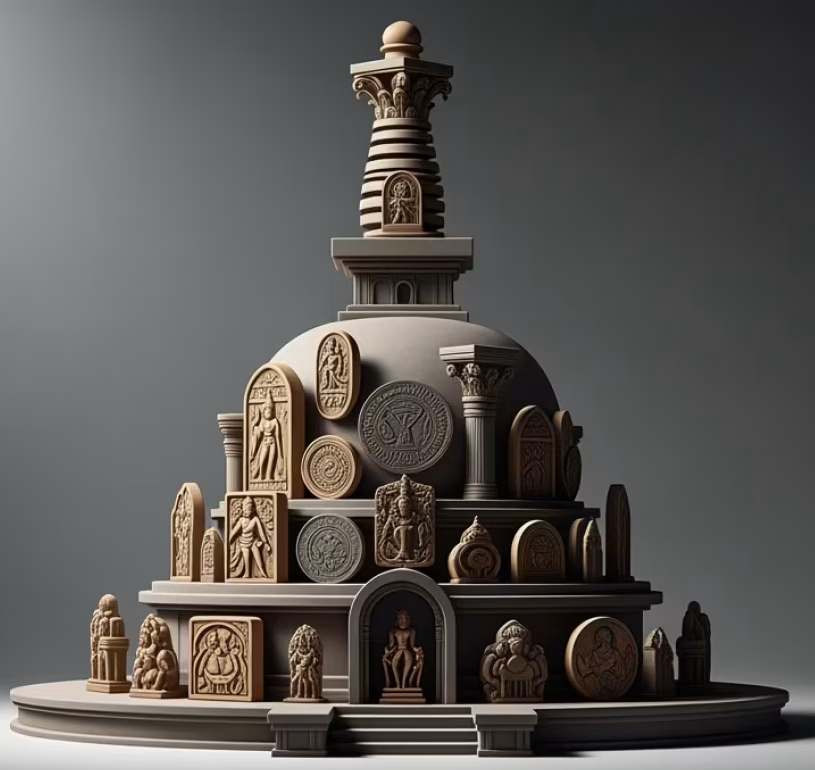
Most students know about World Heritage Sites — the Taj Mahal, Hampi, Kaziranga. These are tangible. You can touch them, visit them, photograph them. But UNESCO recognised something deeper in 2003. Traditions, performing arts, rituals, oral expressions, knowledge systems, and craftsmanship — these are alive in people, not in stones. They can disappear in a single generation if no one carries them forward.
The 2003 Convention for the Safeguarding of the Intangible Cultural Heritage created a formal framework to identify, document, and protect these living traditions. India ratified this convention in 2005. Under it, UNESCO maintains the Representative List of the Intangible Cultural Heritage of Humanity.
As of 2026, India has 15 elements on this list. These include Koodiyattam (the oldest surviving theatre tradition), Yoga, Kumbh Mela, Durga Puja in Kolkata, and Garba of Gujarat — the most recent addition. Each of these has appeared or can appear in UPSC questions.
Why This Concept Keeps Appearing in UPSC
The UPSC loves topics that are both static and dynamic. Intangible Cultural Heritage is a textbook example. The convention itself is static — you study it once. But the UNESCO list gets updated almost every year, creating a fresh current affairs angle. This dual nature makes it a favourite for question setters.
Consider how a single inscription — say, Durga Puja being added in 2021 — can generate questions on Bengali culture, community participation, festival economics, and India’s soft power diplomacy. One event, four papers. That is the kind of efficiency UPSC tests.
Furthermore, the distinction between tangible and intangible heritage is a classic Prelims trap. Students confuse the World Heritage List (for sites) with the Representative List (for practices). The selection criteria are completely different. World Heritage Sites are evaluated on Outstanding Universal Value. Intangible Cultural Heritage elements are evaluated on community involvement and safeguarding plans.
India’s Complete ICH List — Know Every Entry
Here are India’s inscriptions on the UNESCO Representative List. I recommend memorising the name, the year of inscription, and the state or region associated with each:
Koodiyattam (2008, Kerala) — Sanskrit theatre form. Ramlila (2008, Uttar Pradesh) — traditional performance of the Ramayana. Kutiyattam tradition of the Chakyar community. Vedic Chanting (2008) — oral tradition of Vedas. Ramman (2009, Uttarakhand) — religious festival of Garhwal. Mudiyettu (2010, Kerala) — ritual theatre. Kalbelia (2010, Rajasthan) — folk songs and dances. Chhau Dance (2010, Odisha-Jharkhand-West Bengal). Buddhist Chanting of Ladakh (2012). Sankirtana of Manipur (2013). Traditional Brass and Copper Craft of Thatheras (2014, Punjab). Yoga (2016). Kumbh Mela (2017). Durga Puja in Kolkata (2021). Garba of Gujarat (2023).
Notice the geographic spread — from Ladakh to Kerala, from Rajasthan to Manipur. UPSC can frame match-the-following questions pairing the element with its state or its year.
How This Connects to Current Affairs in 2026
India’s Ministry of Culture has been actively pushing for more nominations. The National Mission on Cultural Mapping aims to document cultural assets at the village level across India. This initiative directly feeds into future UNESCO nominations.
In international forums, India uses cultural heritage as a soft power tool. When India hosted the G20 presidency, cultural showcases were a deliberate strategy. Questions on India’s cultural diplomacy in GS-II Mains can easily reference ICH elements.
Additionally, the tension between commercialisation and preservation of intangible heritage is a recurring Mains theme. When Garba went global through social media, debates arose about cultural authenticity versus commercial adaptation. This is exactly the kind of nuanced discussion UPSC expects in a 250-word answer.
The Tangible vs. Intangible Distinction — A Common Prelims Trap
Let me make this very clear because students lose marks here. The 1972 World Heritage Convention protects tangible heritage — monuments, sites, natural areas. The 2003 ICH Convention protects intangible heritage — practices, expressions, knowledge. They are two separate treaties, two separate lists, two separate sets of criteria. A question might list four UNESCO-related items and ask which belongs to which category. If you conflate the two, you get it wrong.
Also remember: there is a third list called the Memory of the World Register which covers documentary heritage — manuscripts, archives, audio-visual material. India’s entries include the Rigveda manuscripts and the archives of the Dutch East India Company. Three conventions, three lists — keep them distinct in your mind.
Previous Year UPSC Questions on This Topic
Q1. With reference to the cultural heritage of India, consider the following pairs:
1.935 Kutiyattam — Kerala
2. Chhau Dance — Madhya Pradesh
3. Kalbelia — Rajasthan
Which of the pairs given above is/are correctly matched?
(UPSC Prelims 2014 — GS)
Answer: Pairs 1 and 3 are correct. Chhau Dance belongs to the Odisha-Jharkhand-West Bengal belt, not Madhya Pradesh. This is a classic geography-culture trap. The examiner tests whether you associate cultural forms with the correct region. Always link each art form to its state of origin during revision.
Q2. What are the significances of UNESCO’s Intangible Cultural Heritage List? How does it help in preserving India’s diverse cultural traditions?
(UPSC Mains 2022 pattern — GS-I, 15 marks)
Model Answer: UNESCO’s ICH List recognises living traditions that communities practise and transmit across generations. For India, inscription brings global visibility, encourages documentation, and channels government funding toward safeguarding. It strengthens community pride and prevents cultural erosion due to urbanisation. However, mere listing is not enough — ground-level implementation of safeguarding plans remains a challenge. India’s 15 inscriptions showcase its cultural diversity, but hundreds of tribal and folk traditions remain undocumented. A bottom-up approach through the National Mission on Cultural Mapping can bridge this gap. The ICH framework also aids India’s cultural diplomacy by projecting soft power globally.
Q3. Consider the following statements about UNESCO conventions:
1. The World Heritage Convention was adopted in 1972.
2. The Intangible Cultural Heritage Convention was adopted in 2003.
3. Both conventions are administered by the same committee.
Which of the statements given above is/are correct?
(UPSC Prelims 2019 style — GS)
Answer: Statements 1 and 2 are correct. Statement 3 is wrong. The World Heritage Committee oversees the 1972 Convention, while the Intergovernmental Committee for the Safeguarding of ICH oversees the 2003 Convention. They are separate bodies under UNESCO. This distinction is tested to check if students have surface-level or deep understanding of institutional architecture.
Key Points to Remember for UPSC
- Two separate conventions — 1972 for tangible (sites), 2003 for intangible (practices). Never mix them.
- India ratified the ICH Convention in 2005 and has 15 elements on the Representative List as of 2026.
- The most recent Indian addition is Garba of Gujarat (2023) — expect current affairs follow-ups.
- ICH elements are evaluated on community participation and safeguarding plans, not on outstanding universal value.
- The Memory of the World Register is a third, separate UNESCO programme covering documentary heritage.
- India’s National Mission on Cultural Mapping is the domestic policy framework linked to ICH preservation.
- Cultural heritage questions can appear across GS-I, GS-II, and even GS-III — prepare cross-linkages.
- Always memorise the state or region associated with each ICH element — match-the-following is a favourite format.
Understanding intangible cultural heritage gives you a reliable anchor for Art and Culture preparation. It connects static knowledge to dynamic current affairs without extra effort. My suggestion: make a one-page chart of all 15 ICH elements with their year and state, revise it once a month, and track UNESCO announcements every December when new inscriptions are declared. That small habit can secure you two to three marks in Prelims and strengthen at least one Mains answer — consistently, year after year.
Get fastest alerts on Results, Admit Cards & Govt Jobs directly on your phone.