
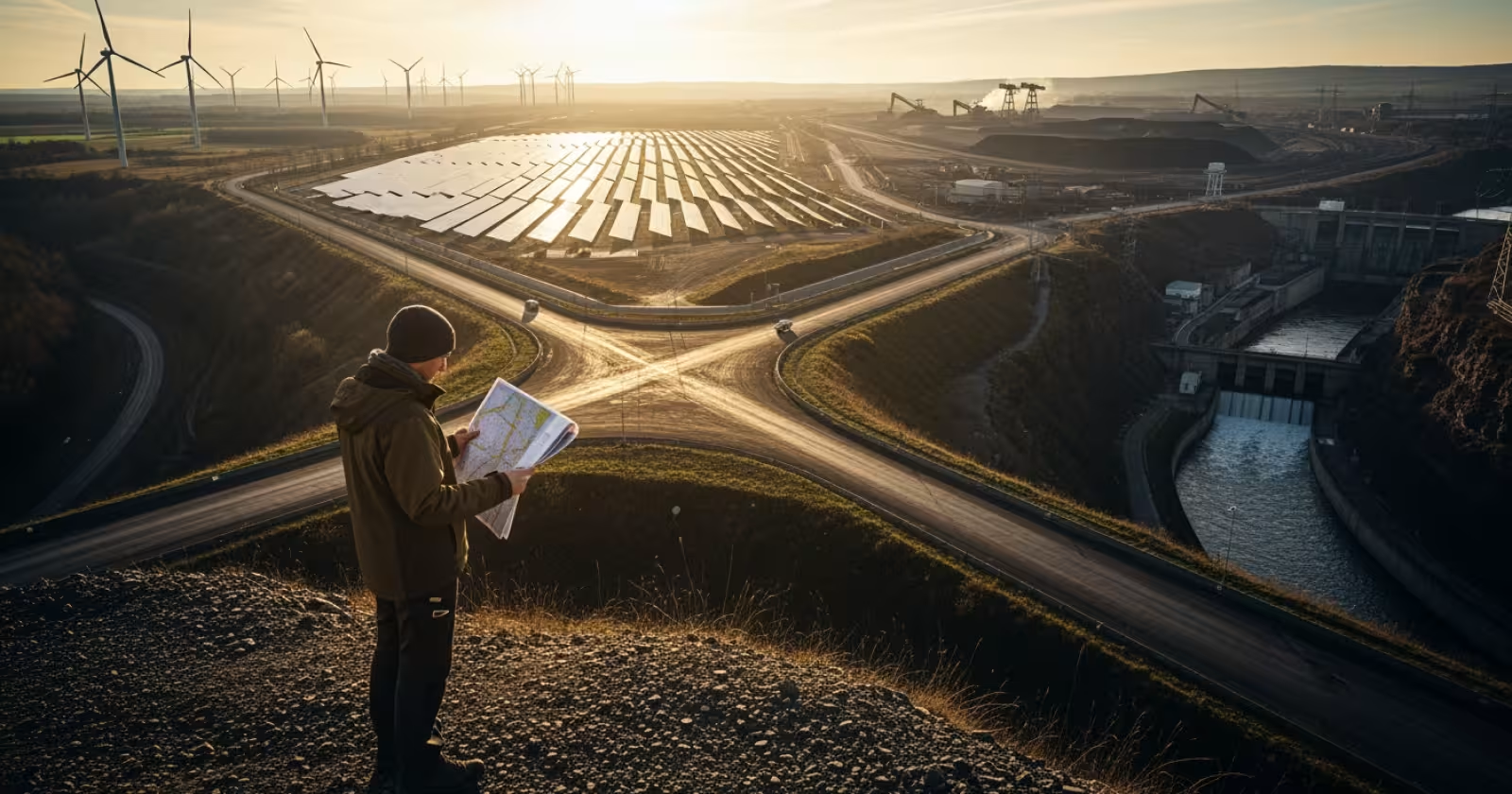
Every year, UPSC finds clever ways to test your understanding of where India’s energy comes from and how that shapes the country’s economic policy. If you have ever wondered why a geography question suddenly feels like an economics question, this article will connect those dots for you clearly.
Where This Topic Sits in the UPSC Syllabus
Energy resources sit at a unique crossroads in the UPSC syllabus. They appear directly in Geography and then resurface in Economy, Environment, and even Security papers. This is exactly why the examiner loves this area — it tests interdisciplinary thinking.
| Exam Stage | Paper | Syllabus Section |
|---|---|---|
| Prelims | General Studies | Indian Geography — Distribution of Key Natural Resources |
| Mains | GS-I | Distribution of Key Natural Resources across the World (including India) |
| Mains | GS-III | Infrastructure: Energy, Conservation, Environmental Pollution |
| Mains | GS-III | Indian Economy — Growth, Development, Resource Mobilisation |
Questions from this zone have appeared in Prelims and Mains consistently over the last decade. The examiner often frames a geography fact inside an economy wrapper — for example, asking about coal import dependency while actually testing your knowledge of coalfield locations.
India’s Coal Geography — The Backbone That Carries Economic Weight
India is the world’s second-largest producer of coal, yet it remains a major coal importer. This single contradiction is a goldmine for UPSC questions. The reason lies in geography: most of India’s coal is found in the Gondwana rock formations of peninsular India — Jharkhand, Odisha, Chhattisgarh, West Bengal, and Madhya Pradesh.
The Damodar Valley region in Jharkhand and West Bengal alone accounts for nearly half of India’s coal reserves. Jharia, Raniganj, Bokaro — these are names every aspirant should know. Tertiary coal deposits exist in the northeast (Meghalaya, Assam), but they are of lower grade and harder to extract.
Here is the economy bridge: India’s thermal power plants depend on domestic coal, but the high-ash content of Indian coal forces many plants to import better-quality coal from Indonesia and Australia. This directly affects India’s current account deficit, import bill, and energy security policy. One geography fact — coal quality — connects to trade balance, fiscal policy, and even foreign relations.
Petroleum and Natural Gas — Where Geography Meets Geopolitics
India produces crude oil primarily from the Mumbai High offshore basin, the Upper Assam basin (Digboi, Naharkatiya), and parts of Rajasthan (Barmer basin). But domestic production meets only about 15-18% of India’s total crude oil demand. The rest is imported, mainly from West Asia.
Natural gas comes from the Krishna-Godavari basin, Mumbai High, and Assam. The KG-D6 block operated by Reliance became a major talking point in both energy policy and corporate governance debates. For UPSC, the location of these basins matters because questions often test whether you can distinguish between oil-producing and gas-producing regions.
The economy angle is sharp here. India’s oil import bill is one of the largest components of its trade deficit. Every time crude oil prices spike globally, India’s inflation rises, the rupee weakens, and fiscal calculations change. I always tell my students — if you understand Bombay High’s output limitations, you automatically understand why India’s foreign policy gives so much weight to Gulf nations.
Renewable Energy — The New Geography of Power
India’s renewable energy story is rewriting the map. Solar energy potential is highest in Rajasthan, Gujarat, and parts of Madhya Pradesh and Andhra Pradesh. The Bhadla Solar Park in Rajasthan is one of the world’s largest. Wind energy is concentrated along the western coast — Tamil Nadu, Gujarat, Karnataka, and Maharashtra lead in installed capacity.
The National Solar Mission, launched under the National Action Plan on Climate Change, set ambitious targets. India aims for 500 GW of non-fossil fuel capacity by 2030. This target shapes budgetary allocations, subsidy structures, and trade policy (since India imports most solar panels from China).
For UPSC Mains, the examiner frequently asks you to evaluate India’s renewable energy progress. The answer requires geography (where resources are), economy (how they are funded), and environment (why they matter for climate commitments). This is the bridge the examiner builds, and you must walk across it confidently.
Nuclear and Hydroelectric Energy — Strategic and Regional Dimensions
India’s nuclear power plants are located at Tarapur (Maharashtra), Kalpakkam (Tamil Nadu), Rawatbhata (Rajasthan), Narora (UP), Kakrapar (Gujarat), and Kudankulam (Tamil Nadu). Uranium comes primarily from Jaduguda in Jharkhand. Thorium reserves — among the world’s largest — are found in the monazite sands of Kerala and Tamil Nadu.
India’s three-stage nuclear programme, envisioned by Homi Bhabha, is designed to eventually use thorium. This long-term vision connects resource geography to strategic self-reliance — a favourite Mains theme.
Hydroelectric power is concentrated in the Himalayan states — Himachal Pradesh, Uttarakhand, Arunachal Pradesh, and Sikkim. The Brahmaputra and Indus systems hold enormous potential. But environmental concerns, displacement issues, and interstate water disputes complicate development. Again, geography feeds directly into governance and economy questions.
How UPSC Frames the Bridge Questions
I have noticed a clear pattern in UPSC papers. The examiner takes a geographic fact — say, the location of coalfields — and frames a question around its economic implication. For example, a Prelims question might ask about the type of coal found in Jharkhand, but the underlying test is whether you understand why India imports coking coal despite having large reserves.
In Mains, you might see a question like: “Discuss how India’s energy resource distribution affects regional economic disparities.” This requires you to combine geography (resource-rich vs resource-poor states), economy (investment patterns, industrial corridors), and governance (centre-state fiscal relations).
The best strategy is to study energy resources not as isolated geographic facts but as starting points for economic chains. Every resource has a location, a limitation, a policy response, and an economic consequence. Map all four, and you will handle any bridge question the examiner throws at you.
Key Points to Remember for UPSC
- Gondwana coalfields (Damodar Valley) hold most of India’s coal, but high ash content forces thermal coal imports — linking geography to trade deficit.
- Mumbai High, Upper Assam, and Barmer are the three key petroleum-producing regions; domestic output covers less than 20% of demand.
- KG Basin is significant for natural gas; its output fluctuations directly affect India’s gas pricing and fertiliser subsidy bill.
- Rajasthan and Gujarat lead solar energy; Tamil Nadu and Gujarat lead wind energy — these states attract maximum renewable energy investment.
- India’s three-stage nuclear programme links Jaduguda’s uranium and Kerala’s thorium to long-term energy independence.
- Hydroelectric potential is concentrated in Himalayan states but faces environmental clearance and interstate dispute challenges.
- India’s 500 GW non-fossil fuel target by 2030 connects energy geography to climate diplomacy and budgetary planning.
Understanding India’s energy geography as an economic chain — from resource location to policy consequence — gives you a serious edge in both Prelims and Mains. I suggest you create a single integrated map marking all major energy resources, and beside each one, note the economic policy it connects to. That one exercise can prepare you for an entire category of UPSC questions that many aspirants find tricky.
Get fastest alerts on Results, Admit Cards & Govt Jobs directly on your phone.