
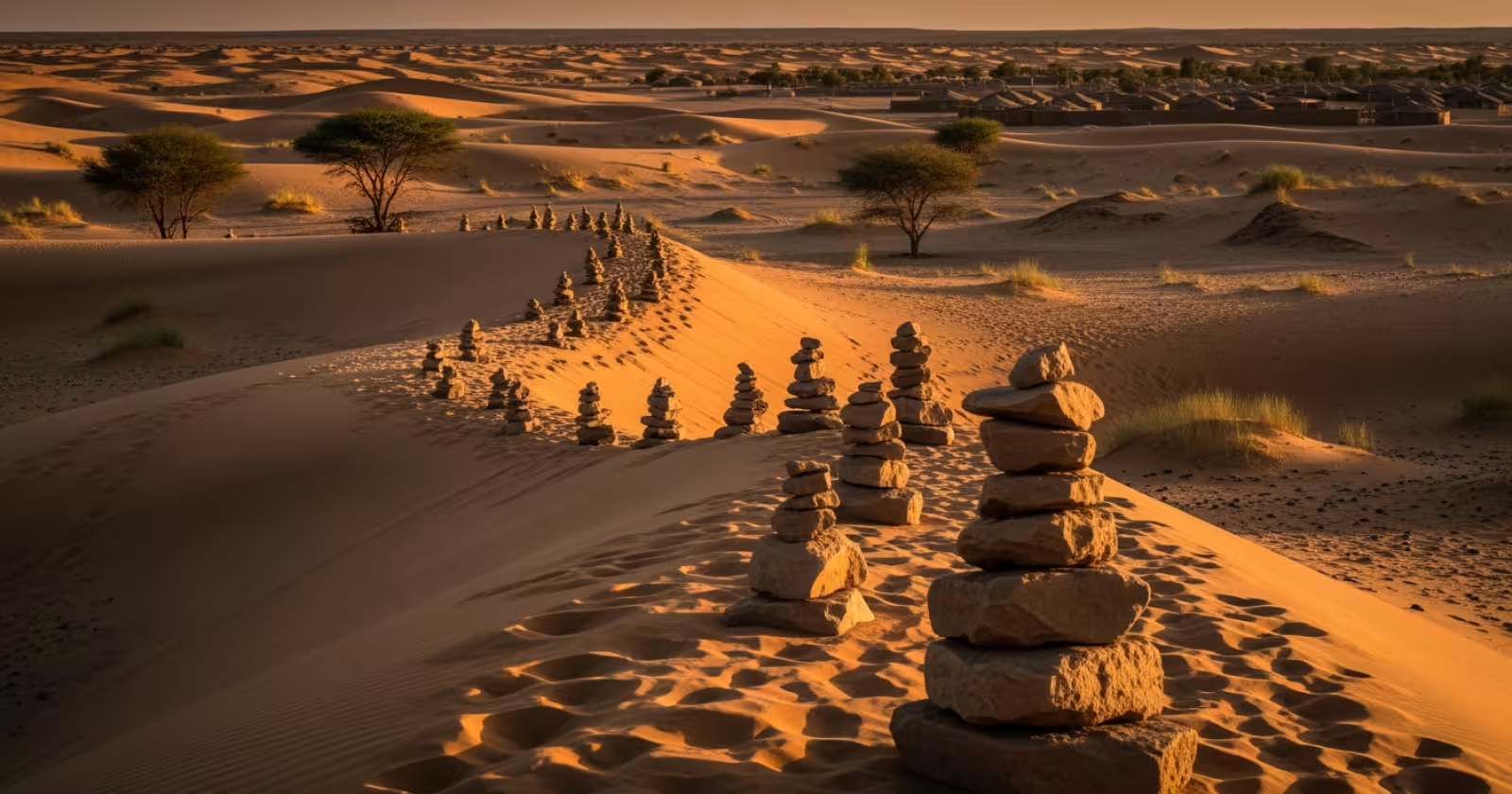
When you think of deserts, you probably picture lifeless sand stretching to the horizon. But India’s deserts are anything but lifeless — they are living classrooms where geography, ecology, and centuries-old culture overlap in ways that UPSC loves to test. Understanding these connections can help you answer questions across multiple sections of GS-I, and even parts of GS-III.
Where This Topic Sits in the UPSC Syllabus
India’s desert regions are a cross-cutting theme. They appear directly in the physical geography section of GS-I under “Distribution of key natural resources” and “Geophysical phenomena.” The cultural dimension falls under “Salient features of Indian Society” and “Diversity of India.” For GS-III, desertification connects to the environment and ecology segment.
| Exam Stage | Paper | Relevant Syllabus Section |
|---|---|---|
| Prelims | General Studies | Indian Physical Geography, Biodiversity |
| Mains | GS-I | Physical Geography, Indian Culture and Society |
| Mains | GS-III | Environment, Conservation, Desertification |
Questions on desert climate, the Thar ecosystem, and cultural practices of arid regions have appeared multiple times in both Prelims and Mains over the last decade.
India’s Two Major Desert Systems
India has two distinct desert types — the hot desert and the cold desert. The Thar Desert (also called the Great Indian Desert) spreads across western Rajasthan, parts of Gujarat, Haryana, and Punjab. It covers roughly 2,00,000 square kilometres and is one of the most densely populated deserts in the world.
The Ladakh Cold Desert sits at an average altitude of over 3,000 metres in the trans-Himalayan region. It receives less than 100 mm of annual rainfall. Unlike the Thar, temperatures here plummet well below minus 30°C in winter. Both deserts are rain-shadow regions, but their geographic mechanisms differ completely.
The Thar lies in the rain shadow of the Aravalli Range, which runs parallel to the southwest monsoon winds and fails to block them effectively. Ladakh, on the other hand, is shielded by the Greater Himalayas, which block moisture-laden winds from reaching the plateau.
Geomorphology and Landforms
The Thar is not a uniform sandy wasteland. It contains sand dunes (both longitudinal and barchan types), rocky platforms called hamada, gravel plains, and seasonal salt lakes like Sambhar Lake and the Rann of Kutch. The Rann of Kutch is a unique seasonal marshy salt flat — it floods during the monsoon and becomes a white salt desert in the dry months.
Ladakh’s landscape features moraines, glacial valleys, and high-altitude plateaus. The Pangong Tso and Tso Moriri lakes are remnants of larger ancient water bodies. These landforms are shaped by frost weathering, glacial activity, and extreme temperature variations — processes quite different from the wind erosion that dominates the Thar.
Biodiversity in Arid Lands
Desert ecosystems support more life than most students expect. The Thar hosts the Great Indian Bustard, now critically endangered, along with the Indian gazelle (chinkara), desert fox, and spiny-tailed lizard. The Desert National Park near Jaisalmer preserves this fragile ecosystem.
Vegetation includes xerophytic species like khejri (Prosopis cineraria), rohida, and various thorny bushes. The khejri tree is sacred to the Bishnoi community of Rajasthan — a direct link between ecology and culture. The Bishnois have protected wildlife and trees for over five centuries, long before modern environmentalism existed.
In Ladakh, the snow leopard, Tibetan wild ass (kiang), and black-necked crane are flagship species. The cold desert biosphere reserve protects some of these. UPSC has asked about cold desert biodiversity in the environment section multiple times.
Culture Rooted in the Desert
Desert cultures in India are shaped entirely by the scarcity of water and the harshness of climate. In western Rajasthan, communities developed remarkable traditional water harvesting systems — tankas (underground tanks), johads (earthen dams), khadins (agricultural embankments), and baoris (step wells). These systems are relevant for both GS-I (society) and GS-III (water management).
The Kalbeliya dance, performed by the Kalbeliya snake-charmer community of Rajasthan, is a UNESCO Intangible Cultural Heritage. Music forms like Maand and instruments like the kamaicha and morchang reflect adaptation to desert life. Festivals like the Pushkar Fair and Desert Festival of Jaisalmer combine trade, religion, and cultural celebration.
In Ladakh, Buddhist monasteries like Hemis, Thiksey, and Diskit are cultural landmarks. The annual Hemis Festival celebrates Guru Padmasambhava. The Ladakhi people practice a form of cooperative agriculture called ress, where entire villages collaborate during the short growing season. This reflects how extreme geography shapes social organisation.
Desertification — The Growing Threat
According to ISRO’s Desertification and Land Degradation Atlas, nearly 30% of India’s land area faces some form of degradation. The Thar is expanding eastward. Causes include overgrazing, deforestation, unsustainable farming, and climate change. The Indira Gandhi Canal (originally Rajasthan Canal) was built partly to check this spread by bringing Sutlej-Beas water to the desert.
India is a signatory to the United Nations Convention to Combat Desertification (UNCCD). India hosted COP-14 of the UNCCD in 2019 in New Delhi and committed to restoring 26 million hectares of degraded land by 2030. The Desert Development Programme (DDP), launched in 1977, remains a key government initiative for arid zone development.
Previous Year UPSC Questions on This Topic
Q1. Which of the following is/are the characteristic features of the Thar Desert? (UPSC Prelims 2021 — GS)
This question tested knowledge of geomorphological features, rainfall patterns, and vegetation types of the Thar. The correct approach required understanding that the Thar receives some monsoon rainfall (100-500 mm annually in different parts) and is not entirely barren. Many aspirants incorrectly assumed zero rainfall.
Q2.935.935.935. Discuss the factors responsible for the formation of the Thar Desert. (UPSC Mains — GS-I)
A model answer here should cover the role of the Aravalli Range orientation, offshore winds, subtropical high-pressure belt, cold Canary-like currents (though absent here, contrast with Sahara), and the western disturbance pattern. Answers that linked geological history — the Thar was once under the sea — scored higher.
Q3. Examine the role of traditional water harvesting methods in arid regions of India. (UPSC Mains — GS-I/GS-III crossover)
This required candidates to name specific systems (tankas, johads, khadins), explain their working mechanism, and connect them to both cultural heritage and modern water management policy. The examiner was looking for local examples rather than textbook generalisations.
Key Points to Remember for UPSC
- India has both hot (Thar) and cold (Ladakh) deserts — each formed by different rain-shadow mechanisms.
- The Thar is among the world’s most populated deserts with a rich cultural and ecological identity.
- Khejri tree and the Bishnoi community represent the ecology-culture link UPSC frequently tests.
- Traditional water systems like tankas, johads, and khadins are relevant for both GS-I and GS-III answers.
- ISRO data shows nearly 30% of India’s land faces degradation — the Thar is expanding eastward.
- India hosted UNCCD COP-14 in 2019 and targets restoring 26 million hectares of degraded land by 2030.
- Cold desert biodiversity (snow leopard, black-necked crane) is a recurring Prelims theme.
This topic rewards aspirants who can think across paper boundaries. A single question on the Thar can test your geography, ecology, culture, and governance knowledge simultaneously. I would suggest making a one-page integrated note covering all three dimensions — geography, environment, and culture — for each desert region. Use that note for quick revision before both Prelims and Mains, and practise writing at least one cross-cutting answer linking all three angles.
Get fastest alerts on Results, Admit Cards & Govt Jobs directly on your phone.