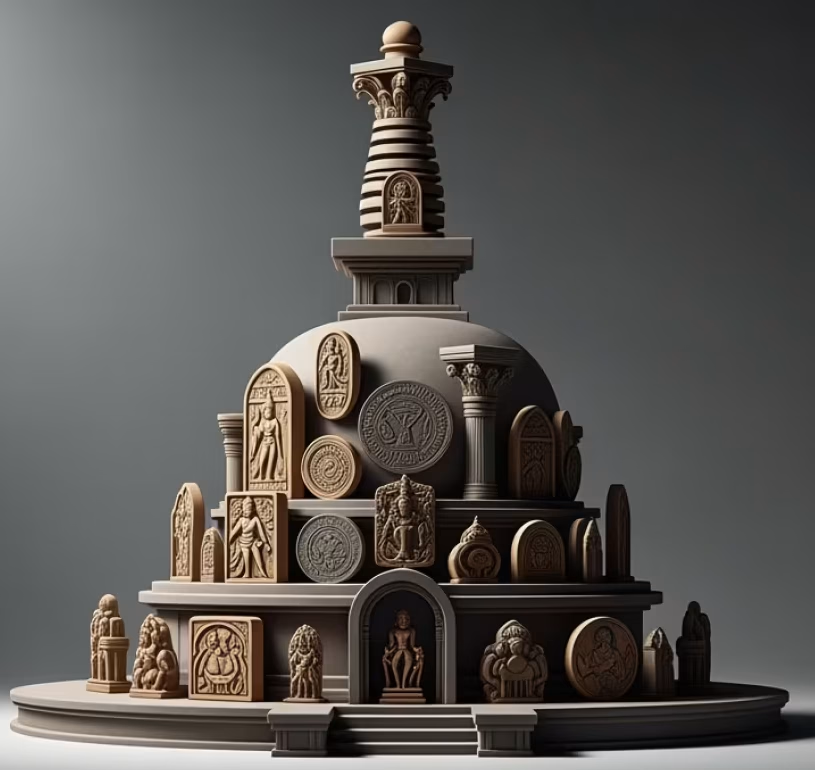

Every year, UPSC drops at least two or three Art and Culture questions in Prelims that make even well-prepared aspirants freeze. The painting you never read about, the tribal dance from a state you skipped, the temple architecture term that sounds completely alien — I have seen toppers lose marks on these. After coaching thousands of aspirants and analysing every Prelims paper since 2011, I developed a structured thinking method that dramatically improves your odds even when the question feels brand new.
This method does not require you to memorise every folk art form in India. Instead, it trains your brain to use context clues hidden inside the question itself. Let me walk you through each step with real examples.
Where Art and Culture Sits in the UPSC Syllabus
Art and Culture falls under the General Studies Paper in Prelims and GS Paper I in Mains. The Prelims syllabus mentions it as “Indian Heritage and Culture” while Mains places it under “Indian culture will cover the salient aspects of Art Forms, Literature and Architecture from ancient to modern times.” On average, 3 to 6 questions appear every year in Prelims from this area alone.
| Exam Stage | Paper | Syllabus Section | Avg. Questions |
|---|---|---|---|
| Prelims | General Studies | Indian Heritage and Culture, History | 3-6 per year |
| Mains | GS-I | Art Forms, Literature, Architecture | 1-2 questions |
The tricky part is that UPSC rarely repeats the same art form or monument. This makes pure memorisation a losing strategy. A thinking framework is far more reliable.
Step 1 — Read the Question for Era and Period Clues
The very first thing I tell my students is to scan the question for time-period markers. UPSC often embeds words like “Chola period,” “Mughal era,” “medieval,” or “Sangam age” inside the question or its options. Even if you do not recognise the specific art form, knowing the era immediately eliminates wrong options.
For example, if a question asks about a bronze sculpture and mentions the Chola dynasty, you can safely connect it to the lost-wax (cire perdue) technique and Nataraja imagery. Any option that places it in the Gandhara school or links it to stone carving is likely wrong. Period identification is your first filter — use it ruthlessly.
Step 2 — Map It to a Region or State
Indian art and culture is deeply tied to geography. If you can identify which region or state a question is pointing to, half your battle is won. I always ask students to build what I call a Regional Culture Map — a mental atlas linking states to their signature art forms, textiles, dances, and crafts.
When you encounter an unfamiliar term like “Rogan art,” the word itself may not ring a bell. But if the question mentions Gujarat or Kutch, you can connect it to textile traditions of that region. UPSC loves testing GI-tagged crafts, and almost every GI tag is tied to a specific district or state. Train yourself to think geographically before thinking encyclopaedically.
Step 3 — Identify the Medium or Material
This step is surprisingly powerful. Ask yourself: is the question about painting, sculpture, textile, dance, music, or architecture? Each medium has its own logic and its own set of associated traditions.
If the question mentions palm leaf, you are likely in the world of Pattachitra (Odisha) or manuscripts from Kerala and Eastern India. If it mentions metal casting, think Dhokra art of Bastar or Chola bronzes. If the word fresco appears, your mind should jump to Ajanta, Bagh, or Lepakshi. The material or medium narrows down your options faster than trying to recall a specific name from your notes.
Step 4 — Use the Options Against Each Other
This is a pure exam-hall technique. In UPSC Prelims, wrong options are not random. They are designed to be plausible. But they often belong to different categories or different regions. Compare the four options and look for the odd one out.
Suppose a question asks which of the following is a classical dance form recognised by the Sangeet Natak Akademi. If three options are dance forms and one is a folk theatre tradition, the folk theatre option is likely the trap. Similarly, if two options belong to the same state and the question is about a different state’s tradition, those two can be eliminated together. I call this cross-option analysis. It works because UPSC designs distractors with patterns, and patterns can be decoded.
Step 5 — Apply the UNESCO and Government Recognition Filter
UPSC has a strong pattern of asking about art forms, sites, or traditions that have received official recognition. This includes UNESCO World Heritage Sites, UNESCO Intangible Cultural Heritage listings, GI Tags, and Sangeet Natak Akademi classifications. If you have studied these curated lists, you already have a powerful verification tool.
When a question feels unfamiliar, ask yourself: has this item appeared in any recent UNESCO or GI Tag announcement? In 2024 and 2026, several Indian traditions were added to the UNESCO intangible heritage list. UPSC loves to test these within a year or two of the announcement. Keeping a running list of such recognitions gives you an edge that no textbook alone can provide.
How to Practice This Method Before the Exam
Knowing the steps is not enough. You must practice applying them under timed conditions. Here is what I recommend to my students. Pick any 10 Art and Culture questions from previous years — preferably ones you got wrong or guessed. Now apply all five steps consciously on each question. Write down which step helped you reach the answer or at least eliminate options.
After doing this for 30 to 40 questions, the method becomes instinctive. You stop panicking when you see an unfamiliar term. Instead, your brain automatically starts scanning for era, region, medium, option patterns, and recognition status. This shift from panic to process is what separates a 90+ Prelims scorer from someone stuck at 75.
Building Your Art and Culture Base Alongside This Method
Let me be honest — this method works best when you already have a reasonable base. You cannot eliminate options if you know nothing at all. The foundation should come from NCERT Class 11 Fine Arts textbook, a standard Art and Culture reference book, and monthly current affairs compilations that track GI Tags and UNESCO updates.
Focus on building familiarity rather than memorising details. You do not need to remember the exact year Bharatanatyam was codified. But you must know it is from Tamil Nadu, it is a classical form, and it has Nritta, Nritya, and Natya components. Familiarity lets the five-step method do its job. Without it, you are guessing blindly.
Key Points to Remember for UPSC
- Era identification is your fastest elimination tool — Chola, Mughal, Gupta, and Pallava periods each have distinct art signatures.
- Build a Regional Culture Map linking every state to its top 3-4 art forms, textiles, and crafts.
- The medium or material (bronze, palm leaf, stone, textile) instantly narrows the tradition to a small set of possibilities.
- UPSC distractors follow patterns — compare options against each other before comparing them against your memory.
- Maintain an updated list of GI Tags, UNESCO heritage listings, and Sangeet Natak Akademi recognitions from 2024 to 2026.
- NCERT Fine Arts textbook plus monthly current affairs is sufficient base-building for most aspirants.
- Practice this method on 30-40 past questions to make it automatic before exam day.
Art and Culture does not have to be the section where you lose marks to luck. With a structured approach, even unfamiliar questions become solvable puzzles. Start applying these five steps on your next practice set — you will notice the difference within a single sitting. Consistent practice with this framework will turn one of the most unpredictable sections of Prelims into one of your most reliable ones.