

Modern History remains one of the most important parts of UPSC preparation, and a large share of Prelims questions can be linked to Spectrum by Rajiv Ahir. For many aspirants, this book is not just a standard source but the main base for understanding the rise of British rule, reform movements, the Revolt of 1857, and the Indian National Movement. The real issue, however, is not whether you are reading Spectrum, but whether you are reading the right chapters with the right priority.
UPSC does not treat every chapter equally, and students should not do so either. Some sections of Spectrum repeatedly produce direct Prelims questions and strong Mains themes, while others are useful mainly for background understanding. This chapter-by-chapter breakdown is meant to help you study more strategically, so you can focus your time on the portions that matter most, revise with better clarity, and connect your reading with actual UPSC question patterns.
Where This Topic Sits in the UPSC Syllabus
Modern Indian History is one of the most consistently tested areas in both Prelims and Mains. The UPSC syllabus mentions it explicitly under multiple heads.
| Exam Stage | Paper | Syllabus Section |
|---|---|---|
| Prelims | General Studies | History of India and Indian National Movement |
| Mains | GS Paper I | Modern Indian History from the middle of the eighteenth century — significant events, personalities, issues |
| Mains | GS Paper I | The Freedom Struggle — its various stages and important contributors from different parts of the country |
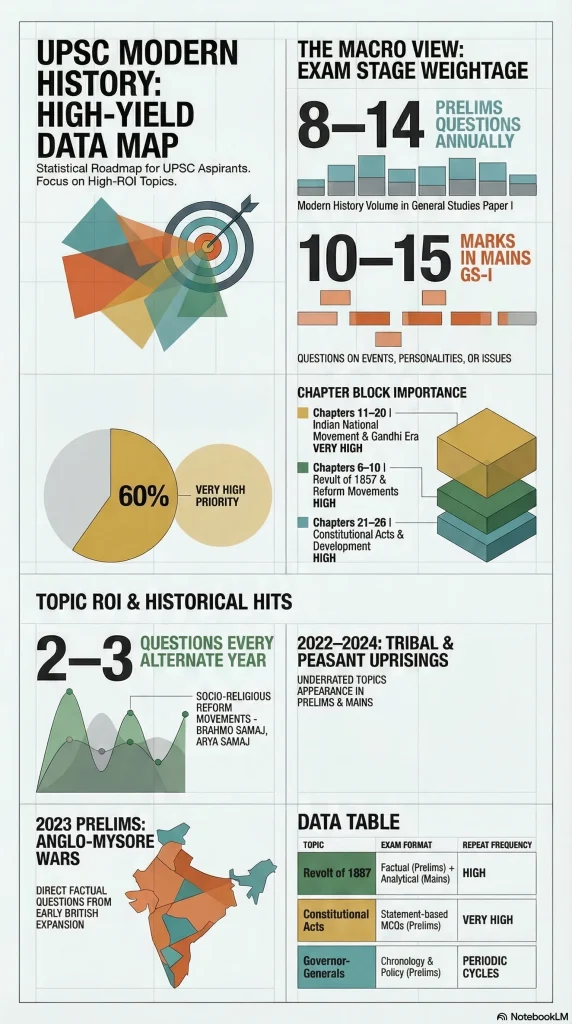
Over the last 15 years, Prelims has consistently asked 8-14 questions from Modern History. Mains GS-I almost always carries one or two questions worth 10-15 marks each. This makes Spectrum one of the highest return-on-investment books in your entire preparation stack.
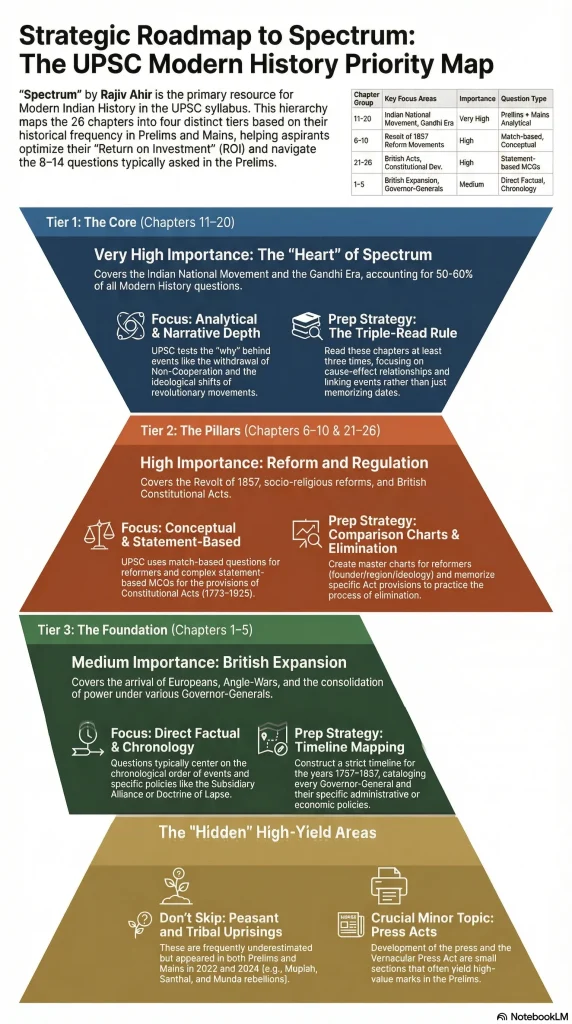
| Section | Key Focus Areas | Importance Level | How UPSC Asks Questions | Preparation Strategy |
|---|---|---|---|---|
| Chapters 1–5 | British Expansion, Anglo Wars, Governor-Generals | Medium | Direct factual, chronology | Make timeline (1757–1857), focus on policies |
| Chapters 6–10 | Revolt of 1857, Reform Movements | High | Match-based, conceptual | Create comparison charts (founder, ideology, region) |
| Chapters 11–20 | Indian National Movement, Gandhi Era | Very High | Prelims + Mains analytical | Read 3 times, focus on cause-effect, link events |
| Chapters 21–26 | British Acts, Constitutional Development | High | Statement-based MCQs | Memorise provisions, practice elimination |
| Repeated PYQ Areas | Tribal, Peasant Movements, Press Acts | High | Repeated factual + conceptual | Do PYQs topic-wise after each chapter |
| Overall Trend | 8–14 Questions in Prelims | Very High | Mixed (static + analytical) | Revise multiple times, avoid multiple sources |
The Early Chapters — European Penetration and Resistance (Chapters 1-5)
Spectrum opens with the arrival of Europeans in India, the establishment of the East India Company, and early resistance movements. These chapters cover figures like Tipu Sultan, the Carnatic Wars, the Bengal Nawabs, and the consolidation of British power.
UPSC loves picking factual questions from this section. In 2023 Prelims, there was a direct question on the Anglo-Mysore Wars. Questions on subsidiary alliance, doctrine of lapse, and the Permanent Settlement appear almost in cycles. I tell my students to make a timeline chart for every Governor-General mentioned in these chapters. Knowing the chronological order of events between 1757 and 1857 is half the battle for Prelims.
Pay special attention to the economic policies of the British discussed in these chapters. UPSC often frames Mains questions around the economic drain theory and deindustrialisation — topics that sit right here.
The Revolt of 1857 and Socio-Religious Reforms (Chapters 6-10)
This is where the question density starts to increase sharply. The Revolt of 1857 itself has been asked repeatedly — sometimes as a straightforward factual question, sometimes as an analytical Mains question asking you to evaluate its nature (was it a mutiny, a rebellion, or the first war of independence?).
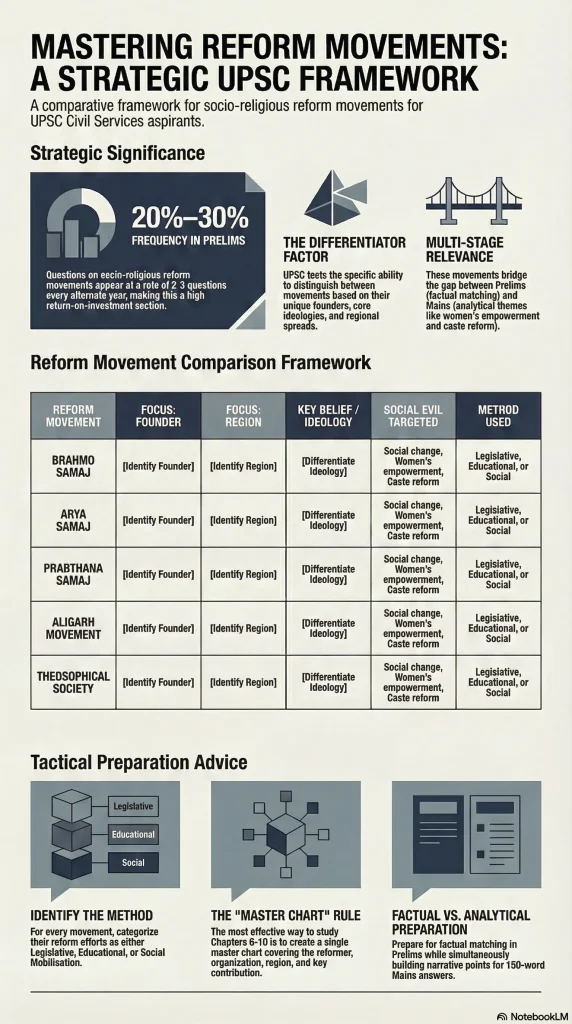
The chapters on socio-religious reform movements are gold mines for UPSC. Brahmo Samaj, Arya Samaj, Prarthana Samaj, Aligarh Movement, the Theosophical Society — UPSC tests your ability to differentiate between these movements, their founders, their core beliefs, and their regional spread. I have seen at least 2-3 Prelims questions every alternate year from this section alone.
For Mains, reform movements connect beautifully with questions on social change, women’s empowerment, and caste reform. When you read these chapters, always note down the specific social evil each reformer targeted and the method they used — legislative, educational, or social mobilisation.
The Indian National Movement — The Heart of Spectrum (Chapters 11-20)
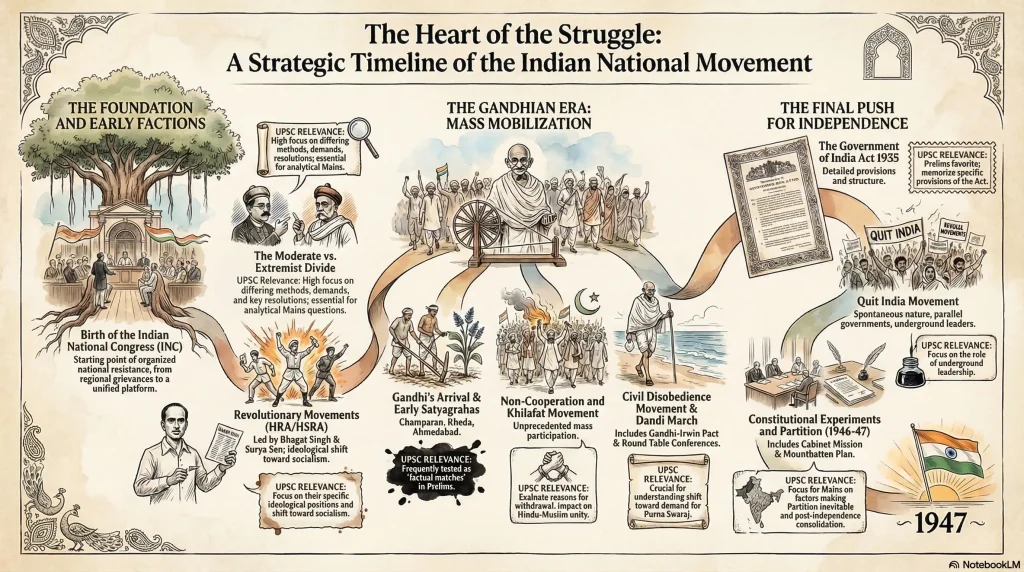
If Spectrum were a movie, this would be the interval sequence that nobody can afford to miss. These chapters cover the birth of the Indian National Congress, the Moderate and Extremist phases, the arrival of Mahatma Gandhi, and the major movements — Non-Cooperation, Civil Disobedience, Quit India.
Let me be direct. Nearly 50-60% of all UPSC Modern History questions come from this block. The pattern is clear:
- Moderates vs Extremists — Expect questions on their methods, demands, and key resolutions
- Gandhi’s early movements in India — Champaran, Kheda, Ahmedabad are tested as factual matches
- Non-Cooperation and Khilafat — Focus on why it was withdrawn and its impact on Hindu-Muslim unity
- Civil Disobedience Movement — The Dandi March, the Gandhi-Irwin Pact, and Round Table Conferences
- Revolutionary Movements — Bhagat Singh, Surya Sen, HRA/HSRA, their ideological positions
- Quit India Movement — Its spontaneous nature, parallel governments, and the role of underground leaders
For Mains, UPSC often asks you to assess the contribution of a specific leader or evaluate the effectiveness of a particular movement. These are not questions you can answer with bullet points alone. You need narrative understanding. Read these chapters slowly, making mental connections between cause and effect.
Constitutional Development and Post-1935 India (Chapters 21-26)
These later chapters cover the constitutional experiments under British rule — the Indian Councils Act, the Morley-Minto Reforms, the Montagu-Chelmsford Reforms, the Government of India Act 1935, and the journey towards independence and partition.
UPSC Prelims frequently tests the specific provisions of each Act. A classic pattern is to give you four statements about the Government of India Act 1935 and ask which are correct. Without reading Spectrum’s chapters on this, these questions become guesswork.
The chapters on the Cabinet Mission, the Mountbatten Plan, and the events of 1946-47 are tested more in Mains. Partition-related questions have appeared in recent years, asking aspirants to discuss the factors that made partition inevitable. These chapters also connect to GS-I questions on post-independence consolidation.
Chapters That Are Often Underestimated
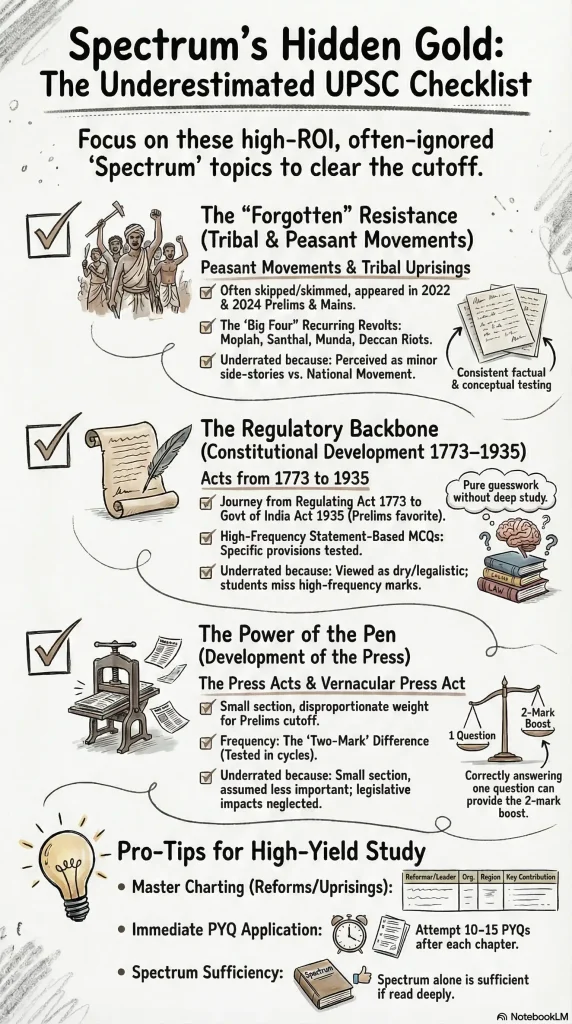
There are two sections in Spectrum that many students skip or skim — the chapters on peasant movements and tribal uprisings. This is a mistake. UPSC has asked about the Moplah Rebellion, the Santhal uprising, the Munda Rebellion, and the Deccan Riots multiple times. In 2022 and 2024, tribal movements appeared in both Prelims and Mains.
Similarly, the section on the development of the press and the Vernacular Press Act is a small but frequently tested area. One question from here can make the difference between clearing the cutoff or falling short by two marks.
How to Actually Use This Map in Your Preparation
Knowing which chapters matter most is only half the work. Here is how I recommend you use this information practically:
- Read the high-yield chapters (11-20) at least three times during your preparation cycle
- For chapters 1-5, focus on making comparison tables — Governor-Generals, their policies, and key events
- For reform movements, create a single master chart with columns for reformer, organisation, region, and key contribution
- After every chapter, attempt 10-15 previous year questions from that specific topic
- For Mains, practice writing 150-word answers on movement-related questions after finishing each chapter
Key Points to Remember for UPSC
- Chapters on the Indian National Movement (11-20) yield the maximum Prelims and Mains questions — prioritise them above all else
- Socio-religious reform movements are tested almost every year; know the differences between each movement’s ideology and method
- Constitutional development Acts (1773 to 1935) are Prelims favourites — memorise specific provisions of each Act
- Peasant and tribal movements are underrated but consistently tested; never skip Spectrum’s coverage of these uprisings
- The Revolt of 1857 appears in both factual (Prelims) and analytical (Mains) formats — prepare for both
- Governor-Generals and their associated policies form the backbone of pre-1857 questions
- Spectrum alone is sufficient for Modern History if read deeply — do not chase multiple books for this subject
Mapping your reading to actual exam patterns transforms passive reading into active preparation. Take this chapter-by-chapter breakdown, sit with your copy of Spectrum, and mark the high-priority sections before your next reading cycle. One well-read book, used strategically, will always outperform five books read carelessly.
Get fastest alerts on Results, Admit Cards & Govt Jobs directly on your phone.