
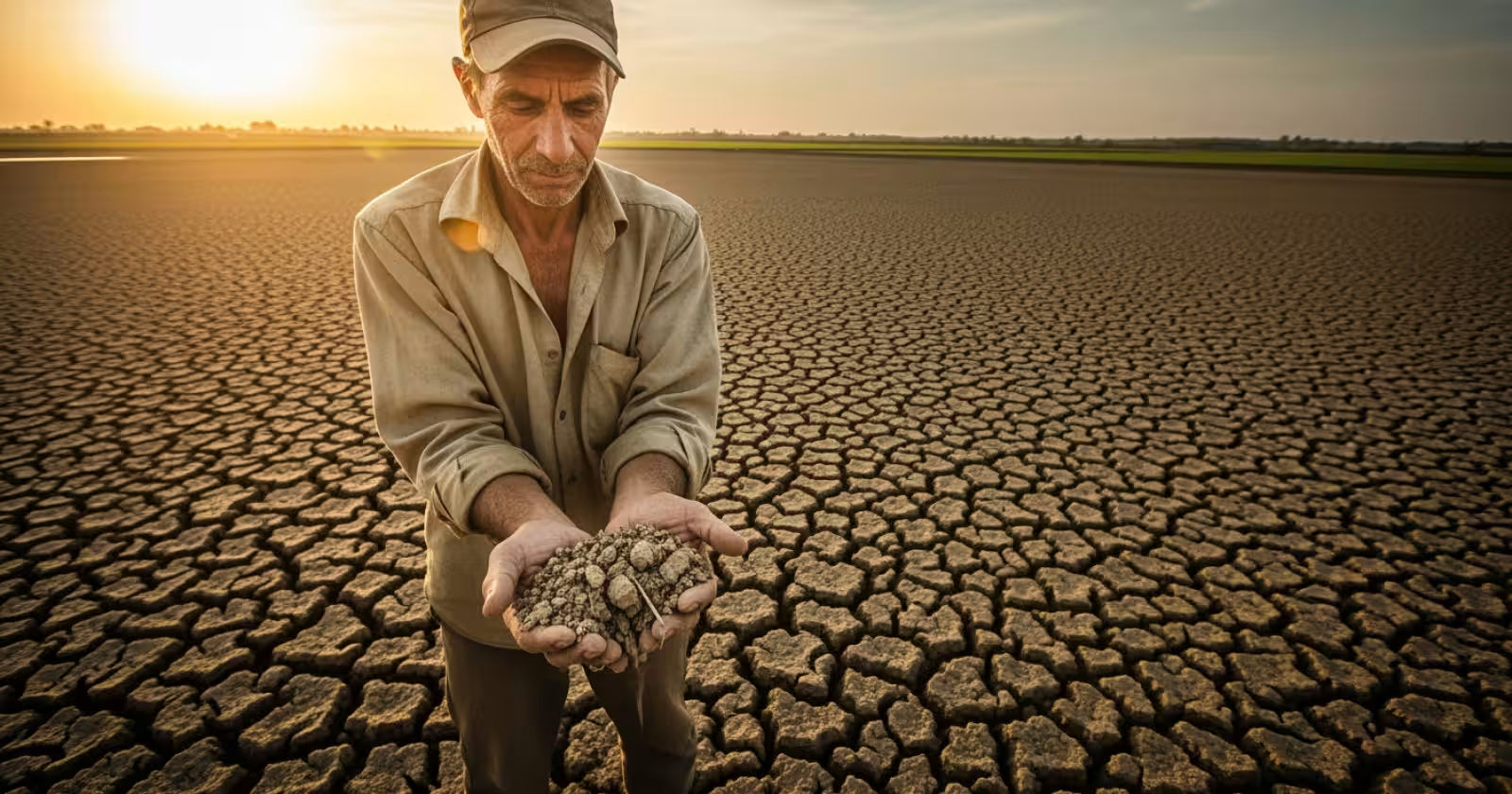
India has lost nearly one-third of its natural wetlands in the last four decades. What most aspirants miss is that this environmental loss directly fuels the agrarian distress that UPSC loves to test across multiple papers. Let me walk you through this powerful cross-cutting connection that can elevate your answers from average to outstanding.
Where This Topic Sits in the UPSC Syllabus
This is not a single-paper topic. The beauty of the wetland-agrarian crisis link is that it cuts across at least three General Studies papers, making it a favourite for examiners who want to test integrated thinking.

| Exam Stage | Paper | Syllabus Section |
|---|---|---|
| Prelims | General Studies | Ecology, Environment, Biodiversity |
| Mains | GS-I | Geography of India — Water Resources, Distribution of Key Natural Resources |
| Mains | GS-III | Environment and Ecology; Agriculture — Issues related to direct and indirect farm subsidies |
| Mains | GS-III | Conservation, Environmental Pollution and Degradation |
Questions on wetlands have appeared in Prelims almost every alternate year since 2015. Mains questions on agrarian distress are a staple of GS-III. But the examiner increasingly rewards candidates who connect these two domains in a single, well-argued answer.
Understanding Wetlands and Their Role in Agriculture
A wetland is any area where water covers the soil or remains near the surface for a significant part of the year. Think of the paddy fields of Kerala’s Kuttanad, the jheels of Bihar, or the marshes along the Brahmaputra. India has over 7.5 lakh wetlands as per the National Wetland Inventory.
Wetlands serve agriculture in ways that are not immediately obvious. They act as natural reservoirs, recharging groundwater that millions of tube wells depend on. They filter water, reducing the cost of irrigation. They support fisheries that provide protein and income to small farmers. During floods, wetlands absorb excess water and protect crops in downstream fields.
When I teach this topic, I use a simple analogy. Think of wetlands as a sponge placed between the river and the farm. Remove the sponge, and the farm either drowns in the monsoon or dries up in summer. That is exactly what is happening across India today.
How Wetland Degradation Drives Agrarian Distress
The connection operates through several channels. Let me break them down clearly.
Groundwater depletion: When wetlands are drained for construction or encroached upon, the natural recharge of aquifers slows down. Punjab and Haryana have lost most of their seasonal wetlands. These are also the states where the groundwater table is falling fastest. Farmers then spend more on deeper borewells, increasing their debt burden.
Loss of flood buffering: Assam and Bihar lose thousands of crores worth of crops to floods every year. The degradation of floodplain wetlands — locally called chaurs and mauns — means floodwater reaches farms faster and with greater force. What was once a natural defence is now a lost asset.
Decline of inland fisheries: For marginal farmers, fishing in local wetlands is a secondary income source. The degradation of lakes like Kolleru in Andhra Pradesh and Loktak in Manipur has reduced fish catch, pushing families deeper into poverty.
Soil salinity and waterlogging: Ironically, poorly managed wetland drainage — especially in canal-irrigated areas of Rajasthan and Haryana — causes waterlogging and soil salinity. This renders farmland unproductive. The Indira Gandhi Canal region is a textbook example.
Loss of ecosystem services: Wetlands provide fodder, medicinal plants, and water for livestock. When these disappear, the hidden support system for small and marginal farmers collapses.
The Policy Dimension — What UPSC Expects You to Know
India notified the Wetlands (Conservation and Management) Rules, 2017 under the Environment Protection Act, 1986. These rules replaced the 2010 rules and shifted the authority for wetland identification and management to State Wetland Authorities. Critics argue this decentralisation has weakened protection because state governments often prioritise development over conservation.
India is a signatory to the Ramsar Convention on Wetlands (1971). As of 2026, India has over 80 Ramsar sites — the highest in South Asia. However, Ramsar designation alone does not guarantee protection on the ground. Encroachment continues even in designated sites like East Kolkata Wetlands, which treat Kolkata’s sewage naturally and support fish farming for thousands of families.
The MGNREGA scheme has been used for wetland restoration in some districts, linking rural employment with ecological recovery. This is a valuable point for Mains answers because it shows how environmental restoration and agrarian welfare can be integrated through existing policy instruments.
Why the Examiner Loves This Cross-Connection
UPSC has been moving towards questions that test your ability to see linkages. A question that appears to be about environment may actually be testing your understanding of economics or social justice. In 2023, a GS-III question on ecological restoration indirectly demanded knowledge of livelihood impacts. In 2019, a question on water conservation expected candidates to discuss agricultural implications.
When you write about wetland degradation, do not treat it as a purely environmental issue. Always bring in the human element — the farmer who loses groundwater access, the fisher who loses income, the village that loses flood protection. This approach earns better marks because it demonstrates analytical depth.
Previous Year UPSC Questions on This Topic
Q1. Which of the following statements about Ramsar Convention is/are correct?
(UPSC Prelims 2022 — General Studies)
Answer: This question tested factual knowledge about the Ramsar Convention’s scope, criteria for designation, and India’s obligations. The key point examiners tested was whether candidates understood that the Convention covers all wetlands, not just those on the Ramsar List. Many aspirants incorrectly assumed only listed sites are protected.
Q2. How does the crippling of the Inland fisheries sector affect the food security of India?
(UPSC Mains 2019 — GS-III, 15 marks)
Answer: This question required candidates to connect fisheries decline with nutrition, rural employment, and wetland degradation. A strong answer would discuss how wetland loss reduces fish habitats, how inland fisheries contribute nearly 70% of India’s total fish production, and how marginal communities dependent on fishing are pushed towards agrarian labour markets that are already saturated. Policy suggestions should include wetland restoration under MGNREGA and strengthening State Wetland Authorities.
Q3. Discuss the environmental and socio-economic consequences of the degradation of wetland ecosystems in India.
(UPSC Mains-style probable question — GS-III)
Answer: This is a high-probability question for upcoming exams. Your answer should cover biodiversity loss, groundwater depletion, flood vulnerability, and livelihood impacts on fishing and farming communities. Use specific examples — Chilika Lake’s revival as a positive case, East Kolkata Wetlands’ ongoing encroachment as a negative one. Conclude with the 2017 Rules and their implementation gaps.
Key Points to Remember for UPSC
- India has over 7.5 lakh wetlands; more than 80 are designated Ramsar sites as of 2026.
- Wetland degradation directly impacts groundwater recharge, flood control, fisheries, and soil quality — all linked to farm livelihoods.
- The Wetlands Rules 2017 shifted management authority to State Wetland Authorities, raising concerns about weakened enforcement.
- Inland fisheries contribute nearly 70% of India’s fish production and depend heavily on healthy wetland ecosystems.
- MGNREGA can be used as a policy tool for wetland restoration, linking employment generation with ecological recovery.
- Always connect wetland questions to agrarian, livelihood, and governance dimensions in Mains answers for higher marks.
- Chilika Lake is a successful restoration example; East Kolkata Wetlands illustrate ongoing urban encroachment challenges.
This topic rewards aspirants who think in connections rather than silos. When you revise environment, consciously link it to agriculture, water resources, and rural poverty. Practice writing at least one integrated answer that brings wetlands and agrarian distress together — it will sharpen your analytical writing and prepare you for the kind of questions UPSC is increasingly setting. Consistent practice with such cross-cutting themes builds the depth that separates selected candidates from the rest.