
You sit down to study. You’ve barely finished one paragraph when someone walks in and asks — “Kitna hua? Kab tak clear hoga?” And just like that, the focus you spent fifteen minutes building quietly disappears.
Most students blame themselves for losing concentration. But what’s actually happening has nothing to do with willpower. It happens inside your brain, at a chemical level, and it repeats every single time someone checks in on your preparation — even with love.
The Question Your Brain Treats as a Threat
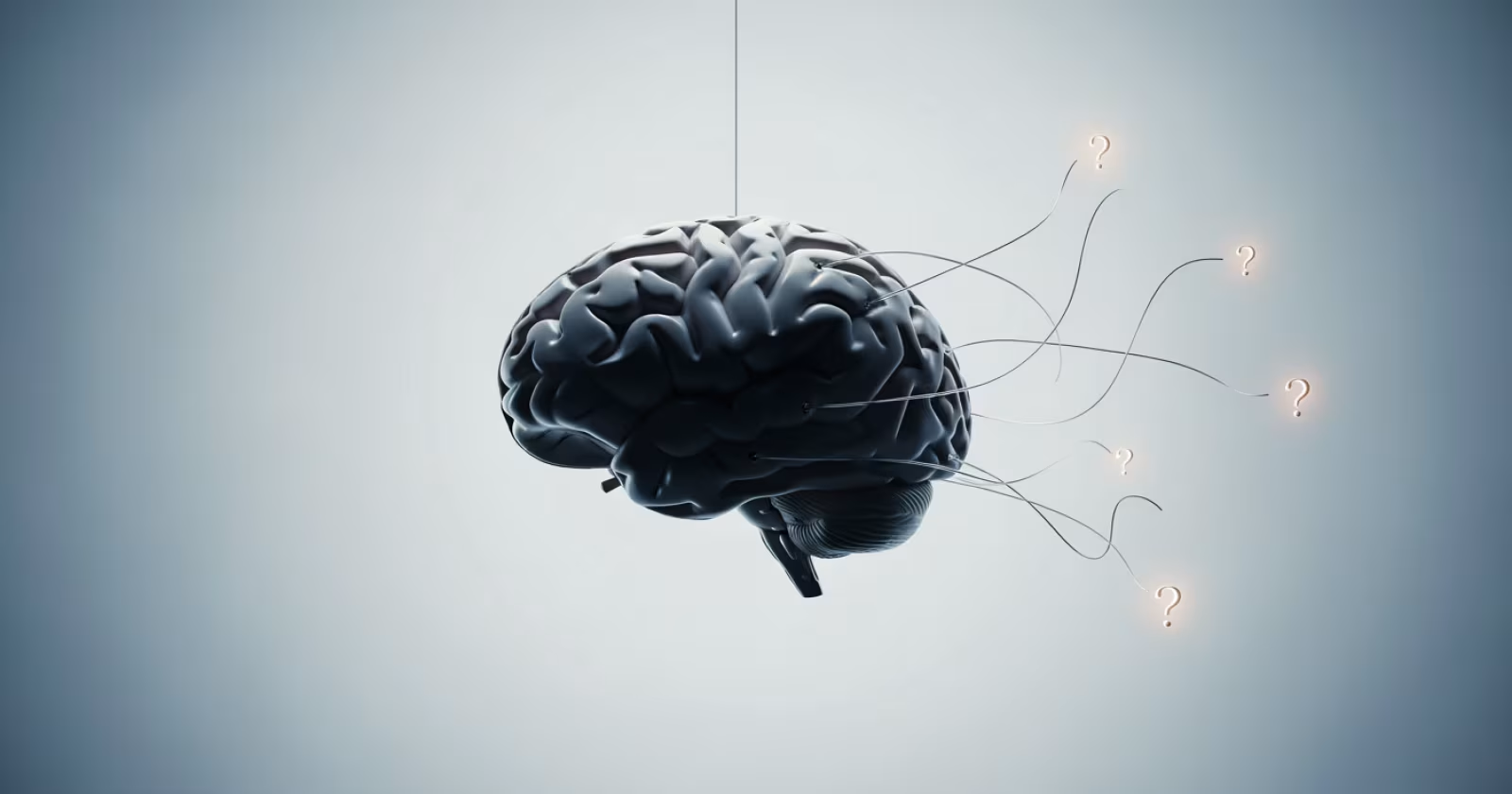
When a parent asks how your preparation is going, they genuinely mean well. But your brain doesn’t process it as care. It processes it as evaluation. And the moment you feel evaluated — even by someone who loves you — cortisol spikes. That’s the stress hormone. Its job is not to help you think better. Its job is to prepare you for a threat.
Your brain cannot tell the difference between a parent’s worried question and an actual danger. So it responds the same way — by pulling activity away from the prefrontal cortex, which is the part responsible for memory, focus, and deep thinking. You get irritated, go quiet, or start over-explaining your progress. None of those states help you study Polity or solve a reasoning problem.
What makes this worse is that the cycle repeats. The question comes. You feel a wave of shame or guilt. You either defend yourself or shut down. Either way, you’ve now burned mental energy that was supposed to go into actual preparation. And this isn’t a one-time thing — it compounds quietly over weeks.
The Invisible Weight That Builds Over Time
Here’s something most students never name out loud: when someone at home asks about your preparation daily, you start absorbing their anxiety as your own. Their timeline becomes your guilt. Their worry becomes your background noise. And somewhere in that space, you lose the thread of why you even started preparing.
Students in joint families feel this even more sharply. It’s not just parents — it’s uncles, aunts, and neighbours who ask with the same well-meaning curiosity. Each question adds a small but real psychological weight. Over time, you start performing the idea of preparation more than actually doing it. You keep the book open even when your mind has checked out, just so no one asks again.
Psychologists call the constant feeling of being watched and assessed “evaluation apprehension.” It doesn’t need someone in the room to be active. Once the pattern is set, you carry it around in your head. You study with one eye on the door. It drains focus without making any visible noise.
How Different Questions Hit Differently
| Type of Question | Emotional Impact | Brain Response |
|---|---|---|
| “Are you even studying?” | Guilt, defensiveness | Cortisol spike, focus drops immediately |
| “When will you clear this?” | Anxiety, hopelessness | Decision fatigue, motivation loss |
| “Others from our area cleared it” | Shame, comparison spiral | Confidence crash, overthinking loop |
| “Should you change your strategy?” | Self-doubt, confusion | Cognitive overload, plan abandonment |
| No questions, calm environment | Neutral, grounded | Sustained focus, deeper retention |
What Students Try vs. What Actually Works
The first thing most students do is avoid the family — lock the room, put on headphones, stop sharing updates entirely. This reduces some friction but creates a different kind of problem. Distance grows. Tension builds. And the internal pressure doesn’t actually leave — it just has no outlet.
The shift that actually works is simpler: one honest conversation, not daily deflection. Something like telling your family — “I’ll update you every Sunday. Daily questions break my concentration, and I know you don’t mean it that way.” Most parents, when spoken to with respect and clarity, adjust more than students expect. They don’t want to hurt you. They just don’t know what helping looks like.
The internal shift matters just as much. You have to consciously separate their anxiety from your performance. Their worry comes from love and investment. It doesn’t have to become your mental interference. What they’re feeling is theirs. What you need to protect is your headspace.
Three things that genuinely reduce this pressure cycle without breaking family relationships: set a weekly progress update so they have something concrete instead of daily uncertainty. Track your own progress privately — when you know what you’ve covered, a sudden question doesn’t shake you as much because you have data, not guesses. And watch for the moment you start studying harder right before someone enters the room. That’s a signal you’re preparing for their approval, not your exam.
Why Structured Preparation Feels Like Protection
Students who follow a written, structured study plan feel noticeably less disturbed by external pressure — not because they’re emotionally stronger, but because they have clarity. They know what they did today and what’s planned for tomorrow. That clarity acts like a psychological shield. A parent’s worried question bounces off because the student actually knows where they stand.
When preparation is vague — “I’ll study whatever feels right today” — every external question becomes a mirror showing you all your gaps. But when your plan is concrete and tied to a timeline, the same question stops feeling like an accusation.
This is something I’ve seen consistently in students preparing for UPSC, RAS, and SSC. The ones who crack it aren’t always the ones who studied the most hours. Many of them are the ones who figured out how to study without carrying everyone else’s fear on their shoulders — and who had a clear enough structure that the noise around them stopped landing.
If right now external pressure is affecting your preparation more than a lack of content knowledge, that tells you something important about where the real gap is. The answer isn’t to study harder under the same conditions. It’s to change the conditions — starting with understanding what’s really happening in your brain when someone asks, with all their love and all their worry: “Beta, kya chal raha hai?”
Get fastest alerts on Results, Admit Cards & Govt Jobs directly on your phone.