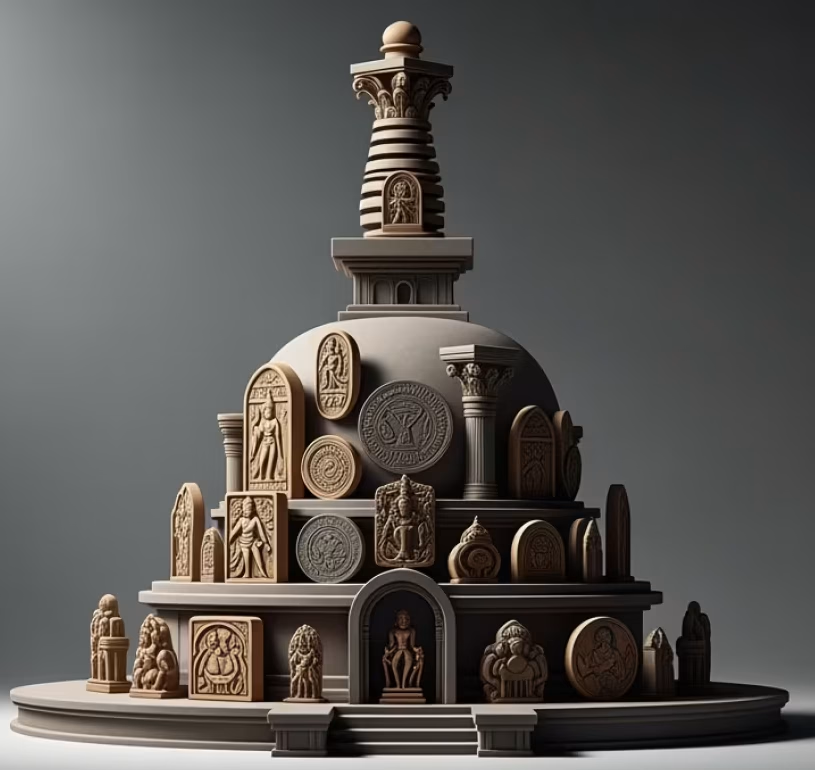

Every year, UPSC finds a way to test whether you truly understand how Indian civilisation absorbed, blended, and transformed diverse cultural streams during the medieval period. Most aspirants write one-dimensional answers — listing saints or monuments. That approach rarely scores well. I want to show you how to build multi-dimensional answers that examiners reward.
Where This Topic Sits in the UPSC Syllabus
Medieval syncretic culture falls squarely under GS Paper I. The syllabus line reads: “Indian culture will cover the salient aspects of Art Forms, Literature and Architecture from ancient to modern times.” It also connects with “Modern Indian history — significant events, personalities, issues” because syncretic traditions directly shaped the social reform movements of the 19th century.
| Exam Stage | Paper | Syllabus Section |
|---|---|---|
| Prelims | General Studies | Indian Heritage and Culture — Art, Literature, Architecture |
| Mains | GS-I | Indian Culture — Salient aspects of Art Forms, Literature, Architecture |
| Mains | GS-I | Social empowerment, Role of women, Population issues |
| Mains | GS-IV | Contributions of moral thinkers from India |
This topic appears in Prelims as factual questions on saints, texts, or architectural features. In Mains, it appears as analytical questions asking you to evaluate the impact of syncretic movements on Indian society. Between 2013 and 2026, questions touching syncretism appeared at least eight to ten times across both stages.
What Syncretism Actually Means in the Medieval Indian Context
Syncretism means the merging of different religious, cultural, or philosophical traditions into something new. In medieval India, this was not a government policy. It happened organically — through trade, migration, shared living spaces, and spiritual curiosity. When a Sufi saint sat under a peepal tree and sang in the local language, that was syncretism in action.
I always tell my students to think of syncretism as a two-way street. Hindu devotional traditions influenced Sufi practices, and Persian-Arabic literary forms reshaped Indian poetry and music. Neither side simply “borrowed.” Both transformed.
The Bhakti and Sufi Dimensions — Beyond Name-Dropping
Most aspirants can name Kabir, Guru Nanak, Ramananda, and Chishti saints. The examiner already knows you can memorise a list. What earns marks is explaining the structural similarities and the social impact.
The Bhakti saints rejected rigid caste hierarchies and ritualism. They composed in vernacular languages — Avadhi, Punjabi, Marathi, Kannada — making spiritual ideas accessible to ordinary people. The Sufi saints, particularly from the Chishti order, did something remarkably parallel. They embraced local languages, used music (sama) as a devotional tool, and opened their khanqahs to people of all faiths.
Kabir is the most cited example, and rightly so. His dohas criticised both Hindu and Muslim orthodoxy. But go beyond Kabir. Mention Bulleh Shah in Punjab, Dadu Dayal in Rajasthan, and the Mahanubhava sect in Maharashtra. This shows the examiner that your understanding is pan-Indian, not textbook-limited.
Architecture and Art — The Visual Evidence of Blending
When UPSC asks about syncretic culture, many aspirants forget that architecture is one of the strongest pieces of evidence. Indo-Islamic architecture is not simply “Islamic architecture built in India.” It is a genuinely hybrid form.
Consider the Quwwat-ul-Islam mosque in Delhi. It reused pillars from destroyed Hindu and Jain temples. Over time, this crude reuse evolved into deliberate artistic fusion. The Atala Masjid in Jaunpur, the monuments of the Bahmani Sultanate, and especially the buildings of Akbar’s reign at Fatehpur Sikri show conscious blending of trabeate (beam-based) Hindu construction with arcuate (arch-based) Islamic techniques.
In painting, the Mughal miniature tradition combined Persian refinement with Indian naturalism. Rajput and Pahari schools then absorbed Mughal techniques while retaining Hindu mythological themes. This back-and-forth is syncretism made visible.
Language and Literature — The Dimension Most Students Miss
Amir Khusrau is the single most important figure here. He composed in Persian, Hindavi, and a mixed register that some scholars call early Urdu. His riddles, songs, and masnavi poetry brought together two literary worlds. Urdu itself, which developed in the camps and bazaars of the Delhi Sultanate, is a syncretic language — Hindi grammar carrying a large Persian and Arabic vocabulary.
Regional literatures also reflect this blending. Bengali literature of the medieval period carries deep Sufi influences alongside Vaishnavite devotion. Dakhani literature in the Deccan is another powerful example. When you cite these in your Mains answer, you demonstrate geographic and thematic range.
How to Structure a Multi-Dimensional Mains Answer
I recommend a simple framework I call RALS — Religion, Art, Language, Society. When you get a question on medieval syncretic culture, mentally map your answer across these four pillars.
Start your introduction by defining syncretism in one or two sentences. Then dedicate one paragraph each to at least three of the four RALS dimensions. In your conclusion, connect medieval syncretism to the idea of composite Indian nationalism — this links GS-I content to the broader freedom struggle narrative, which examiners appreciate.
Avoid writing everything you know. A 250-word Mains answer cannot cover every saint and every monument. Pick two strong examples per dimension. Quality and analytical depth always beat exhaustive listing.
Previous Year UPSC Questions on This Topic
Q1. Assess the role of the Bhakti and Sufi movements in bridging the socio-religious divide in medieval India.
(UPSC Mains 2014 — GS-I)
Answer: Both movements emerged as responses to religious orthodoxy. Bhakti saints like Kabir and Ravidas rejected caste discrimination and ritualism. Sufi saints like Nizamuddin Auliya emphasised love, service, and equality before God. Structurally, both used vernacular languages and music to reach common people. Their khanqahs and ashrams served as spaces where Hindus and Muslims interacted freely. However, their impact on formal social structures was limited — caste and religious divisions persisted. Their lasting contribution was cultural: shared festivals, musical traditions like qawwali, and a vocabulary of devotion that transcended religious boundaries.
Explanation: The examiner wanted both appreciation and critical evaluation. Simply praising the movements is not enough. You must acknowledge their limitations — they did not end caste or communalism — while clearly stating their cultural legacy.
Q2. Which of the following is/are associated with the Chishti order of Sufism?
1. Emphasis on sama (musical gatherings) 2. Acceptance of state patronage 3. Use of local languages for preaching
(UPSC Prelims 2019 — GS)
Answer: Statements 1 and 3 are correct. The Chishti order, unlike the Suhrawardi order, generally avoided close association with political power. Chishtis were known for their embrace of sama and their preference for vernacular communication.
Explanation: UPSC Prelims often tests whether you can distinguish between different Sufi orders. The Chishti order is the most frequently asked. Remember: Chishtis avoided state patronage, Suhrawardis accepted it. This single distinction has appeared in multiple question formats.
Q3. Discuss how Indo-Islamic architecture represents a synthesis of Indian and Central Asian building traditions.
(UPSC Mains 2015 — GS-I)
Answer: Indo-Islamic architecture is not a mere transplant of Central Asian forms. It evolved through centuries of interaction. Early Sultanate structures like the Qutb complex reused Hindu temple elements, creating an unplanned hybrid. By the 15th century, regional sultanates in Bengal, Malwa, and the Deccan developed distinct styles blending local materials and motifs with Islamic geometric patterns. Mughal architecture perfected this synthesis — Fatehpur Sikri uses red sandstone with both Hindu chhatris and Islamic domes. The Taj Mahal combines Persian garden design with Indian inlay work (pietra dura borrowed from Rajasthani craftsmanship). This architectural tradition proves that cultural exchange was not superficial but deeply structural.
Explanation: Architecture questions demand specific monument names and technical terms. Mentioning trabeate versus arcuate construction, naming specific buildings across regions, and showing chronological evolution — these are what separate a good answer from an average one.
Key Points to Remember for UPSC
- Syncretism in medieval India was organic and two-directional — not imposed by any ruler or policy.
- The Bhakti and Sufi movements shared structural features: vernacular language, rejection of orthodoxy, and inclusive spiritual spaces.
- Amir Khusrau is the single most important literary figure representing medieval cultural synthesis.
- Indo-Islamic architecture evolved from crude reuse of temple materials to conscious artistic fusion over three centuries.
- Use the RALS framework (Religion, Art, Language, Society) to structure multi-dimensional Mains answers.
- Always distinguish between Sufi orders — Chishti saints avoided state patronage; Suhrawardi saints accepted it.
- Connect medieval syncretism to the concept of composite nationalism in your conclusion for Mains answers.
- Regional examples (Dakhani literature, Bengal Vaishnavism, Bahmani architecture) strengthen your answer beyond the Delhi-centric narrative.
Understanding how different cultural streams merged during the medieval period gives you material for Art and Culture, Indian Society, and even Ethics paper answers. As a next step, pick any three monuments from three different regions and practice writing a 150-word note on each, highlighting their syncretic features. This exercise builds the kind of specific, grounded knowledge that translates directly into marks on exam day.
Get fastest alerts on Results, Admit Cards & Govt Jobs directly on your phone.