
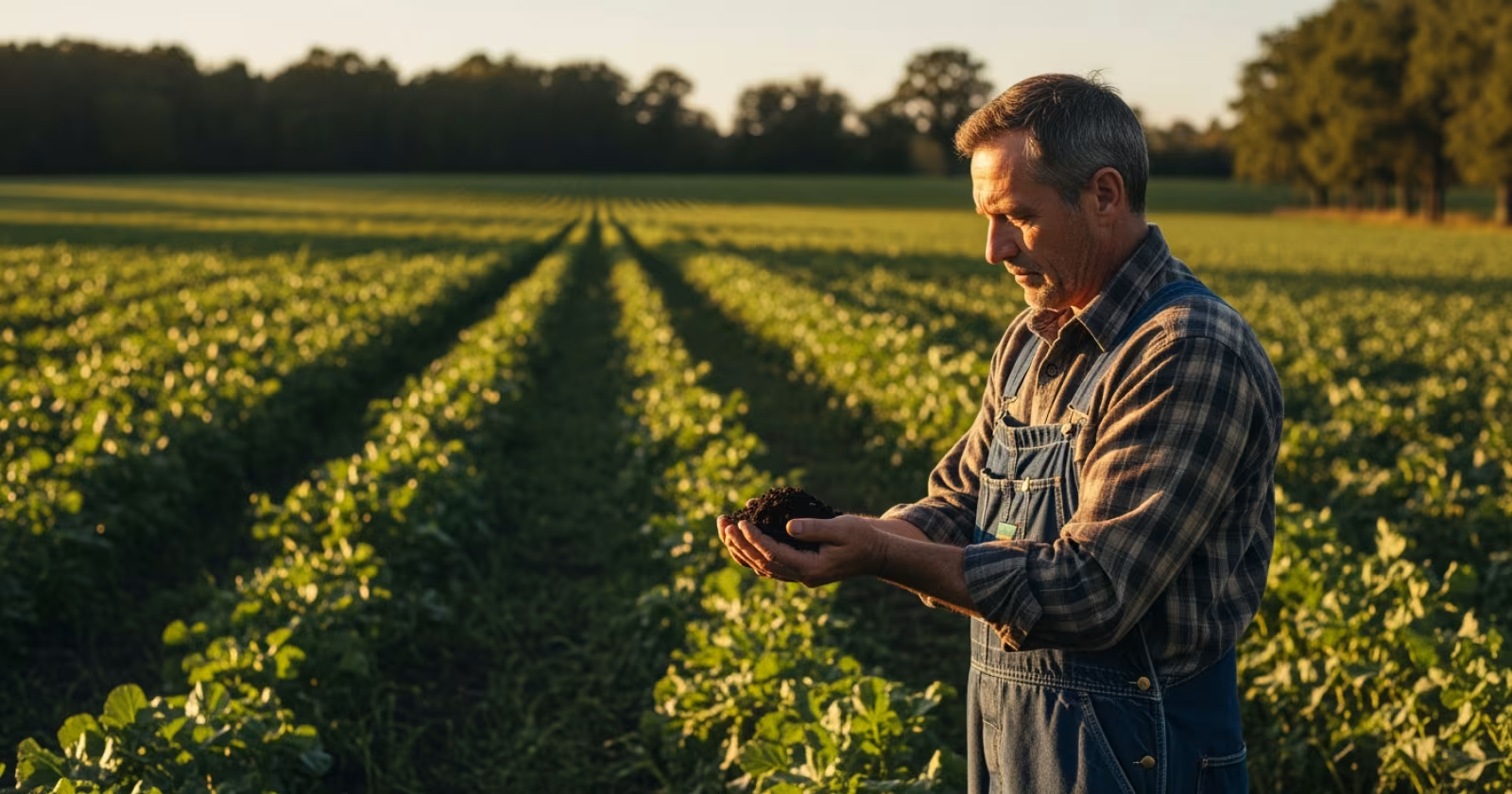
If you have been solving UPSC previous year papers from 2018 onwards, you have probably noticed something. Questions on agroforestry, organic farming, and sustainable agriculture are appearing with increasing regularity in both Prelims and Mains. This is not a coincidence — it reflects India’s shifting policy priorities and UPSC’s love for topics that sit at the intersection of environment, economy, and governance.
I have spent years tracking these patterns, and I want to walk you through exactly what you need to know, why this trend exists, and how to prepare smartly for it in 2026.
Where This Topic Sits in the UPSC Syllabus
Agroforestry and sustainable agriculture fall squarely under GS-III. But they also have connections to GS-I (geography of agriculture) and even GS-IV (environmental ethics). Here is the precise mapping:
| Exam Stage | Paper | Syllabus Section |
|---|---|---|
| Prelims | General Studies | Economic Development, Biodiversity, Environment |
| Mains | GS-III | Major crops, cropping patterns, irrigation, technology in agriculture, food security |
| Mains | GS-III | Conservation, environmental pollution, and degradation |
| Optional | Agriculture / Geography | Agroforestry systems, sustainable land management |
Related syllabus topics include food processing, PDS, buffer stocks, technology missions, and e-technology for farmers. Questions have appeared at least 8-10 times since 2015 in direct or indirect forms. This frequency is growing, not shrinking.
What Exactly Is Agroforestry
Agroforestry means deliberately growing trees alongside crops or livestock on the same piece of land. It is not just planting a few trees on a farm boundary. It is a planned, science-backed system where trees and crops benefit each other.
For example, a farmer in Rajasthan might grow khejri trees alongside bajra. The khejri fixes nitrogen in the soil, provides shade to reduce water evaporation, and its pods serve as fodder. The bajra gets better soil and the farmer gets multiple income sources. This is agroforestry in action.
India became the first country in the world to adopt a National Agroforestry Policy in 2014. This is a fact UPSC loves to test. The policy was implemented through the Sub-Mission on Agroforestry (SMAF) under the National Mission for Sustainable Agriculture.
Why UPSC Is Asking More Questions on This
Three forces are driving this trend. First, climate change has made conventional agriculture increasingly risky. UPSC reflects national priorities, and climate-resilient farming is now at the top of India’s policy agenda.
Second, India’s commitments under the Paris Agreement and the UN Sustainable Development Goals require measurable action on sustainable land use. Agroforestry directly contributes to SDG 2 (Zero Hunger), SDG 13 (Climate Action), and SDG 15 (Life on Land). UPSC examiners find these cross-cutting themes ideal for analytical Mains questions.
Third, the government has launched several schemes — from the Paramparagat Krishi Vikas Yojana for organic farming to the Natural Farming Mission announced in recent budgets. Every new scheme creates fresh material for question setters.
Key Concepts You Must Know
Let me break down the concepts that appear most frequently in UPSC papers.
Zero Budget Natural Farming (ZBNF) was popularised by Subhash Palekar. It uses local inputs like beejamrit and jeevamrit instead of chemical fertilisers. Andhra Pradesh adopted it on a large scale. UPSC has asked about ZBNF in both Prelims and Mains.
Integrated Farming Systems (IFS) combine crop production with animal husbandry, fisheries, or bee-keeping on the same farm. The idea is to recycle waste from one component as input for another. This reduces costs and increases total farm income.
Precision Agriculture uses technology like GPS, drones, and soil sensors to apply water, fertiliser, and pesticide in exact quantities. It reduces waste and environmental damage. UPSC links this to the e-technology and GS-III technology section.
Permaculture is a design philosophy for agriculture that mimics natural ecosystems. While less frequently tested, it appears in environment-related optional papers.
Types of Agroforestry Systems in India
India practices several agroforestry models suited to different agro-climatic zones. Agri-silviculture combines crops with trees — like wheat grown under poplar trees in Punjab. Silvopastoral systems combine trees with grazing land — common in arid regions of Gujarat and Rajasthan. Agri-horticulture combines fruit trees with field crops, widely seen in Himalayan states.
The Indian Council of Forestry Research and Education (ICFRE) and state agricultural universities have developed region-specific models. For your Mains answers, mentioning specific state-level examples makes a strong impression on examiners.
Challenges to Sustainable Agriculture in India
No UPSC answer on this topic is complete without discussing challenges. The biggest barrier is small landholding size. Over 86% of Indian farmers are small and marginal. They cannot afford to wait years for trees to mature when they need income every season.
Market access remains weak. A farmer growing organic produce often sells it at the same price as chemically-grown crops because certification is expensive and supply chains are fragmented. The lack of a robust carbon credit market in India also means farmers get no reward for sequestering carbon through agroforestry.
Policy implementation is another gap. The National Agroforestry Policy is well-designed on paper, but state-level adoption has been uneven. Transit rules for timber — which require permits to transport even farm-grown wood — discourage farmers from planting trees.
The M.S. Swaminathan Connection
The late M.S. Swaminathan, known as the father of India’s Green Revolution, spent his later years advocating for an “Evergreen Revolution.” This meant moving from input-heavy, chemical-dependent farming to ecologically sustainable methods. His National Commission on Farmers (2004-2006) recommended integrating trees into farming systems. UPSC has referenced his work in questions about agricultural policy and farmer welfare.
How to Answer These Questions in Mains
When you face a Mains question on sustainable agriculture, structure your answer around three pillars: economic viability for the farmer, environmental sustainability, and policy framework. Always include at least one scheme name, one committee or report reference, and one real-world example from an Indian state.
For Prelims, focus on matching schemes with their parent missions, knowing which states have adopted specific models, and understanding definitions precisely. UPSC often gives close-sounding options to confuse you — like mixing up ZBNF with organic farming or agroforestry with social forestry.
Key Points to Remember for UPSC
- India launched the world’s first National Agroforestry Policy in 2014, implemented through the Sub-Mission on Agroforestry under NMSA.
- ZBNF uses four wheels — beejamrit, jeevamrit, mulching, and waaphasa — and Andhra Pradesh is the largest adopter.
- Agroforestry contributes to multiple SDGs simultaneously — SDG 2, 13, and 15 — making it a favourite for UPSC’s interdisciplinary questions.
- Over 86% of Indian farmers are small and marginal, which is the single biggest constraint to adopting long-gestation agroforestry models.
- Timber transit regulations at the state level remain a key barrier even though the central policy encourages farm-grown timber.
- The Paramparagat Krishi Vikas Yojana supports cluster-based organic farming with certification and marketing support.
- M.S. Swaminathan’s concept of Evergreen Revolution directly connects Green Revolution critique to sustainable agriculture solutions.
This topic will only grow in importance as India pushes towards its net-zero 2070 target and climate-resilient agriculture becomes a governance priority. I would recommend making a consolidated note covering all schemes, policies, and committee recommendations on sustainable agriculture. Revise it alongside your environment notes. Preparing this topic well gives you ammunition for at least 2-3 questions across Prelims and GS-III Mains in 2026.
Get fastest alerts on Results, Admit Cards & Govt Jobs directly on your phone.