
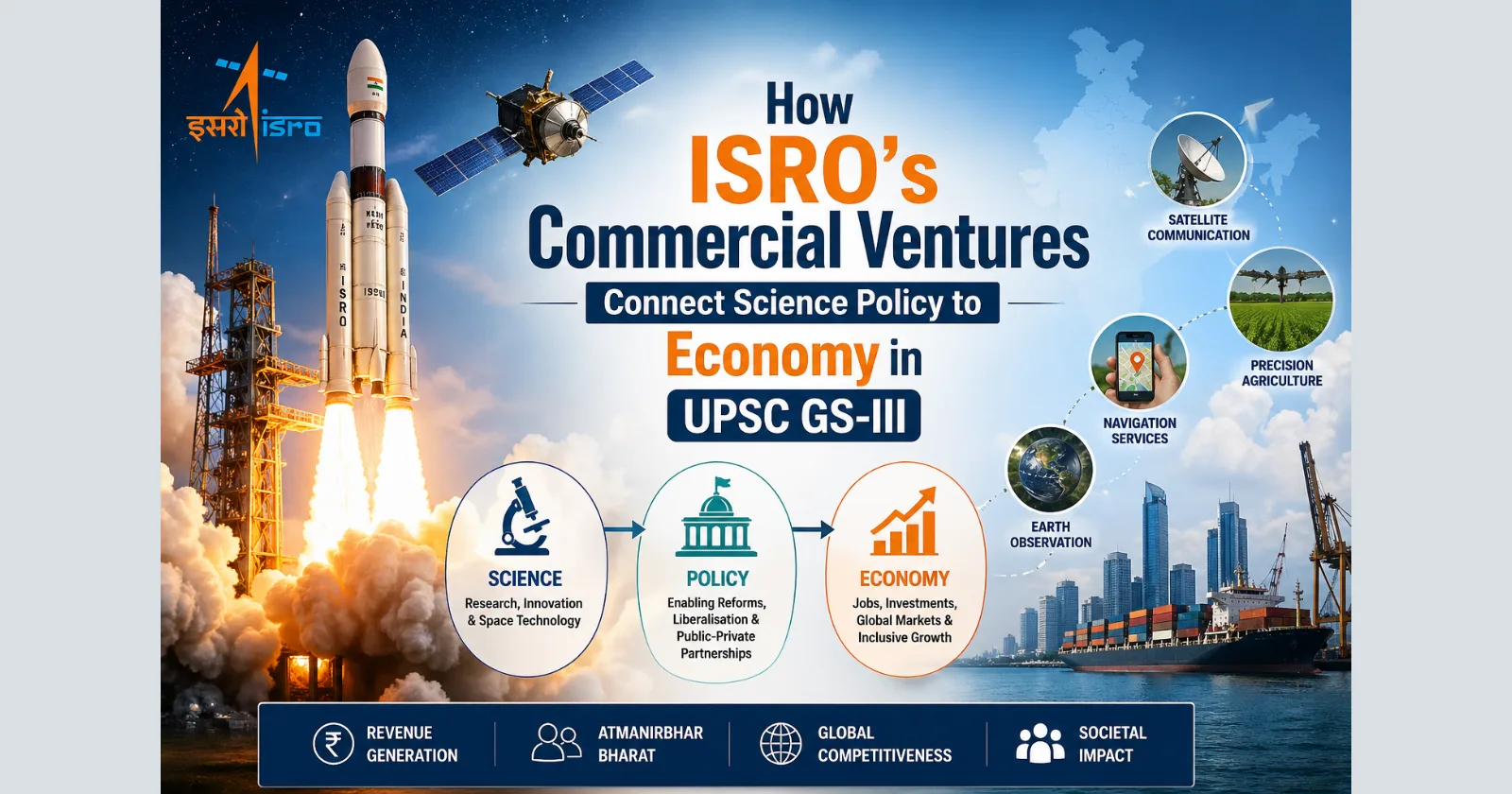
India’s space programme was once purely about national pride and scientific research. Today, it is a revenue-generating enterprise that directly shapes economic policy. If you are preparing for UPSC Mains, understanding this shift is not optional — it sits right at the intersection of two major GS-III themes: Science and Technology, and the Indian Economy.
I have seen this topic appear in various forms across Prelims and Mains over the past decade. The examiner is no longer asking just “What does ISRO do?” The questions now probe how space technology drives economic growth, how policy reforms enable private participation, and what India’s commercial space strategy means for self-reliance. Let me walk you through all of this in a structured way.
Where This Topic Sits in the UPSC Syllabus
This topic straddles multiple areas within GS-III. Here is a clear mapping so you know exactly where to place it in your notes.
| Exam Stage | Paper | Syllabus Section |
|---|---|---|
| Prelims | General Studies | Science and Technology — developments and their applications in everyday life |
| Mains | GS-III | Science and Technology — developments and their applications; Awareness in the fields of IT, Space, Computers, Robotics, Nanotechnology |
| Mains | GS-III | Indian Economy — Government policies and interventions for development in various sectors |
| Mains | GS-III | Indigenisation of technology and developing new technology |
Questions on ISRO and space policy have appeared at least 8 to 10 times in the last 15 years across both Prelims and Mains. The trend is clearly moving towards policy and economic dimensions rather than purely technical facts.
From Government Lab to Commercial Powerhouse
ISRO was founded in 1969 with a clear mandate — use space technology for national development. For decades, it focused on communication satellites, remote sensing, and weather forecasting. The commercial angle was minimal.
The turning point came gradually. ISRO’s Polar Satellite Launch Vehicle (PSLV) became so reliable that foreign countries started paying India to launch their satellites. In 2017, ISRO launched 104 satellites in a single mission — a world record at the time. This was not just a technical achievement. It proved that India could compete in the global launch market.
The commercial arm initially operated through Antrix Corporation, set up in 1992. Antrix handled marketing of ISRO’s products and services. But as demand grew and the global space economy expanded beyond $400 billion, the Indian government realised that a single PSU could not handle the scale needed.
NSIL and IN-SPACe — The New Architecture
NewSpace India Limited (NSIL) was created in 2019 as a second commercial entity under the Department of Space. Its role is different from Antrix. NSIL is meant to transfer ISRO’s technologies to Indian industries and enable them to manufacture and deliver space products independently. Think of it this way — Antrix sold ISRO’s services, while NSIL aims to build an entire industry around ISRO’s knowledge.
Then came IN-SPACe — the Indian National Space Promotion and Authorisation Centre — established in 2020. This body acts as a regulator and promoter for private space activities. Before IN-SPACe, there was no clear framework for a private Indian company to build and launch its own rocket. Now there is.
These two bodies together represent a fundamental policy shift. The government moved from being the sole player to becoming an enabler. This is the kind of governance reform that UPSC loves to test.
The Indian Space Policy 2023 — A Landmark Document
The Indian Space Policy 2023 formalised everything. It clearly defined the roles of ISRO, NSIL, and IN-SPACe. Under this policy, ISRO focuses on research, development, and deep-space missions. NSIL handles commercial operations. IN-SPACe regulates and promotes private sector participation.
This separation matters for your exam preparation. When the question asks about “government policies for development in various sectors,” the Space Policy 2023 is a strong example. It shows how India is moving from a state-driven model to a public-private partnership model in a strategic sector.
The policy also opened up satellite manufacturing, launch services, and ground-based operations to private companies. Startups like Skyroot Aerospace and Agnikul Cosmos have already conducted test launches. India now has over 200 registered space startups — a number that was nearly zero a decade ago.
How This Connects Science Policy to the Economy
Here is where the GS-III crossover becomes clear. The commercial space sector contributes to the economy in several direct ways.
First, there is revenue from launch services. NSIL earns foreign exchange by launching satellites for other countries. The LVM3 rocket, which carried the Chandrayaan missions, is now being marketed for commercial launches including OneWeb constellation satellites.
Second, there is technology transfer and industrial growth. When ISRO transfers manufacturing of satellite components to private firms, it creates jobs, builds supply chains, and develops indigenous capability. This directly connects to the syllabus theme of “indigenisation of technology.”
Third, there is the downstream economy. Satellite data is used in agriculture (crop monitoring), disaster management (flood mapping), urban planning, and defence. These applications generate economic value far beyond the cost of the satellite itself.
Fourth, the startup ecosystem in space tech attracts private investment. India’s space economy is projected to reach $44 billion by 2033 according to the Indian Space Association. This growth creates a multiplier effect across engineering, software, materials science, and insurance sectors.
What the Examiner Expects You to Know
From my experience analysing past papers, UPSC tests this topic in three ways. For Prelims, expect factual questions — which body does what, when was a policy launched, what is the role of NSIL versus Antrix. For Mains, expect analytical questions — how does space commercialisation contribute to economic growth, or evaluate the role of the private sector in India’s space programme.
The most scoring approach in Mains is to connect the dots. Do not write about ISRO in isolation. Link it to Make in India, Atmanirbhar Bharat, FDI policy in the space sector, and India’s position in the global space economy. A well-connected answer always scores higher than a descriptive one.
Key Points to Remember for UPSC
- NSIL (2019) handles commercial exploitation of ISRO technologies; Antrix (1992) was the original marketing arm — know the distinction.
- IN-SPACe is both a promoter and regulator for private space activities — it is not a replacement for ISRO.
- The Indian Space Policy 2023 formally separated R&D (ISRO), commercial (NSIL), and regulatory (IN-SPACe) functions.
- India’s space economy is estimated to grow to $44 billion by 2033, driven by launch services, satellite manufacturing, and downstream applications.
- PSLV remains the workhorse for commercial launches; LVM3 is being positioned for heavier commercial payloads including constellation deployments.
- Over 200 space startups now operate in India — this is a direct result of policy liberalisation post-2020.
- For Mains, always connect ISRO’s commercial growth to broader themes: indigenisation, self-reliance, FDI, and public-private partnership models.
This topic gives you a ready-made case study that works across multiple GS-III questions — from science policy to economic development to indigenisation. I would suggest making a one-page note that maps ISRO’s commercial ecosystem with the three bodies, their roles, and two or three data points on economic impact. Use that note as a building block whenever a related question appears in your answer writing practice. Steady, structured preparation on topics like this is what separates average answers from the ones that get noticed.
Get fastest alerts on Results, Admit Cards & Govt Jobs directly on your phone.