
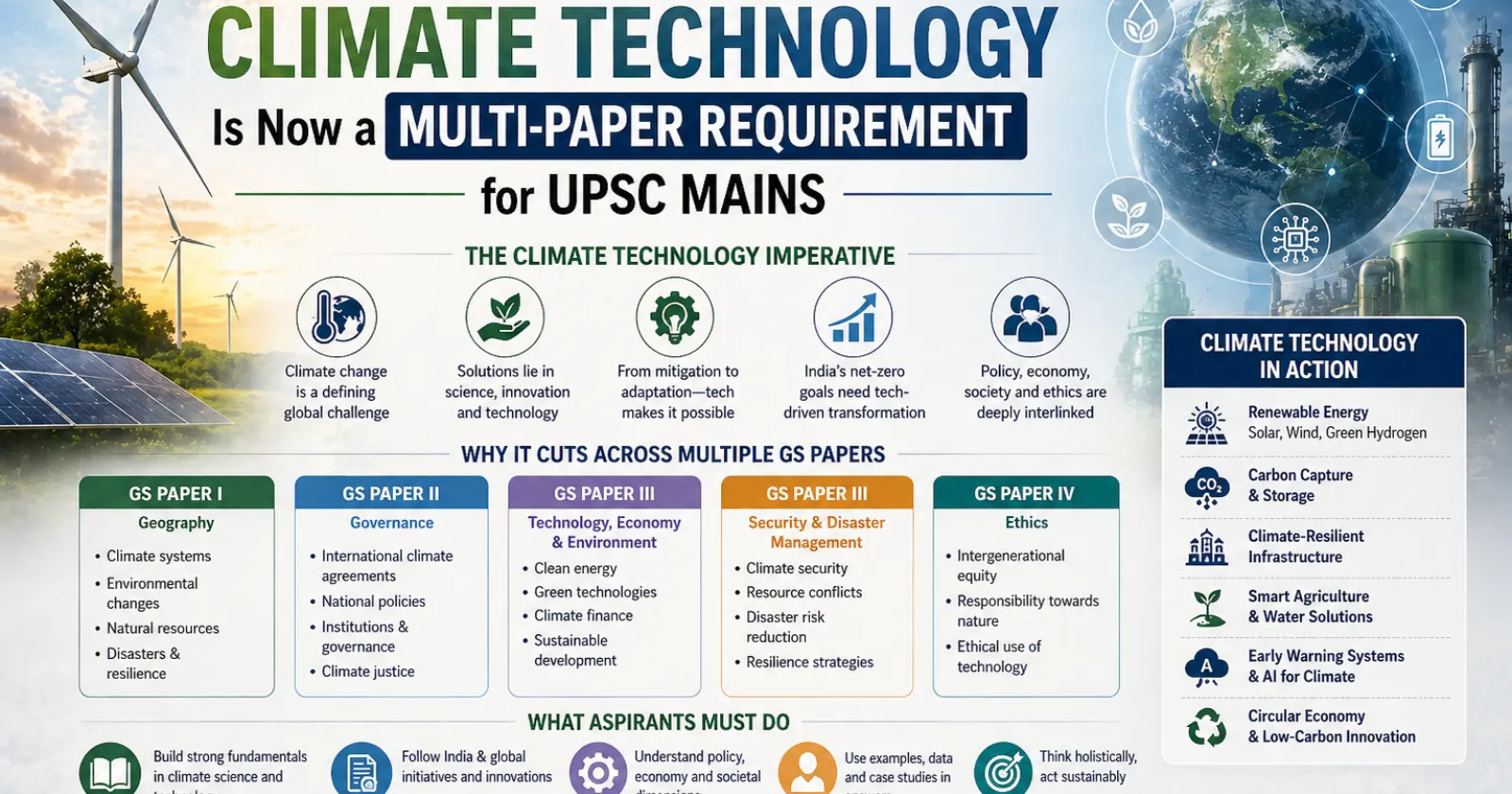
Five years ago, a question on solar energy would appear in GS-III and that was about it. Today, climate technology touches your Essay paper, your GS-I geography answer, your GS-II governance response, and obviously your GS-III science and environment section. If you are still treating it as a single-paper topic, you are leaving marks on the table.
I have watched UPSC’s pattern shift steadily since 2020. The examiner no longer wants you to simply define carbon capture or list renewable energy types. They want you to connect technology to diplomacy, governance to geography, and ethics to environment — all in one answer. This article breaks down exactly how climate technology spans multiple papers and how you should prepare for it in 2026.
Where This Topic Sits in the UPSC Syllabus
Climate technology does not sit in one neat box. That is precisely why it catches aspirants off guard. Here is how it maps across papers:
| Exam Stage | Paper | Syllabus Section | How Climate Tech Appears |
|---|---|---|---|
| Prelims | General Studies | Science & Technology, Environment | Factual questions on specific technologies, missions, agreements |
| Mains | GS-I | Geography — Climate, Resources | Impact of climate change on monsoons, agriculture, migration |
| Mains | GS-II | International Relations, Governance | Climate diplomacy, Paris Agreement, ISA, bilateral tech transfers |
| Mains | GS-III | Environment, Science & Tech, Economy | Green hydrogen, carbon markets, renewable energy economics |
| Mains | GS-IV | Ethics — Environmental Ethics | Intergenerational equity, corporate responsibility, climate justice |
| Mains | Essay | Open | Philosophical and practical essays on technology vs nature, development models |
Climate-related questions have appeared in Prelims and Mains consistently since 2015. In recent years, the frequency has increased to 3-5 questions per cycle across all papers combined.
The GS-III Core — Technology and Environment
This is where most aspirants focus, and rightly so. GS-III directly asks about science and technology developments and conservation and environmental pollution. You need a working understanding of these key climate technologies:
- Solar photovoltaic technology — how panels convert sunlight to electricity, India’s manufacturing push under PLI schemes
- Green hydrogen — produced by splitting water using renewable energy, central to India’s National Hydrogen Mission launched in 2023
- Carbon Capture and Storage (CCS) — trapping CO2 emissions from industrial sources and storing them underground
- Battery storage systems — lithium-ion and emerging sodium-ion technologies that solve the intermittency problem of renewables
- Climate-smart agriculture — drought-resistant crops, precision irrigation, and soil carbon sequestration techniques
You do not need to be an engineer. But you must understand what each technology does, why India needs it, and what limits its adoption. For instance, green hydrogen sounds promising, but its production cost is still roughly two to three times that of grey hydrogen made from natural gas. That kind of nuance is what separates a 7-mark answer from a 10-mark one.
GS-II — Climate Diplomacy and Governance
This is the paper where most aspirants miss the climate technology connection. GS-II covers international relations and governance. Climate technology is now at the heart of both.
India’s position in global climate negotiations has evolved significantly. At COP26 in Glasgow, India committed to net-zero by 2070. At COP28 in Dubai, the Global Stocktake pushed nations to triple renewable energy capacity by 2030. These are not just environment topics — they are foreign policy positions that shape India’s relationships with the US, EU, and China.
The International Solar Alliance (ISA), co-founded by India and France, is a direct example of climate technology becoming a diplomatic tool. India uses it to project soft power among developing nations. When UPSC asks about India’s multilateral engagements, ISA is a strong example to cite.
On the governance side, think about how India’s federal structure handles climate policy. The National Action Plan on Climate Change (NAPCC) has eight missions, but implementation happens at the state level through State Action Plans. The gap between central policy and state execution is a classic GS-II governance question waiting to happen.
GS-I — Geography and Climate Patterns
GS-I covers physical geography, including climate and resource distribution. Climate technology connects here through its relationship with changing weather patterns. When monsoon variability increases due to global warming, the technology response — like weather prediction models, early warning systems, and climate-resilient infrastructure — becomes part of your geography answer.
I always tell my students: if a GS-I question asks about the impact of climate change on Indian agriculture, do not just describe the problem. Mention the technological solutions being deployed. It shows the examiner you think in connected frameworks.
GS-IV and Essay — The Ethical Dimension
Climate technology raises deep ethical questions. Who bears the cost of transitioning to clean energy? Should developing nations sacrifice economic growth for technologies that rich nations created the need for? The concept of Common but Differentiated Responsibilities (CBDR) is not just a GS-II term — it is an ethical principle rooted in fairness.
Intergenerational equity — the idea that current generations must not compromise the environment for future ones — is a direct GS-IV concept. If you get an ethics case study about a government choosing between a coal plant that provides immediate jobs and a solar park that benefits the region long-term, your understanding of climate technology will shape the quality of your answer.
For the Essay paper, topics like “Technology is the answer, but what was the question?” or “Development and environment are two sides of the same coin” require you to weave climate technology into a broader philosophical argument. Without concrete examples — specific missions, specific technologies, specific data — your essay will remain abstract and score average marks.
How to Prepare This as a Multi-Paper Topic
I recommend building a single consolidated note on climate technology that is tagged by paper. Here is a practical method:
- Create one master document with sections for GS-I, GS-II, GS-III, GS-IV, and Essay
- Under each section, list 5-6 points specific to that paper’s angle
- For every technology you study, write one line on its diplomatic relevance, one on its ethical dimension, and one on its geographic context
- Track India’s Nationally Determined Contributions (NDCs) — these are updated commitments under the Paris Agreement and they connect to every paper
- Read the Economic Survey’s chapter on climate and energy every year — it gives you data points the examiner respects
Do not study solar energy for GS-III and then study ISA separately for GS-II as if they are unrelated. They are the same story told from different angles. Your preparation should reflect that.
Key Points to Remember for UPSC
- Climate technology is no longer confined to GS-III — it appears across GS-I, GS-II, GS-IV, and Essay with increasing frequency.
- India’s NDCs under the Paris Agreement target 50% cumulative electric power from non-fossil sources by 2030 — a data point useful in multiple papers.
- The International Solar Alliance is both a climate initiative and a diplomatic instrument — use it in GS-II answers on multilateralism.
- Green hydrogen, carbon capture, and battery storage are the three technologies UPSC is most likely to test in the 2026 cycle.
- CBDR and intergenerational equity are ethical frameworks that connect climate technology to GS-IV.
- State-level implementation gaps in NAPCC missions make for strong governance examples in GS-II.
- The Economic Survey and India’s Energy Outlook reports are the most exam-friendly sources for climate technology data.
Climate technology is one of those rare topics where a single hour of focused, cross-paper preparation gives you material for four different answers. Build your notes with that interconnected approach, and you will find yourself writing richer, more layered responses in the actual exam. Start with India’s NDCs and the National Hydrogen Mission — they are the two threads that connect most naturally across all papers.
Get fastest alerts on Results, Admit Cards & Govt Jobs directly on your phone.