Why Understanding Climate Technology Is Now a Multi-Paper Requirement for UPSC Mains

Why Understanding Climate Technology Is Now a Multi-Paper Requirement for UPSC Mains
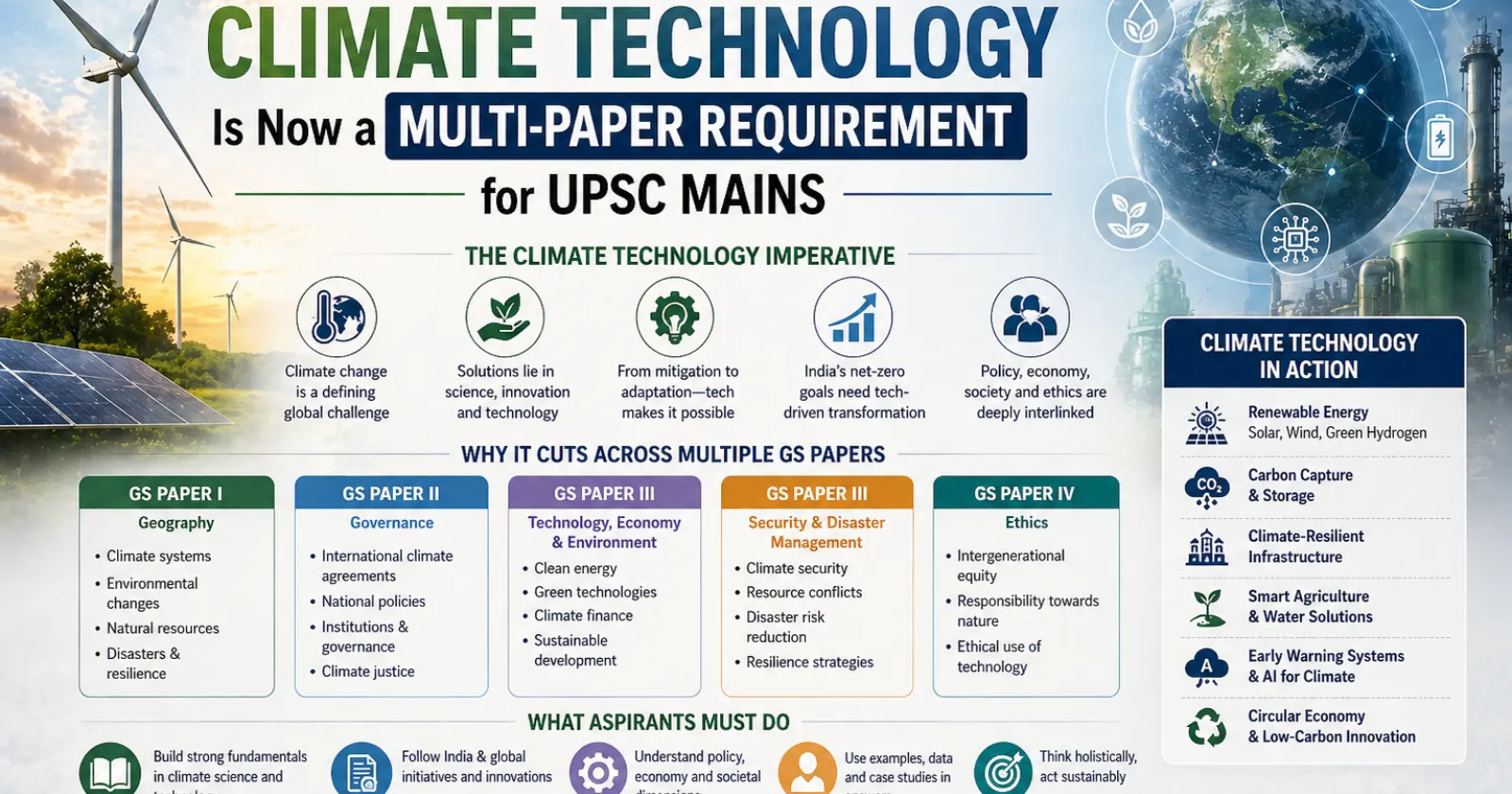
Five years ago, a question on solar energy would appear in GS-III and that was about it. Today, climate technology touches your Essay paper, your GS-I geography answer, your GS-II governance response, and obviously your GS-III science and environment section. If you are still treating it as a single-paper topic, you are leaving marks on … Read more


Why Understanding 5G, Satellite Internet, and Telecom Policy Is Now Essential for UPSC

Why Understanding 5G, Satellite Internet, and Telecom Policy Is Now Essential for UPSC

Telecom questions in UPSC have shifted dramatically in the last three years. The examiner no longer asks simple definitions — they now test your understanding of policy frameworks, spectrum allocation debates, and the geopolitics of connectivity. If you are preparing for UPSC 2026, this convergence of technology and governance deserves serious attention. I have seen … Read more

Why Understanding the IPCC’s Assessment Reports Matters for UPSC Mains Environment Answers

Why Understanding the IPCC's Assessment Reports Matters for UPSC Mains Environment Answers

Every second or third year, UPSC Mains throws an environment question where generic textbook knowledge simply does not cut it. The examiner wants you to reference real global scientific evidence — and that evidence almost always traces back to one source: the IPCC. If you have been writing vague answers about “rising temperatures” and “melting … Read more

Why Understanding MSP and Procurement Policy Is Essential for UPSC GS-III Agriculture

Why Understanding MSP and Procurement Policy Is Essential for UPSC GS-III Agriculture

Every year, when Rabi or Kharif season arrives, newspapers flood with debates about MSP. Yet most aspirants I have taught over the years struggle to explain how procurement actually works on the ground. If you are preparing for GS-III, this single topic connects agriculture, food security, subsidies, WTO disputes, and even federalism — making it … Read more

Why Understanding River Valley Civilisations Requires Both Geography and History for UPSC

Why Understanding River Valley Civilisations Requires Both Geography and History for UPSC

Most aspirants study river valley civilisations as a history chapter — memorising dates, sites, and artefacts. But UPSC examiners have consistently tested the geographical reasoning behind why these civilisations rose, flourished, and declined. If you ignore the geography, you are preparing with only half the picture. I have seen this gap hurt students in both … Read more

How Understanding Syncretic Traditions Helps You Score in Both History and Society in UPSC

How Understanding Syncretic Traditions Helps You Score in Both History and Society in UPSC

Most UPSC aspirants study medieval History and Indian Society as two separate silos. That approach costs marks. When you understand how India’s syncretic traditions bridge both subjects, you unlock a powerful way to write richer, more connected answers across GS-I. I have seen aspirants struggle with Mains questions on composite culture simply because they memorised … Read more

Why Understanding Mass Movements Analytically Is the Key to 140+ in UPSC GS-I Mains

Why Understanding Mass Movements Analytically Is the Key to 140+ in UPSC GS-I Mains

Most aspirants can name every major mass movement in Indian history. Yet, very few cross the 130-mark barrier in GS-I. The difference is not knowledge — it is the ability to think analytically about events that everyone already knows. I have seen hundreds of answer sheets over the years. The pattern is clear. Students who … Read more

Why Understanding the INC’s Phases Is Still the Most Important History Prep for UPSC

Why Understanding the INC's Phases Is Still the Most Important History Prep for UPSC

Every year, at least 4 to 6 questions in UPSC Prelims and Mains trace back to a single organisation — and most aspirants still struggle with it. I have spent over 15 years teaching Modern Indian History, and I can tell you with confidence that if you master the phases of the Indian National Congress, … Read more

How Understanding Article 21 Unlocks Answers Across Polity, Ethics, and Society in UPSC

How Understanding Article 21 Unlocks Answers Across Polity, Ethics, and Society in UPSC

One single article of the Indian Constitution has been interpreted by the Supreme Court in over a hundred landmark judgments. That article — just 21 words long — has reshaped how we understand human dignity, state accountability, and the very meaning of life in a democratic republic. If you are preparing for UPSC, mastering this … Read more

This One Mistake in Understanding Directive Principles Cost Me My First UPSC Attempt

This One Mistake in Understanding Directive Principles Cost Me My First UPSC Attempt

I walked out of the UPSC Prelims hall in 2021 thinking I had nailed the Polity section. Three months later, when the results came, I had missed the cutoff by just four marks. When I analysed my mistakes, one topic stood out — Directive Principles of State Policy. I had memorised the Articles, but I … Read more