
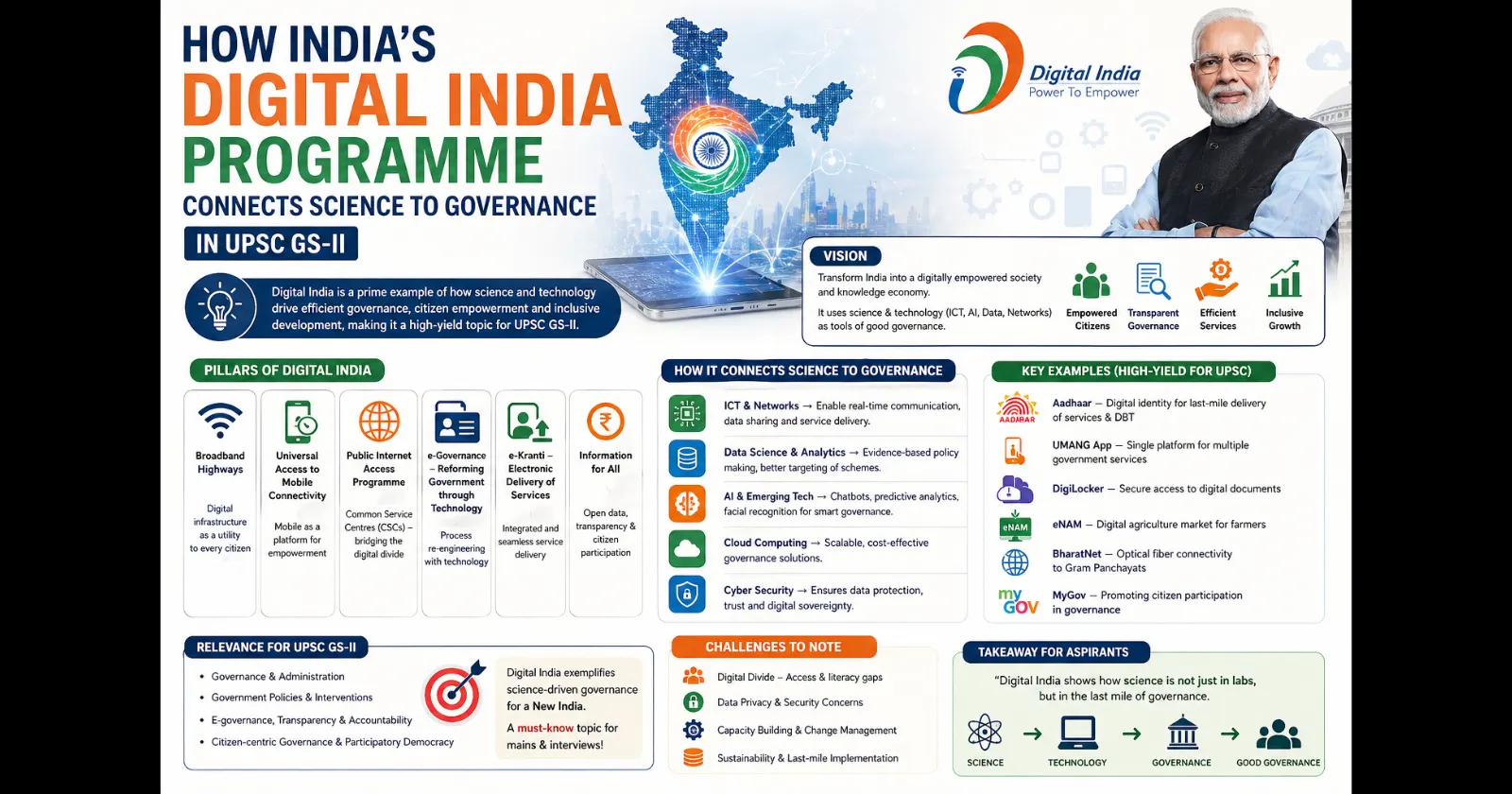
Technology is no longer just about gadgets and apps. For UPSC aspirants, it has become a bridge between how governments function and how citizens experience that functioning. The Digital India Programme sits right at this intersection, and understanding it deeply can help you answer questions across multiple dimensions of GS-II.
Where This Topic Sits in the UPSC Syllabus
The Digital India Programme is directly relevant to GS Paper II under the heading “Governance, Constitution, Polity, Social Justice and International Relations.” Specifically, it falls under the sub-topic of e-governance — its applications, models, successes, limitations, and potential.
| Exam Stage | Paper | Syllabus Section |
|---|---|---|
| Prelims | General Studies | Government policies and interventions in various sectors |
| Mains | GS-II | E-governance: applications, models, successes, limitations, and potential |
| Mains | GS-III | Science and Technology — developments and their applications in everyday life |
This topic has appeared in various forms in UPSC papers since 2015. Questions range from direct factual ones in Prelims to analytical ones in Mains asking you to evaluate the effectiveness of e-governance models. Related topics include Right to Information, citizen charters, transparency in governance, and the role of technology in reducing corruption.
What Digital India Actually Means
Launched on 1 July 2015, Digital India is an umbrella programme of the Government of India. It aims to transform India into a digitally empowered society and knowledge economy. The programme is coordinated by the Ministry of Electronics and Information Technology (MeitY).
At its core, Digital India rests on three vision areas. First, digital infrastructure as a utility to every citizen. Second, governance and services on demand. Third, digital empowerment of citizens. These are not just slogans — they translate into specific schemes, platforms, and measurable outcomes that UPSC loves to test.
The Nine Pillars of Digital India
The programme is built on nine pillars. Each pillar addresses a specific gap between technology and governance delivery:
- Broadband Highways — connecting rural and urban India through high-speed internet (BharatNet is the flagship project here)
- Universal Access to Mobile Connectivity — covering uncovered villages with network access
- Public Internet Access Programme — making Common Service Centres (CSCs) the delivery points for government services
- E-Governance — reforming government processes through technology, not just digitising old paperwork
- E-Kranti — electronic delivery of services in health, education, agriculture, justice, and financial inclusion
- Information for All — open data platforms and proactive sharing of government information
- Electronics Manufacturing — making India a hub for electronics production
- IT for Jobs — training youth in IT skills for employment
- Early Harvest Programmes — quick-win projects like biometric attendance and Wi-Fi in universities
For UPSC Mains, you do not need to memorise all nine. But you must understand how they connect governance reform to technology adoption. The examiner wants to see whether you can link a scheme to a governance outcome.
How Science Connects to Governance Here
This is where many aspirants miss the point. Digital India is not just a GS-III (Science and Technology) topic. It is fundamentally a governance reform programme that uses science and technology as tools. Let me explain this connection clearly.
When Aadhaar provides a unique identity to 1.3 billion people, it is biometric science serving governance. When DigiLocker stores your certificates on a cloud, it is information technology reducing bureaucratic delays. When the UMANG app puts 1,700+ government services on your phone, it is mobile technology enabling citizen-centric governance.
The UPSC examiner in GS-II is not asking you to explain how cloud computing works. They want you to explain how cloud computing changes the relationship between the state and the citizen. This distinction is critical for scoring well.
Key Initiatives You Must Know
Aadhaar and JAM Trinity: Jan Dhan-Aadhaar-Mobile together enable Direct Benefit Transfer (DBT). By 2026, DBT has saved the government over Rs 3 lakh crore by eliminating ghost beneficiaries. This is technology directly improving governance efficiency.
Common Service Centres (CSCs): Over 5 lakh CSCs operate across India, acting as the last-mile delivery point for government services in rural areas. A farmer in Jharkhand can access land records, apply for schemes, or pay bills without visiting a district office.
Government e-Marketplace (GeM): This platform has transformed public procurement by making it transparent and competitive. It reduces corruption in government purchasing — a direct governance outcome from a technology platform.
DigiLocker and e-Sign: These reduce the need for physical documents and in-person verification. They save time for both citizens and officials, making governance less paper-dependent.
Limitations and Challenges — The Critical Angle
UPSC Mains rewards balanced answers. You must also know the limitations of Digital India:
The digital divide remains real. Rural internet penetration, while growing, still lags behind urban areas. Women, elderly citizens, and people with disabilities face access barriers. If governance moves entirely online, those without digital literacy get excluded — this is called digital exclusion.
Data privacy is another concern. The Digital Personal Data Protection Act, 2023 addresses some issues, but implementation challenges remain. When government holds biometric and financial data of all citizens, the risk of surveillance and misuse exists.
Cybersecurity threats increase as more governance moves online. A breach in a government database is not just a technical failure — it is a governance failure affecting citizen trust.
Infrastructure gaps also persist. Server downtimes, poor app interfaces, and lack of vernacular language support reduce the effectiveness of digital governance platforms.
How to Use This in Your UPSC Answers
For a GS-II question on e-governance, I recommend structuring your answer around three layers. First, explain the initiative briefly. Second, show how it changes the governance process (not just the technology). Third, mention one limitation and one way forward.
For example, if asked about “the role of technology in improving transparency,” do not just list schemes. Explain how RTI + open data portals + GeM together create an ecosystem where information asymmetry between government and citizen reduces. That is analytical depth.
Key Points to Remember for UPSC
- Digital India was launched in 2015 and is coordinated by MeitY — it is a governance programme, not just a technology programme.
- The JAM Trinity (Jan Dhan-Aadhaar-Mobile) is the backbone of Direct Benefit Transfer, saving lakhs of crores by removing middlemen.
- Common Service Centres are the physical bridge between digital governance and rural citizens who lack personal internet access.
- For GS-II, always frame technology as a tool for governance reform — focus on outcomes like transparency, accountability, and citizen empowerment.
- Digital divide, data privacy, and cybersecurity are the three main limitations you should mention in any balanced answer.
- The Digital Personal Data Protection Act, 2023 is the legislative framework addressing data concerns arising from digital governance.
- GeM has transformed public procurement by introducing transparency and competition — a direct anti-corruption measure through technology.
Understanding Digital India as a governance reform programme rather than a technology showcase will set your answers apart. As a next step, pick any two initiatives under Digital India and practice writing a 200-word answer connecting them to the e-governance syllabus line in GS-II. That exercise alone will clarify your thinking for Mains.
Get fastest alerts on Results, Admit Cards & Govt Jobs directly on your phone.